
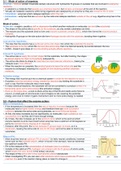
3.1 - Mode of action of enzymes:
Enzymes - Globular protein molecules (tertiary structure with hydrophilic R-groups on outside) that are involved in catalysing
reactions.
• A catalyst is a molecule that speeds up a chemical reaction but remains unchanged at the end of the reaction.
• Virtually all metabolic reactions within living organisms are catalysed by an enzyme so they are crucial for life to exist.
• Intracellular - enzymes which catalyse reactions within the cell.
• Extracellular - enzymes that are secreted by the cells and catalyse reactions outside of the cell e.g. digestive enzymes in the
gut.
Mode of action...
Active site - a region, usually a cleft or depression to which another molecule or molecules can bind (the substrate).
• The shape of the active site is speci c to the substrate, so only certain substrates can bind.
• The enzyme and the substrate bind to form and enzyme substrate complex (ESC), which then forms the enzyme product
complex.
• Hydrophilic R groups on the site active site form Hydrogen bonds with the substrate, bonding them together.
Lock and key hypothesis...
• The idea that the enzyme has a particular active site shape into which the substrate ts exactly.
• The substrate is the key which ts the lock (the active site), then it is held temporarily by bonds between the two.
• CONS - Doesn’t give ideas of how the binding actually a ects reactions.
Induced t hypothesis...
• The active site is nearly the correct shape for the substrate, but after binding, the shape
is altered slightly for them to t perfectly (induced t).
• The active site alters its shape to maximise the intermolecular attractions, making the
catalysis even more e cient.
• When the reaction is complete, the product/products leave the active site and the
enzyme is unchanged, meaning it is capable of now receiving another substrate
molecule.
Activation energy...
• The energy that must be put into a chemical system in order for the reaction to occur.
• Enzymes lower the activation energy needed for reactions by holding the substrate in
such a way that the molecules react more easily.
• In many chemical reactions, the substrate will not be converted to a product unless it is
temporarily given some extra energy (the activation energy).
• Rock on the slope idea - a rock is stuck at the top of the hill and needs some force to
move it. A small gust of wind knocks it and it begins to fall, lowering the potential
energy, and once in motion it gains momentum and no more extra energy is needed.
3.2 - Factors that a ect the enzyme action:
E ect of temperature...
• If the temperature is increased then the rate of reaction increases because the
molecules have a higher kinetic energy and therefore there are more successful
collisions between the active sites and substrates, so more ESCs are formed.
• At rst, the temp increases but not signi cantly, so molecules might collide but not
successfully bind as they don’t have enough energy.
• As it rises, the rate increases up to the optimum temp which is the point at which
enzyme reaction is at its max (most human enzymes have a optimum of 40 degrees so
we try to maintain this by staying at 37 degrees).
• However, after this point, the bonds between R groups begin to break, so it is
denatured, causing the active site to lose its 3D shape and not be able to bind to any
substrates.
E ect of PH...
• Most enzymes have an optimum PH of around 7 (in fairly neutral conditions), however
some such as the protease pepsin, which is found in the stomach, have an extremely
low optimum acidic PH.
• PH is the measure of the concentration of hydrogen ions in a solution.
• Outside of the optimum PH, hydrogen ions interact with the R-groups of amino acids
which breaks the ionic bonds in the tertiary structure.
• The shape of the active site is thus permanently altered (denatured).
• When investigating PH, you can use bu er solutions which have a particular PH and
maintain this even if the reaction taking place is meant to change it.
Enzymes - Globular protein molecules (tertiary structure with hydrophilic R-groups on outside) that are involved in catalysing
reactions.
• A catalyst is a molecule that speeds up a chemical reaction but remains unchanged at the end of the reaction.
• Virtually all metabolic reactions within living organisms are catalysed by an enzyme so they are crucial for life to exist.
• Intracellular - enzymes which catalyse reactions within the cell.
• Extracellular - enzymes that are secreted by the cells and catalyse reactions outside of the cell e.g. digestive enzymes in the
gut.
Mode of action...
Active site - a region, usually a cleft or depression to which another molecule or molecules can bind (the substrate).
• The shape of the active site is speci c to the substrate, so only certain substrates can bind.
• The enzyme and the substrate bind to form and enzyme substrate complex (ESC), which then forms the enzyme product
complex.
• Hydrophilic R groups on the site active site form Hydrogen bonds with the substrate, bonding them together.
Lock and key hypothesis...
• The idea that the enzyme has a particular active site shape into which the substrate ts exactly.
• The substrate is the key which ts the lock (the active site), then it is held temporarily by bonds between the two.
• CONS - Doesn’t give ideas of how the binding actually a ects reactions.
Induced t hypothesis...
• The active site is nearly the correct shape for the substrate, but after binding, the shape
is altered slightly for them to t perfectly (induced t).
• The active site alters its shape to maximise the intermolecular attractions, making the
catalysis even more e cient.
• When the reaction is complete, the product/products leave the active site and the
enzyme is unchanged, meaning it is capable of now receiving another substrate
molecule.
Activation energy...
• The energy that must be put into a chemical system in order for the reaction to occur.
• Enzymes lower the activation energy needed for reactions by holding the substrate in
such a way that the molecules react more easily.
• In many chemical reactions, the substrate will not be converted to a product unless it is
temporarily given some extra energy (the activation energy).
• Rock on the slope idea - a rock is stuck at the top of the hill and needs some force to
move it. A small gust of wind knocks it and it begins to fall, lowering the potential
energy, and once in motion it gains momentum and no more extra energy is needed.
3.2 - Factors that a ect the enzyme action:
E ect of temperature...
• If the temperature is increased then the rate of reaction increases because the
molecules have a higher kinetic energy and therefore there are more successful
collisions between the active sites and substrates, so more ESCs are formed.
• At rst, the temp increases but not signi cantly, so molecules might collide but not
successfully bind as they don’t have enough energy.
• As it rises, the rate increases up to the optimum temp which is the point at which
enzyme reaction is at its max (most human enzymes have a optimum of 40 degrees so
we try to maintain this by staying at 37 degrees).
• However, after this point, the bonds between R groups begin to break, so it is
denatured, causing the active site to lose its 3D shape and not be able to bind to any
substrates.
E ect of PH...
• Most enzymes have an optimum PH of around 7 (in fairly neutral conditions), however
some such as the protease pepsin, which is found in the stomach, have an extremely
low optimum acidic PH.
• PH is the measure of the concentration of hydrogen ions in a solution.
• Outside of the optimum PH, hydrogen ions interact with the R-groups of amino acids
which breaks the ionic bonds in the tertiary structure.
• The shape of the active site is thus permanently altered (denatured).
• When investigating PH, you can use bu er solutions which have a particular PH and
maintain this even if the reaction taking place is meant to change it.


