DNA Translation
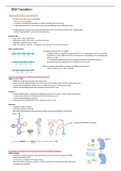
Genetic code and how it was discovered
- 20 amino acids, but only 4 nucleotides
→ one to one not possible
→ minimum: 4x4x4=64 (nucleotides in triplets encoding one amino acid)
→ redundant triplet code, so one amino acid can be coded by several different codes
- Nirenberg added synthetic polyribonucleotides to bacteria to show they make certain polypeptides
→ polyU made polyPhe = UUU codes Phenylalanine
Genetic code
- Start codon: AUG - Methionine
- Stop codon: UAG/ UGA/ UAA - no amino acids bind
- Trp/Met is coded by only 1 codon
- Code redundancy is specific → redundancy (variation) on the 3rd base position
Open reading frames
3 possible reading frames for mRNA
- 3 different ways to read RNA sequence from 5'-3' in consecutive sets of 3 nucleotides
- One RNA can code 3 different amino acid sequences, depending on the reading frame
- DNA has 6 ORF
→ 2 possible template strand w/each coding 3 possible amino acid sequences
- Generally only one reading frame is coding b/c of stop codon
Different species have different codons and different frequencies
- codon preferences are specie specific
Structure and properties of tRNA (the adaptor molecule)
tRNA (transfer RNA)
- mRNA do not directly recognise the amino acids
- adaptor proteins (tRNA) recognise and bind to both the mRNA codon and the coding amino acid
- specific base pairing btwn triplet codon in mRNA and 3 bases in tRNA (anti-codon)
- specific corresponding amino acid covalently linked to the 3' end
Features
- contain modified bases: enzymatic modification of precursor, which is often due to methylation
→ ψ (pseudouridine) and D (dihydrouridine) derived from uracil
- 5' end is phosphorylated, usually G
- Activated amino acid attached to the -OH group of the 3' end
Structure
- L-shaped / single stranded
- extremely compact molecule
- directed by intramolecular base pairing and base staking (hydrophobic interactions)
Recognised by tRNA synthetase
How tRNAs are charged with amino acids by aminoacyl tRNA synthetases
tRNA Charging
- Synthetase-catalysed reaction that attached the amino acid to the 3'end of the tRNA
- require hydrolysis of ATP
- not rely only on Watson-Crick base pairing
- aminoacyl-tRNA synthetase catalyses : provide specificity of recognising slight differences
in amino acid structures
Genetic code and how it was discovered
- 20 amino acids, but only 4 nucleotides
→ one to one not possible
→ minimum: 4x4x4=64 (nucleotides in triplets encoding one amino acid)
→ redundant triplet code, so one amino acid can be coded by several different codes
- Nirenberg added synthetic polyribonucleotides to bacteria to show they make certain polypeptides
→ polyU made polyPhe = UUU codes Phenylalanine
Genetic code
- Start codon: AUG - Methionine
- Stop codon: UAG/ UGA/ UAA - no amino acids bind
- Trp/Met is coded by only 1 codon
- Code redundancy is specific → redundancy (variation) on the 3rd base position
Open reading frames
3 possible reading frames for mRNA
- 3 different ways to read RNA sequence from 5'-3' in consecutive sets of 3 nucleotides
- One RNA can code 3 different amino acid sequences, depending on the reading frame
- DNA has 6 ORF
→ 2 possible template strand w/each coding 3 possible amino acid sequences
- Generally only one reading frame is coding b/c of stop codon
Different species have different codons and different frequencies
- codon preferences are specie specific
Structure and properties of tRNA (the adaptor molecule)
tRNA (transfer RNA)
- mRNA do not directly recognise the amino acids
- adaptor proteins (tRNA) recognise and bind to both the mRNA codon and the coding amino acid
- specific base pairing btwn triplet codon in mRNA and 3 bases in tRNA (anti-codon)
- specific corresponding amino acid covalently linked to the 3' end
Features
- contain modified bases: enzymatic modification of precursor, which is often due to methylation
→ ψ (pseudouridine) and D (dihydrouridine) derived from uracil
- 5' end is phosphorylated, usually G
- Activated amino acid attached to the -OH group of the 3' end
Structure
- L-shaped / single stranded
- extremely compact molecule
- directed by intramolecular base pairing and base staking (hydrophobic interactions)
Recognised by tRNA synthetase
How tRNAs are charged with amino acids by aminoacyl tRNA synthetases
tRNA Charging
- Synthetase-catalysed reaction that attached the amino acid to the 3'end of the tRNA
- require hydrolysis of ATP
- not rely only on Watson-Crick base pairing
- aminoacyl-tRNA synthetase catalyses : provide specificity of recognising slight differences
in amino acid structures