
In this assignment I will explain how ratio analysis can be used to measure the
profitability, liquidity and efficiency of Mr Han’s business and I will outline what is
meant by the terms profitability, liquidity and efficiency.
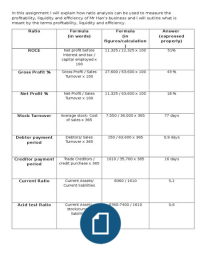
Ratio Formula Formula Answer
(in words) (in (expressed
figures/calculation properly)
)
ROCE Net profit before 11,,325 x 100 51%
interest and tax /
capital employed x
100
Gross Profit % Gross Profit / Sales 27,,600 x 100 43 %
Turnover x 100
Net Profit % Net Profit / Sales 11,,600 x 100 18 %
Turnover x 100
Stock Turnover Average stock: Cost 7,,000 x 365 77 days
of sales x 365
Debtor payment Debtors/ Sales ,600 x 365 0,9 days
period Turnover x 365
Creditor payment Trade Creditors / ,700 x 365 16 days
period credit purchase x 365
Current Ratio Current Assets/ 5,2
Current liabilities
Acid test Ratio Current Assets- 8360- 0,6
stock/current
liabilities
1
, o Profitability
Profitability ratios are used to assess a business’s ability to generate earnings as
compared to its expenses and other costs incurred during a specific period of
time. For most of these ratios having a higher value or the same ratio as a
previous period indicates that the company is doing well.
There are three profitability ratios:
- Gross profit percentage
- Net profit percentage
- Return on capital employed (ROCE)
Gross Profit Percentage:
This is calculated using the formula:
GROSS PROFIT
×100
SALES TURNOVER
Gross profit percentage shows how much sales revenue is spent on providing the goods
or services sold. The gross profit percentage shows for every £1 made in sales how
much is left as gross profit after the costs of goods sold has been deducted. A gross
profit percentage of sales of 88 per cent mean that for every £1 of sales made, 88p are
left as gross profit. Generally, the higher the figure, the better.
Net Profit Percentage:
This is calculated using the formula:
NET PROFIT
×100
SALES TURNOVE R
This ratio shows for every £1 made in sales how much of it is left as net profit
after all expenses of sales were taken. Therefore means that for every £1 of sales
made, 31p is left as net profit.
The net profit percentage is the profit left for the business after taking away the
taxes. The higher the profit margin is, the more effective the company is at
converting revenue into actual profit.
Return on capital employed (ROCE):
This is calculated using the formula:
NET PROFIT BEFORE INTEREST ∧TAX
×100
CAPITAL EMPLOYED
2
profitability, liquidity and efficiency of Mr Han’s business and I will outline what is
meant by the terms profitability, liquidity and efficiency.
Ratio Formula Formula Answer
(in words) (in (expressed
figures/calculation properly)
)
ROCE Net profit before 11,,325 x 100 51%
interest and tax /
capital employed x
100
Gross Profit % Gross Profit / Sales 27,,600 x 100 43 %
Turnover x 100
Net Profit % Net Profit / Sales 11,,600 x 100 18 %
Turnover x 100
Stock Turnover Average stock: Cost 7,,000 x 365 77 days
of sales x 365
Debtor payment Debtors/ Sales ,600 x 365 0,9 days
period Turnover x 365
Creditor payment Trade Creditors / ,700 x 365 16 days
period credit purchase x 365
Current Ratio Current Assets/ 5,2
Current liabilities
Acid test Ratio Current Assets- 8360- 0,6
stock/current
liabilities
1
, o Profitability
Profitability ratios are used to assess a business’s ability to generate earnings as
compared to its expenses and other costs incurred during a specific period of
time. For most of these ratios having a higher value or the same ratio as a
previous period indicates that the company is doing well.
There are three profitability ratios:
- Gross profit percentage
- Net profit percentage
- Return on capital employed (ROCE)
Gross Profit Percentage:
This is calculated using the formula:
GROSS PROFIT
×100
SALES TURNOVER
Gross profit percentage shows how much sales revenue is spent on providing the goods
or services sold. The gross profit percentage shows for every £1 made in sales how
much is left as gross profit after the costs of goods sold has been deducted. A gross
profit percentage of sales of 88 per cent mean that for every £1 of sales made, 88p are
left as gross profit. Generally, the higher the figure, the better.
Net Profit Percentage:
This is calculated using the formula:
NET PROFIT
×100
SALES TURNOVE R
This ratio shows for every £1 made in sales how much of it is left as net profit
after all expenses of sales were taken. Therefore means that for every £1 of sales
made, 31p is left as net profit.
The net profit percentage is the profit left for the business after taking away the
taxes. The higher the profit margin is, the more effective the company is at
converting revenue into actual profit.
Return on capital employed (ROCE):
This is calculated using the formula:
NET PROFIT BEFORE INTEREST ∧TAX
×100
CAPITAL EMPLOYED
2


