ASSES BEHAVIOURISM
INTRO: Outline General behaviourism
All forms of behaviourism fail as even in its softest form (Ryle) it cannot
account for introspective self knowledge.
Defeating for HARD
HEMPELL: Hard Behaviourism
Multiple realisability
➢ Defeating of hard behaviourism as if we only know and understand mental states through
behaviours - yet if these can be multiply realised then we can never be certain/have a clear
understanding mental states.
RYLE: Soft Behaviourism
PUTNAM: super spartans
➢ People who disapprove greatly of showing pain = all pain behaviour has been suppressed
Yet they could still be in pain. Pain is conceivable without any associated pain behaviour. So
Minor issue for SOFT
pain can’t be understood just in terms of pain behaviour.
RYLE: still have the disposition to pain behaviour
PUTNAM: super super spartans
➢ Super super spartans: are so used to suppressing pain related behaviour that they do not
even say they’re in pain or have dispositions to do so.
First need the concept of pain
➢ Impossible to form the concept of pain, without the concept of pain. Impossible to
distinguish which behaviour they were supposed to be suppressing in the rst place.
Asymmetry
Defeating issue for SOFT
➢ We seem to understand our mental states the most, however it behaviourism was true its
would be easier to understand others than out own (easier to observe others behaviours) =
there’s an asymmetry here.
RYLE: internal monologues = behaviour
What about visualisation, feelings, sensations?
➢ We don’t always “think quietly to ourselves with internal monologues, therefore there would
still be an asymmetry.
Behaviourism fails as a theory of the mind as both versions fall to criticisms. Hard behaviourism
cannot get passed the issue of multiple realisability, and soft behaviourism eventually fails due to
the issue of asymmetry and therefore its inability to account for introspective self knowledge.
fi
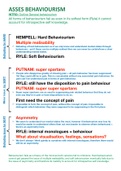
INTRO: Outline General behaviourism
All forms of behaviourism fail as even in its softest form (Ryle) it cannot
account for introspective self knowledge.
Defeating for HARD
HEMPELL: Hard Behaviourism
Multiple realisability
➢ Defeating of hard behaviourism as if we only know and understand mental states through
behaviours - yet if these can be multiply realised then we can never be certain/have a clear
understanding mental states.
RYLE: Soft Behaviourism
PUTNAM: super spartans
➢ People who disapprove greatly of showing pain = all pain behaviour has been suppressed
Yet they could still be in pain. Pain is conceivable without any associated pain behaviour. So
Minor issue for SOFT
pain can’t be understood just in terms of pain behaviour.
RYLE: still have the disposition to pain behaviour
PUTNAM: super super spartans
➢ Super super spartans: are so used to suppressing pain related behaviour that they do not
even say they’re in pain or have dispositions to do so.
First need the concept of pain
➢ Impossible to form the concept of pain, without the concept of pain. Impossible to
distinguish which behaviour they were supposed to be suppressing in the rst place.
Asymmetry
Defeating issue for SOFT
➢ We seem to understand our mental states the most, however it behaviourism was true its
would be easier to understand others than out own (easier to observe others behaviours) =
there’s an asymmetry here.
RYLE: internal monologues = behaviour
What about visualisation, feelings, sensations?
➢ We don’t always “think quietly to ourselves with internal monologues, therefore there would
still be an asymmetry.
Behaviourism fails as a theory of the mind as both versions fall to criticisms. Hard behaviourism
cannot get passed the issue of multiple realisability, and soft behaviourism eventually fails due to
the issue of asymmetry and therefore its inability to account for introspective self knowledge.
fi