ASSESS VIRTUE ETHICS
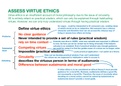
Virtue ethics is an insu cient account of moral philosophy due to the issue of circularity.
VE is entirely reliant on practical wisdom, which can only be explained through habituating
virtues. However, we can only truly understand virtues through having practical wisdom.
So vague - could be interpreted to t someone’s pre- existing ideas
De ne virtue ethics of what’s moral as its so subjective. Not everyone has a virtuous
character and therefore how can we access the virtuous way of
living or assess how others are living.
No clear guidance
Problems
Never intended to provide a set of rules (practical wisdom)
rely on time context Aristotle was alive in 300BC, what was valuable and important is di erent
to now. So how can we be certain we’re living virtuously if the hedonic
calculus is so outdated. Even if practical wisdom was enough guidance,
Substantial Competing virtues we could be using it to nd the golden mean of a virtue we no longer value.
issue
Impossible (practical wisdom) Lacks practical application = not useful as a theory
How can we develop practical wisdom if we can’t understand
Circularity the virtues we are supposed to habituate in order to access it.
Defeating describes the virtuous person in terms of eudiamonia
Di erence between eudaimonia and moral good
If virtue ethics is to be considered an ethical theory it must provide
guidance for a moral life. However, eudiamonia de nes a good life,
not necessarily a moral life. Therefore, the issue of circularity when
deciding on a moral action, cannot be solved by eudaimonia as
eudaimonia doesn’t provide a moral guide.
fffi fi ffi fi fi ff
Virtue ethics is an insu cient account of moral philosophy due to the issue of circularity.
VE is entirely reliant on practical wisdom, which can only be explained through habituating
virtues. However, we can only truly understand virtues through having practical wisdom.
So vague - could be interpreted to t someone’s pre- existing ideas
De ne virtue ethics of what’s moral as its so subjective. Not everyone has a virtuous
character and therefore how can we access the virtuous way of
living or assess how others are living.
No clear guidance
Problems
Never intended to provide a set of rules (practical wisdom)
rely on time context Aristotle was alive in 300BC, what was valuable and important is di erent
to now. So how can we be certain we’re living virtuously if the hedonic
calculus is so outdated. Even if practical wisdom was enough guidance,
Substantial Competing virtues we could be using it to nd the golden mean of a virtue we no longer value.
issue
Impossible (practical wisdom) Lacks practical application = not useful as a theory
How can we develop practical wisdom if we can’t understand
Circularity the virtues we are supposed to habituate in order to access it.
Defeating describes the virtuous person in terms of eudiamonia
Di erence between eudaimonia and moral good
If virtue ethics is to be considered an ethical theory it must provide
guidance for a moral life. However, eudiamonia de nes a good life,
not necessarily a moral life. Therefore, the issue of circularity when
deciding on a moral action, cannot be solved by eudaimonia as
eudaimonia doesn’t provide a moral guide.
fffi fi ffi fi fi ff