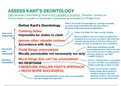
ASSESS KANT’S DEONTOLOGY
Fails because universalising maxims isn’t possible or practical. Therefore, instead we
should deduct a system of hypothetic imperatives as proposed by Phillipa Foot.
Even if we accept it’s impossible to correctly formulate,
De ne Kant’s Deontology we come across situations like this fairly often &
therefore it still lacks practical application
Clashing duties Father A & Father B = feels counter intuitive
Quite weak
(impractical) Impossible for duties to clash Bernard Williams: we can’t adopt an impersonal
perspective as we loose our place in the world our
Ignores other valuable motives interest and any sense of self. Accordance isn’t
Accordance with duty enough, we have to accept our own motivations
When does something morally
Substantial
issue
Trivial things universalised permissible become duty? If we only
know when it’s not our duty, how do
(impractical) Morally permissible not necessarily our duty we know when it is our duty?
= HARD TO APPLY
Defeating Moral things that can’t be universalised Forms a contradiction in conception
(Impossible)
NO RESPONSE but not in our WILL e.g. donating to
charity could help us when in need
THEREFORE PHILLIPA FOOT’S APPROACH
How can we accept a system
= MUCH MORE SUCCESSFUL where things like donating to
charity is immoral. We have
higher practical application and is much more plausible empirical evidence that it brings
than the categorical imperative. about far more good than bad.
fi
Fails because universalising maxims isn’t possible or practical. Therefore, instead we
should deduct a system of hypothetic imperatives as proposed by Phillipa Foot.
Even if we accept it’s impossible to correctly formulate,
De ne Kant’s Deontology we come across situations like this fairly often &
therefore it still lacks practical application
Clashing duties Father A & Father B = feels counter intuitive
Quite weak
(impractical) Impossible for duties to clash Bernard Williams: we can’t adopt an impersonal
perspective as we loose our place in the world our
Ignores other valuable motives interest and any sense of self. Accordance isn’t
Accordance with duty enough, we have to accept our own motivations
When does something morally
Substantial
issue
Trivial things universalised permissible become duty? If we only
know when it’s not our duty, how do
(impractical) Morally permissible not necessarily our duty we know when it is our duty?
= HARD TO APPLY
Defeating Moral things that can’t be universalised Forms a contradiction in conception
(Impossible)
NO RESPONSE but not in our WILL e.g. donating to
charity could help us when in need
THEREFORE PHILLIPA FOOT’S APPROACH
How can we accept a system
= MUCH MORE SUCCESSFUL where things like donating to
charity is immoral. We have
higher practical application and is much more plausible empirical evidence that it brings
than the categorical imperative. about far more good than bad.
fi