Photosynthesis
Stevie-Jade Lisa Vickers – BTEC Nat Diploma in Applied Science Level 3 Medical
Photosynthesis and Stages
Photosynthesis is the process which plants use in order to convert energy from the sun into chemical energy which is
then used by the plant to synthesise larger organic molecules (such as carbohydrates) via inorganic molecules.
Photosynthesis takes place within the plant organelles called chloroplasts.
The formula for photosynthesis is 6CO2 + 6H20 + light C6H1206 + 02 which is carbon dioxide + water + light
glucose and oxygen. The products of photosynthesis can then be used for aerobic respiration by both animals and
plants.
Organisms can be autotrophic (have the ability to synthesise complex organic molecules from simpler molecules and
an energy source) or heterotrophic (have the ability to digest complex organic molecules and break then down into
simpler ones). Organisms which are autotrophic can be categorised into two groups which are chemoautotrophs and
photoautotrophs. Chemoautotrophs use the energy from exergonic reactions for the synthesis of complex molecules
whereas photoautotrophs use the energy from light
for the synthesis of these complex molecules.
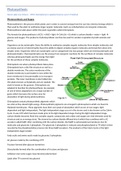
Chloroplasts are where photosynthesis takes place.
Chloroplasts have a disc-like structure as well as a
double membrane. The outer membrane of the
double membrane is permeable to ions whilst the
inner membrane is less permeable as to transport
proteins. This inner membrane is also folded into
thin plates known as thylakoids and are stacked. The
stack is known as the granum. Chloroplasts are
adapted to function for photosynthesis. An example
of one of these adaptations are a large number of
grana which increases the surface area for
absorption of light during photosynthesis.
Chloroplasts contain photosynthetic pigments which
are vital as they absorb light energy. Photosynthetic pigments are arranged in photosystems which are found in
thylakoid membranes. These pigments have their own peak of absorption which occurs in two stages: light
dependent and light independent. The light independent stage occurs in the stroma and is also known as the Calvin
Cycle. It uses ATP which has been made prior in the light dependent stage. During the light independent stage,
carbon dioxide becomes fixed into complex organic compounds and carbon and oxygen are vital elements used for
structure and as an energy store. The stroma has carbon dioxide diffused into it which then combines with a 5C
acceptor called RuBP. After combining with the carbon dioxide, the RuBP is carboxylated and produces two 3C
molecules and glycerate 3-phosphate. The glycerate 3-phosphate is reduced and phosphorylated to TP which is then
recycled by the phosphorylation process into three RuBP acceptors. The products of the Calvin Cycle or the light
independent stage include:
Fatty acids and amino acids made by glycerate 3-phosphate
6C glucose made by the combining of TP
Fructose formed after glucose isomerises
Disaccharide formed after the combination of fructose and glucose
Cellulose once some sugars have become polymerised
Lipids after TP converts into glycerol
, Chlorophyll is the general name for a mixture of pigments (which all have a similar structure of a long hydrocarbon
chain and a porphyrin ring) and include chlorophyll a and b, xanthophyll, and carotene. These pigments all absorb
various wavelengths of light and are involved in the light dependent stage of photosynthesis. The stroma present
inside chloroplasts is a fluid matrix which contains enzymes required for the light dependent stage of
photosynthesis. The granum is where light is absorbed and where ATP is synthesised during the light dependent
stage.
The light-dependent reactions include photo stem I and photo stem II.
Photo Stem I Photo Stem II
Uses energy from light to convert NADP+ into NADPH2 Uses protein complexes to absorb light energy as well
as functioning in the dissociation of water molecules.
Found on the outer surface of the grana thylakoid Found on the inner surface of the grana thylakoid
membrane membrane
Not involved in the photolysis of water Involved in the photolysis of water
Participates in cyclic and non-cyclic Participates in only non-cyclic photophosphorylation
photophosphorylation
During cyclic photophosphorylation, ATP is synthesised This is where the hydrolysis of water occurs as well as
and during non-cyclic photophosphorylation, NADPH is the synthesis of ATP
synthesised
The Photo Stem II (PSII) involves a process where enzymes with the ability to split water into hydrogen ions and
oxygen are contained. This process is called photolysis. The oxygen produced here is partially used by the plants in
their own aerobic respiration processes, whilst the rest diffuses out of the leaves via the stomata. The hydrogen ions
produced during photolysis are used in a process called chemiosmosis which produces ATP. The coenzyme called
NADP is reduced and now accepts protons and carries them to the light dependent stage, whilst electrons are used
to replace the electrons lost when chlorophyll is oxidised.
Photophosphorylation is another process in PSII which involves a photon colliding with a molecule of chlorophyll
causing two electrons to become excited and pass down the photosystem. The electrons are accepted by electron
acceptors and passed along electron carriers which are embedded within the membranes of the thylakoids. Energy is
released as the electrons are passed along the carriers and is then used to pump protons into the thylakoid space in
order to achieve a built-up proton gradient which would allow protons to then flow through the ATP synthase. Once
the ATP is made, it can then be used for light-independent reactions. Hydrogen ions which have moved through the
ATP synthase can be then pumped back across the membrane or are able to combine with NADP enzyme in the
stroma.
Stevie-Jade Lisa Vickers – BTEC Nat Diploma in Applied Science Level 3 Medical
Photosynthesis and Stages
Photosynthesis is the process which plants use in order to convert energy from the sun into chemical energy which is
then used by the plant to synthesise larger organic molecules (such as carbohydrates) via inorganic molecules.
Photosynthesis takes place within the plant organelles called chloroplasts.
The formula for photosynthesis is 6CO2 + 6H20 + light C6H1206 + 02 which is carbon dioxide + water + light
glucose and oxygen. The products of photosynthesis can then be used for aerobic respiration by both animals and
plants.
Organisms can be autotrophic (have the ability to synthesise complex organic molecules from simpler molecules and
an energy source) or heterotrophic (have the ability to digest complex organic molecules and break then down into
simpler ones). Organisms which are autotrophic can be categorised into two groups which are chemoautotrophs and
photoautotrophs. Chemoautotrophs use the energy from exergonic reactions for the synthesis of complex molecules
whereas photoautotrophs use the energy from light
for the synthesis of these complex molecules.
Chloroplasts are where photosynthesis takes place.
Chloroplasts have a disc-like structure as well as a
double membrane. The outer membrane of the
double membrane is permeable to ions whilst the
inner membrane is less permeable as to transport
proteins. This inner membrane is also folded into
thin plates known as thylakoids and are stacked. The
stack is known as the granum. Chloroplasts are
adapted to function for photosynthesis. An example
of one of these adaptations are a large number of
grana which increases the surface area for
absorption of light during photosynthesis.
Chloroplasts contain photosynthetic pigments which
are vital as they absorb light energy. Photosynthetic pigments are arranged in photosystems which are found in
thylakoid membranes. These pigments have their own peak of absorption which occurs in two stages: light
dependent and light independent. The light independent stage occurs in the stroma and is also known as the Calvin
Cycle. It uses ATP which has been made prior in the light dependent stage. During the light independent stage,
carbon dioxide becomes fixed into complex organic compounds and carbon and oxygen are vital elements used for
structure and as an energy store. The stroma has carbon dioxide diffused into it which then combines with a 5C
acceptor called RuBP. After combining with the carbon dioxide, the RuBP is carboxylated and produces two 3C
molecules and glycerate 3-phosphate. The glycerate 3-phosphate is reduced and phosphorylated to TP which is then
recycled by the phosphorylation process into three RuBP acceptors. The products of the Calvin Cycle or the light
independent stage include:
Fatty acids and amino acids made by glycerate 3-phosphate
6C glucose made by the combining of TP
Fructose formed after glucose isomerises
Disaccharide formed after the combination of fructose and glucose
Cellulose once some sugars have become polymerised
Lipids after TP converts into glycerol
, Chlorophyll is the general name for a mixture of pigments (which all have a similar structure of a long hydrocarbon
chain and a porphyrin ring) and include chlorophyll a and b, xanthophyll, and carotene. These pigments all absorb
various wavelengths of light and are involved in the light dependent stage of photosynthesis. The stroma present
inside chloroplasts is a fluid matrix which contains enzymes required for the light dependent stage of
photosynthesis. The granum is where light is absorbed and where ATP is synthesised during the light dependent
stage.
The light-dependent reactions include photo stem I and photo stem II.
Photo Stem I Photo Stem II
Uses energy from light to convert NADP+ into NADPH2 Uses protein complexes to absorb light energy as well
as functioning in the dissociation of water molecules.
Found on the outer surface of the grana thylakoid Found on the inner surface of the grana thylakoid
membrane membrane
Not involved in the photolysis of water Involved in the photolysis of water
Participates in cyclic and non-cyclic Participates in only non-cyclic photophosphorylation
photophosphorylation
During cyclic photophosphorylation, ATP is synthesised This is where the hydrolysis of water occurs as well as
and during non-cyclic photophosphorylation, NADPH is the synthesis of ATP
synthesised
The Photo Stem II (PSII) involves a process where enzymes with the ability to split water into hydrogen ions and
oxygen are contained. This process is called photolysis. The oxygen produced here is partially used by the plants in
their own aerobic respiration processes, whilst the rest diffuses out of the leaves via the stomata. The hydrogen ions
produced during photolysis are used in a process called chemiosmosis which produces ATP. The coenzyme called
NADP is reduced and now accepts protons and carries them to the light dependent stage, whilst electrons are used
to replace the electrons lost when chlorophyll is oxidised.
Photophosphorylation is another process in PSII which involves a photon colliding with a molecule of chlorophyll
causing two electrons to become excited and pass down the photosystem. The electrons are accepted by electron
acceptors and passed along electron carriers which are embedded within the membranes of the thylakoids. Energy is
released as the electrons are passed along the carriers and is then used to pump protons into the thylakoid space in
order to achieve a built-up proton gradient which would allow protons to then flow through the ATP synthase. Once
the ATP is made, it can then be used for light-independent reactions. Hydrogen ions which have moved through the
ATP synthase can be then pumped back across the membrane or are able to combine with NADP enzyme in the
stroma.