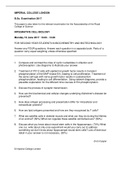
IMPERIAL COLLEGE LONDON
B.Sc. Examination 2017
This paper is also taken for the relevant examination for the Associateship of the Royal
College of Science
INTEGRATIVE CELL BIOLOGY
Monday 19 June 2017 10.00 - 13.00
FOR SECOND YEAR STUDENTS IN BIOCHEMISTRY AND BIOTECHNOLOGY
Answer any FOUR questions. Answer each question in a separate book. Parts of a
question carry equal weighting unless otherwise specified.
1. Compare and contrast the roles of cyclic nucleotides in olfaction and
photoreception. Use diagrams to illustrate your answer.
2. Treatment of PC12 cells with epidermal growth factor results in transient
phosphorylation of the MAP kinase Erk, leading to cell proliferation. Treatment of
the same cell type with nerve growth factor results in sustained Erk
phosphorylation, leading to cell differentiation. Using network diagrams, provide a
plausible explanation for the different time courses of Erk phosphorylation.
3. Discuss the process of synaptic transmission.
4. How can the biochemical and cellular changes underlying Alzheimer’s disease be
prevented?
5. How does antigen processing and presentation differ for intracellular and
extracellular proteins?
6. How are lipid antigens presented and how are they recognised by T cells?
7. What are satellite cells in skeletal muscle and what can they do during the lifetime
of an animal? (50%) What can regulate these satellite cell behaviours? (50%)
8. Discuss what you know about neural stem cells in the hippocampus. (70%) What
one (i.e. write about only one) experiment would you carry out to address
something we don’t know about hippocampal neural stem cells? Lots of technical
detail in your answer is not necessary. (30%)
End of paper
© Imperial College London
B.Sc. Examination 2017
This paper is also taken for the relevant examination for the Associateship of the Royal
College of Science
INTEGRATIVE CELL BIOLOGY
Monday 19 June 2017 10.00 - 13.00
FOR SECOND YEAR STUDENTS IN BIOCHEMISTRY AND BIOTECHNOLOGY
Answer any FOUR questions. Answer each question in a separate book. Parts of a
question carry equal weighting unless otherwise specified.
1. Compare and contrast the roles of cyclic nucleotides in olfaction and
photoreception. Use diagrams to illustrate your answer.
2. Treatment of PC12 cells with epidermal growth factor results in transient
phosphorylation of the MAP kinase Erk, leading to cell proliferation. Treatment of
the same cell type with nerve growth factor results in sustained Erk
phosphorylation, leading to cell differentiation. Using network diagrams, provide a
plausible explanation for the different time courses of Erk phosphorylation.
3. Discuss the process of synaptic transmission.
4. How can the biochemical and cellular changes underlying Alzheimer’s disease be
prevented?
5. How does antigen processing and presentation differ for intracellular and
extracellular proteins?
6. How are lipid antigens presented and how are they recognised by T cells?
7. What are satellite cells in skeletal muscle and what can they do during the lifetime
of an animal? (50%) What can regulate these satellite cell behaviours? (50%)
8. Discuss what you know about neural stem cells in the hippocampus. (70%) What
one (i.e. write about only one) experiment would you carry out to address
something we don’t know about hippocampal neural stem cells? Lots of technical
detail in your answer is not necessary. (30%)
End of paper
© Imperial College London