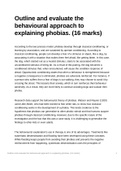
Outline and evaluate the
behavioural approach to
explaining phobias. (16 marks)
According to the two-process model, phobias develop through classical conditioning, or
learning by association, and are sustained by operant conditioning. According to
classical conditioning, people can develop a fear of a stimulus or object, like a dog, by
associating it with a situation that makes them feel afraid, like getting bitten. In this case,
the dog, which started out as a neutral stimulus, starts to be associated with the
unconditioned stimulus of being bit. As a result of this pairing, the dog becomes a
conditioned stimulus that, when encountered, will cause the condition response of
dread. Opportunistic conditioning states that when a behaviour is strengthened because
a negative consequence is eliminated, phobias are adversely reinforced. For instance, if
a person who suffers from a fear of dogs is out walking, they may choose to avoid it by
crossing the street. This lessens their anxiety, which in turn reinforces their behaviour
adversely. As a result, they are more likely to continue avoiding dogs and sustain their
phobia.
Research data support the behaviourist theory of phobias. Watson and Raynor (1920)
used Little Albert, who had been trained to fear white rats, to show how classical
conditioning works in the development of a phobia. This lends credence to the
hypothesis that phobias can generalise to other phobic stimuli and that humans acquire
phobias through classical conditioning. However, due to the specific nature of the
investigation and the fact that this was a case study, it is challenging to generalise the
findings to other kids or even adults.
The behaviourist explanation's use in therapy is one of its advantages. Treatments like
systematic desensitisation and flooding have been developed using these concepts.
While flooding keeps people from avoiding their phobias and prevents the negative
reinforcement from happening, systematic desensitisation uses the principles of
Outline and evaluate the behavioural approach to explaining phobias. (16 marks) 1
behavioural approach to
explaining phobias. (16 marks)
According to the two-process model, phobias develop through classical conditioning, or
learning by association, and are sustained by operant conditioning. According to
classical conditioning, people can develop a fear of a stimulus or object, like a dog, by
associating it with a situation that makes them feel afraid, like getting bitten. In this case,
the dog, which started out as a neutral stimulus, starts to be associated with the
unconditioned stimulus of being bit. As a result of this pairing, the dog becomes a
conditioned stimulus that, when encountered, will cause the condition response of
dread. Opportunistic conditioning states that when a behaviour is strengthened because
a negative consequence is eliminated, phobias are adversely reinforced. For instance, if
a person who suffers from a fear of dogs is out walking, they may choose to avoid it by
crossing the street. This lessens their anxiety, which in turn reinforces their behaviour
adversely. As a result, they are more likely to continue avoiding dogs and sustain their
phobia.
Research data support the behaviourist theory of phobias. Watson and Raynor (1920)
used Little Albert, who had been trained to fear white rats, to show how classical
conditioning works in the development of a phobia. This lends credence to the
hypothesis that phobias can generalise to other phobic stimuli and that humans acquire
phobias through classical conditioning. However, due to the specific nature of the
investigation and the fact that this was a case study, it is challenging to generalise the
findings to other kids or even adults.
The behaviourist explanation's use in therapy is one of its advantages. Treatments like
systematic desensitisation and flooding have been developed using these concepts.
While flooding keeps people from avoiding their phobias and prevents the negative
reinforcement from happening, systematic desensitisation uses the principles of
Outline and evaluate the behavioural approach to explaining phobias. (16 marks) 1