Organisms respond to changes in their internal and
external environments
Nervous System
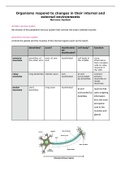
somatic nervous system
the division of the peripheral nervous system that controls the body's skeletal muscles
autonomic nervous system
controls the glands and the muscles of the internal organs (such as the heart)
dendrites? axon? myelinated / cell body? function
un-
myelinated?
sensory dendrites at axon at one myelinated cell body in carry
neurone the other end end the middle information
from receptor
cells to relay
neurone in
the CNS
relay long dendrites shorter axon non- at end connect
neurone myelinated surrounded sensory
by dendrites neurones to
motor
neurones
motor short long axon myelinated
neurone dendrites
at end neurons that
surrounded by carry outgoing
dendrites information
from the brain
and spinal
cord to the
muscles and
glands
,cell body
contains a nucleus and large amounts of rough ER. Associated with the production of proteins and
neurotransmitters
dendrites
Small extensions from the cell body which subdivide into smaller branches fibres that carry the
nerve impulses towards the cell body
axon
single long fibre extending from the cell body; it carries outgoing messages
Schwan cells
- Surround the axon
- protecting and providing electrical insulation
- Carry out phagocytosis and play a part in regeneration of nerve cells, wrap around the axon
many times, building the phospholipid bilayer
Myelin sheath
- Forms a covering to the axon and is made of membranes of Schwann cells
- Rich in myelin lipid and speed up transmission of nerve impulses
nodes of ranvier
Gaps between adjacent Schwann cells where there is no myelin sheath
what is the nervous system?
the body's speedy, electrochemical communication network, consisting of all the nerve cells of the
peripheral and central nervous systems
respond to environmental changes and co-ordinates responses
stimulus
A change in an organism's environment that causes the organism to react
receptor
detects stimulus and generates nerve impulse
co-ordinator
, the central nervous system, or the interneurons it contains, which receive information from sensory
receptors and organize a response by effectors (muscles and glands)
effector
An organ (a gland or muscle) that becomes active in response to nerve impulses.
response
a reaction to a stimulus
simple reflex arc
- A relatively direct connection between a sensory neurone and a motor neurone (via a relay
neuron)
- that allows an extremely rapid response to a stimulus
- often without conscious brain involvement to avoid damage to tissues
- 3neurones
protective effect of the simple reflex
- avoids damage to tissues
- by having very few neurones and very few synapses (just enough to get the message from
receptor to effector)
- 3 neurones
structure / process of the reflex arc
1. Receptor
2. Sensory neuron (cell body in dorsal root)
3.CNS (relay neurone in grey matter)
4. motor neuron (cell body in grey matter, axon in myelinated white matter)
5. effector
external environments
Nervous System
somatic nervous system
the division of the peripheral nervous system that controls the body's skeletal muscles
autonomic nervous system
controls the glands and the muscles of the internal organs (such as the heart)
dendrites? axon? myelinated / cell body? function
un-
myelinated?
sensory dendrites at axon at one myelinated cell body in carry
neurone the other end end the middle information
from receptor
cells to relay
neurone in
the CNS
relay long dendrites shorter axon non- at end connect
neurone myelinated surrounded sensory
by dendrites neurones to
motor
neurones
motor short long axon myelinated
neurone dendrites
at end neurons that
surrounded by carry outgoing
dendrites information
from the brain
and spinal
cord to the
muscles and
glands
,cell body
contains a nucleus and large amounts of rough ER. Associated with the production of proteins and
neurotransmitters
dendrites
Small extensions from the cell body which subdivide into smaller branches fibres that carry the
nerve impulses towards the cell body
axon
single long fibre extending from the cell body; it carries outgoing messages
Schwan cells
- Surround the axon
- protecting and providing electrical insulation
- Carry out phagocytosis and play a part in regeneration of nerve cells, wrap around the axon
many times, building the phospholipid bilayer
Myelin sheath
- Forms a covering to the axon and is made of membranes of Schwann cells
- Rich in myelin lipid and speed up transmission of nerve impulses
nodes of ranvier
Gaps between adjacent Schwann cells where there is no myelin sheath
what is the nervous system?
the body's speedy, electrochemical communication network, consisting of all the nerve cells of the
peripheral and central nervous systems
respond to environmental changes and co-ordinates responses
stimulus
A change in an organism's environment that causes the organism to react
receptor
detects stimulus and generates nerve impulse
co-ordinator
, the central nervous system, or the interneurons it contains, which receive information from sensory
receptors and organize a response by effectors (muscles and glands)
effector
An organ (a gland or muscle) that becomes active in response to nerve impulses.
response
a reaction to a stimulus
simple reflex arc
- A relatively direct connection between a sensory neurone and a motor neurone (via a relay
neuron)
- that allows an extremely rapid response to a stimulus
- often without conscious brain involvement to avoid damage to tissues
- 3neurones
protective effect of the simple reflex
- avoids damage to tissues
- by having very few neurones and very few synapses (just enough to get the message from
receptor to effector)
- 3 neurones
structure / process of the reflex arc
1. Receptor
2. Sensory neuron (cell body in dorsal root)
3.CNS (relay neurone in grey matter)
4. motor neuron (cell body in grey matter, axon in myelinated white matter)
5. effector