- celebratory
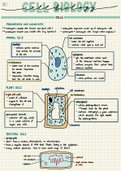
CELLS
PROKARYOTES AND EUKARYOTES
>
eukaryotic complex
: cells ( animal and plant cells ) eukaryotes organisms
: made up of eukaryotic cells
>
prokaryotic simpler
: and smaller cells ( e. g. bacteria ) prokaryotes
=
prokaryotic cells ( single-celled organism )
ANIMAL CELLS "" " " "" "
holds the cell together
nucleus controls what in and out
goes
contains genetic material
that controls the activities ①
⑥
of the cells @
cytoplasm
° like substance where most
get -
mitochondria
of the chemical reactions happen
contains that control these
where most of the reactions enzymes
chemical reactions
for aerobic respiration
⑧
0
take place
☐ • ribosomes
respiration transfers energy
where proteins are made
that the cell needs to work
PLANT CELLS cytoplasm
nucleus
cell membrane
rigid cell wall
¥¥É
mitochondria
made of cellulose
supports the cell and
chloroplast
"" " " "" " ""
" """ """" " " ""
>
makes food for the plant
contains chlorophyll ,
a
green substance
permanent vacuole which absorbs the light
•
◦ needed
0 0
contains cell sap which for
,
photosynthesis
is a weak solution of
and salts •
0 .
%
sugar ribosomes
BACTERIA CELLS
prokaryotes
don't have a nucleus , chloroplasts or mitochondria
have a
singular strand of DNA that floats freely in the
cytoplasm
contain plasmids ( one small of DNA )
many or more rings
☒
cell wall
0 plasmid
cell membrane
single circular strand
cytoplasm of DNA
CELLS
PROKARYOTES AND EUKARYOTES
>
eukaryotic complex
: cells ( animal and plant cells ) eukaryotes organisms
: made up of eukaryotic cells
>
prokaryotic simpler
: and smaller cells ( e. g. bacteria ) prokaryotes
=
prokaryotic cells ( single-celled organism )
ANIMAL CELLS "" " " "" "
holds the cell together
nucleus controls what in and out
goes
contains genetic material
that controls the activities ①
⑥
of the cells @
cytoplasm
° like substance where most
get -
mitochondria
of the chemical reactions happen
contains that control these
where most of the reactions enzymes
chemical reactions
for aerobic respiration
⑧
0
take place
☐ • ribosomes
respiration transfers energy
where proteins are made
that the cell needs to work
PLANT CELLS cytoplasm
nucleus
cell membrane
rigid cell wall
¥¥É
mitochondria
made of cellulose
supports the cell and
chloroplast
"" " " "" " ""
" """ """" " " ""
>
makes food for the plant
contains chlorophyll ,
a
green substance
permanent vacuole which absorbs the light
•
◦ needed
0 0
contains cell sap which for
,
photosynthesis
is a weak solution of
and salts •
0 .
%
sugar ribosomes
BACTERIA CELLS
prokaryotes
don't have a nucleus , chloroplasts or mitochondria
have a
singular strand of DNA that floats freely in the
cytoplasm
contain plasmids ( one small of DNA )
many or more rings
☒
cell wall
0 plasmid
cell membrane
single circular strand
cytoplasm of DNA