Year 1
Biology Department
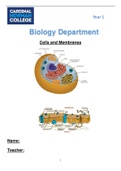
Cells and Membranes
Name:
Teacher:
1
, Cells
Cell structure
Methods of studying cells
Biologists are often working with very small organisms and therefore need to use microscopes to
study them and their parts. The images the microscope produces can then be drawn or
photographed. To enable a clear image to be seen, two keys factors have to be taken into
consideration, these are magnification and resolution.
Resolution = The resolution of a microscope is defined as the shortest distance between two
points on a specimen that can still be distinguished clearly. The higher the resolution greater the
detail you can see.
Magnification = the degree to which the size of an image is larger than the object itself.
We can then use the images of specimens we see using a microscope to calculate:
• The actual size of the object
• The magnification of image
Measuring in Biology
1 mm is 1 millimetre – you will almost ALWAYS make actual measurements in mm. But many
biological structures are much smaller than 1 mm so we also need some smaller units:
1 µm is
1 nm is
To convert from mm to µm you x 1000
To convert from mm to nm you x 1000,000
Therefore 72 mm would be equal to _______ µm or __________ nm
2
,Calculating the magnification, actual size of organelles and image size of cells
and parts of cells (organelles)
Magnification = the number of times by which an image is larger than the object itself e.g. x 10
means that the image is 10 x larger than the actual size.
We can therefore use the image size to calculate:
• The actual size of the object
• The magnification of the image
I = image size
A = actual size
M= magnification
Example 1 Calculating the magnification of a photograph or drawing, when provided with the
actual size in micrometres.
Question
If the actual diameter size of organelle A is 10µm what is the magnification of the image?
1. Measure the diameter of organelle A in mm, this is the image size.
2. Convert to micrometres by X 1000
3. Magnification = Image size
Actual size
Extra question:
If the actual width of organelle B is 27 µm. What is the magnification of the image?
3
, Example 2 calculating the actual size of a cell or organelle from a photograph or drawing when
provided with its magnification.
A
C
B
D
Magnification 1500X
Question
Find the actual diameter size of structure A to the nearest µm
1. Measure the diameter of structure A in mm, this is your image size
2. Convert to µm by X 1000
3. Actual size = Image
Magnification
4. actual size is in µm
Extra questions:
What is the width of organelle C to the nearest µm?
What is the width of organelle D to the nearest µm?
4
Biology Department
Cells and Membranes
Name:
Teacher:
1
, Cells
Cell structure
Methods of studying cells
Biologists are often working with very small organisms and therefore need to use microscopes to
study them and their parts. The images the microscope produces can then be drawn or
photographed. To enable a clear image to be seen, two keys factors have to be taken into
consideration, these are magnification and resolution.
Resolution = The resolution of a microscope is defined as the shortest distance between two
points on a specimen that can still be distinguished clearly. The higher the resolution greater the
detail you can see.
Magnification = the degree to which the size of an image is larger than the object itself.
We can then use the images of specimens we see using a microscope to calculate:
• The actual size of the object
• The magnification of image
Measuring in Biology
1 mm is 1 millimetre – you will almost ALWAYS make actual measurements in mm. But many
biological structures are much smaller than 1 mm so we also need some smaller units:
1 µm is
1 nm is
To convert from mm to µm you x 1000
To convert from mm to nm you x 1000,000
Therefore 72 mm would be equal to _______ µm or __________ nm
2
,Calculating the magnification, actual size of organelles and image size of cells
and parts of cells (organelles)
Magnification = the number of times by which an image is larger than the object itself e.g. x 10
means that the image is 10 x larger than the actual size.
We can therefore use the image size to calculate:
• The actual size of the object
• The magnification of the image
I = image size
A = actual size
M= magnification
Example 1 Calculating the magnification of a photograph or drawing, when provided with the
actual size in micrometres.
Question
If the actual diameter size of organelle A is 10µm what is the magnification of the image?
1. Measure the diameter of organelle A in mm, this is the image size.
2. Convert to micrometres by X 1000
3. Magnification = Image size
Actual size
Extra question:
If the actual width of organelle B is 27 µm. What is the magnification of the image?
3
, Example 2 calculating the actual size of a cell or organelle from a photograph or drawing when
provided with its magnification.
A
C
B
D
Magnification 1500X
Question
Find the actual diameter size of structure A to the nearest µm
1. Measure the diameter of structure A in mm, this is your image size
2. Convert to µm by X 1000
3. Actual size = Image
Magnification
4. actual size is in µm
Extra questions:
What is the width of organelle C to the nearest µm?
What is the width of organelle D to the nearest µm?
4