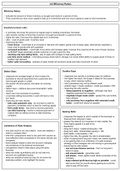
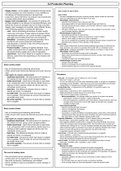
3.6 Efficiency Ratios
Efficiency Ratios:
• indicate the amount of times inventory us bought and resold in a period of time.
• They could tell you how much capital is tied up in inventories and how much capital is used to hold inventories
Inventory turnover ratio:
• in principle, the lower the amount of capital used in holding inventories, the better
• ratio records number of time they inventory is bought and resold in a period of time
• higher the ratio, the lower the capital tied up in inventories
• ratio = cost of goods sold / inventory level
• Improving the ratio:
• lower prices - could lead to an increase in demand with elastic goods and increase sales, alternatively negotiate a
lower cost of goods sold with suppliers
• increased promotion - could help move stock and increase sales, however this could be at the cost of lower revenue
as BOGOF deals essentially enable customer s to get a good for free
• stocking only fast-selling items - rate of sales will increase for fast-selling items
• just-time stock method - minimising excess stock held in storage, but could inhibit ability to supply good in times of
sudden high demand
• better sales forecasting - analysis of sales trends will aid stock levels and help movement of stock
Debtor Days: Creditor Days:
• measures the average length of time it takes the • measures how quickly a business pays its creditors
business to recover payments from customers who • the higher the result, the longer it takes for the business
have bought goods on credit to pay, which reduces outflow
• the shorter the time period, the better for working • new businesses may not be offered credit
capital • creditor days = (trade creditors / credit purchases) x 365
• debtor days = debtors (accounts receivable) / sales • Improving the ratio results:
revenue • delay payments to suppliers - although may face
• result vary from business to business negative response from supplier
• a business selling exclusively in cash will have a very • negotiate longer trade credit - spread the cost further,
low result less outflows
• Improving the ratio results: • only purchase from suppliers with extended credit
• take cash payments only - do not have to wait for terms - could limit choice of supplier
payment, immediate which is best for working capital
• limit credit terms - less time to recover payments
• use debt factoring - receive a reduced payment of Gearing Ratio:
original debt by selling invoice to debt factoring
company.
• measures the degree to which capital of the business is
financed from long-term loans
• greater the reliance of a business on loan capital, the
more highly geared it is said to be
Limitations of Ratio Analysis: • Equations:
• (long-term loans / capital employed) x 100
• one ratio result is not very helpful , more are needed in • (long-term debt / shareholders equity) x 100
order to compare them • (total debts / total assets) x 100
• inter-firm comparisons need to be used with caution as • higher the ratio, the greater the risk to shareholders
most effective when companies in the same industry are • strain of paying back long-term loans can reduce liquidity
compared • a low gearing ratio is an indication of a safe business
• trend analysis needs to take into account changing strategy or that managers are not loaning to grow/expand
circumstances in the external environment • Improving the ratio results
• comparisons need to take place using the same • use non-loan finance sources - then no long-term
formulas loans to repay
• ratios are solely quantitative and do not take into • sell unused assets - generates cash
account any qualitative factors • sell shares - share capital could dilute ownership of the
• ratios are analytical tools but they do not solve the company
business problem, only highlight the issues • keep retained profit level as high as possible - could
take some time but would reduce gearing as could be
used to pay off the loans
Efficiency Ratios:
• indicate the amount of times inventory us bought and resold in a period of time.
• They could tell you how much capital is tied up in inventories and how much capital is used to hold inventories
Inventory turnover ratio:
• in principle, the lower the amount of capital used in holding inventories, the better
• ratio records number of time they inventory is bought and resold in a period of time
• higher the ratio, the lower the capital tied up in inventories
• ratio = cost of goods sold / inventory level
• Improving the ratio:
• lower prices - could lead to an increase in demand with elastic goods and increase sales, alternatively negotiate a
lower cost of goods sold with suppliers
• increased promotion - could help move stock and increase sales, however this could be at the cost of lower revenue
as BOGOF deals essentially enable customer s to get a good for free
• stocking only fast-selling items - rate of sales will increase for fast-selling items
• just-time stock method - minimising excess stock held in storage, but could inhibit ability to supply good in times of
sudden high demand
• better sales forecasting - analysis of sales trends will aid stock levels and help movement of stock
Debtor Days: Creditor Days:
• measures the average length of time it takes the • measures how quickly a business pays its creditors
business to recover payments from customers who • the higher the result, the longer it takes for the business
have bought goods on credit to pay, which reduces outflow
• the shorter the time period, the better for working • new businesses may not be offered credit
capital • creditor days = (trade creditors / credit purchases) x 365
• debtor days = debtors (accounts receivable) / sales • Improving the ratio results:
revenue • delay payments to suppliers - although may face
• result vary from business to business negative response from supplier
• a business selling exclusively in cash will have a very • negotiate longer trade credit - spread the cost further,
low result less outflows
• Improving the ratio results: • only purchase from suppliers with extended credit
• take cash payments only - do not have to wait for terms - could limit choice of supplier
payment, immediate which is best for working capital
• limit credit terms - less time to recover payments
• use debt factoring - receive a reduced payment of Gearing Ratio:
original debt by selling invoice to debt factoring
company.
• measures the degree to which capital of the business is
financed from long-term loans
• greater the reliance of a business on loan capital, the
more highly geared it is said to be
Limitations of Ratio Analysis: • Equations:
• (long-term loans / capital employed) x 100
• one ratio result is not very helpful , more are needed in • (long-term debt / shareholders equity) x 100
order to compare them • (total debts / total assets) x 100
• inter-firm comparisons need to be used with caution as • higher the ratio, the greater the risk to shareholders
most effective when companies in the same industry are • strain of paying back long-term loans can reduce liquidity
compared • a low gearing ratio is an indication of a safe business
• trend analysis needs to take into account changing strategy or that managers are not loaning to grow/expand
circumstances in the external environment • Improving the ratio results
• comparisons need to take place using the same • use non-loan finance sources - then no long-term
formulas loans to repay
• ratios are solely quantitative and do not take into • sell unused assets - generates cash
account any qualitative factors • sell shares - share capital could dilute ownership of the
• ratios are analytical tools but they do not solve the company
business problem, only highlight the issues • keep retained profit level as high as possible - could
take some time but would reduce gearing as could be
used to pay off the loans