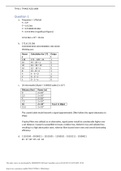
TM111 TMA03 K221168X
Question 1
a. Frequency = 1/Period
F = 1/P
F = 1/6.5ms
F = 0.153846154 KHz
F = 0.154 KHz (3 significant figures)
0.154 KHz x 103 = 154 Hz
b. 172.61.35.186
10101100 00111101 00100011 10111010
Working out:
Denar Calculation for 172 Outpu
y t
128 172 – 128 = 44 1
64 44 – 64 = x 0
32 44 – 32 = 12 1
16 12 – 16 = x 0
8 12 – 8 = 4 1
4 4–4=0 1
2 0–2=x 0
1 0–1=x 0
c. 20 microwatts (20µw) = 0.00002 watts (2 x 10⁻⁵)
Distance (km) Power (w)
0 2 x 10⁻¹
2.5 2 x 10⁻²
5 2 x 10⁻³
7.5 2 x 10⁻⁴
10 2 x 10⁻⁵ Equal to 20µw
12.5 2 x 10⁻⁶
The coaxial cable would transmit a signal approximately 10km before the signal attenuates to
20µw.
If optical fibre was utilized as an alternative, signal power would be considerably higher over
a set distance. Coaxial is susceptible to losses; resistive loss, dielectric loss and radiated loss
resulting in a high attenuation rates, whereas fibre boasts lower rates and overall dominating
efficiency.
d. 11101100 – 00100111 – 10111001 – 11010101 – 01101111 – 10100011
EC : 27 : B9 : D5 : 6F : A3
This study source was downloaded by 100000808701186 from CourseHero.com on 09-09-2022 19:36:59 GMT -05:00
https://www.coursehero.com/file/57694177/TM111-TMA03docx/
, TM111 TMA03 K221168X
Question 2
a. (i) The licensed spectrum boasts minimal vulnerability to interference as a result of its
exclusive nature and endures fewer data errors. consequently, operation of the spectrum
comes at an expensive rate to manufacture, resulting of magnified charges for clients.
(ii) The variations concerning both spectrums accessible for low power wide area networks
(LPWAN), demonstrates that the licensed spectrum can only be accessed by the company
that licensed them, eliminating interference. whereas anyone can obtain access of the
unlicensed spectrum. Both versions are built to use minimal power, to access a long range of
transmission and reception and are suited to small data transactions.
LPWAN’s use base stations and fixed points for the licensed spectrum and arrive in two
forms, narrow band internet of things (NB – IoT) and long-term evolution category m1 (LTE
Cat M1).NB – IoT supports low complexity devices with a very narrow bandwidth, 200 KHz
which was previously the same volume used for 2G radio channels. NB – IoT consents
communication from device to network. LTE cat M1 is a two-way method of communication
based personally on 4G mobile communication. Cellular operators using such network would
be expected to dedicate a minor volume of their capacity for IoT traffic. Established a low
power mode for devices and sensors by permitting a dormant state while no data is being
transmitted.
For license free LPWAN’s a modern network has been developed that is not associated with
typical cellular networks. Although there are numerous variations, they have many mutual
features including the use of the license free spectrum, use of low data rates to achieve long
distances and simplicity and cheapness. Examples of this variation of LPWAN comprise of
Sigfox, LoRaWan, Ingenu and WAVIoT which are relatively straightforward to implement,
they originate in the form off grey and blue boxes which simply have connections just for
power and broadband called gateways. Unlike cellular methods they occupy very little space
but still promote comparable ranges and cost just a few hundred pounds each.
LPWAN’s that employ the licensed spectrum operate on the infrastructure of conventional
cellular communications and are less susceptible to interference. Whereas the unlicensed
spectrum labours its own modern infrastructure that is simpler and cheaper.
b.
Meters Unit (d)
225m 1
450m 2
675m 3
1/d3 = 1/unit 33 = 1/33
1/33 = 1/27
The signal received at 675m will be 1/27 0f the starting value 8µw.
1/27 X 8µw = 0.2962962962962963µw
Which expressed in scientific notation to two decimal places.
This study source was downloaded by 100000808701186 from CourseHero.com on 09-09-2022 19:36:59 GMT -05:00
https://www.coursehero.com/file/57694177/TM111-TMA03docx/
Question 1
a. Frequency = 1/Period
F = 1/P
F = 1/6.5ms
F = 0.153846154 KHz
F = 0.154 KHz (3 significant figures)
0.154 KHz x 103 = 154 Hz
b. 172.61.35.186
10101100 00111101 00100011 10111010
Working out:
Denar Calculation for 172 Outpu
y t
128 172 – 128 = 44 1
64 44 – 64 = x 0
32 44 – 32 = 12 1
16 12 – 16 = x 0
8 12 – 8 = 4 1
4 4–4=0 1
2 0–2=x 0
1 0–1=x 0
c. 20 microwatts (20µw) = 0.00002 watts (2 x 10⁻⁵)
Distance (km) Power (w)
0 2 x 10⁻¹
2.5 2 x 10⁻²
5 2 x 10⁻³
7.5 2 x 10⁻⁴
10 2 x 10⁻⁵ Equal to 20µw
12.5 2 x 10⁻⁶
The coaxial cable would transmit a signal approximately 10km before the signal attenuates to
20µw.
If optical fibre was utilized as an alternative, signal power would be considerably higher over
a set distance. Coaxial is susceptible to losses; resistive loss, dielectric loss and radiated loss
resulting in a high attenuation rates, whereas fibre boasts lower rates and overall dominating
efficiency.
d. 11101100 – 00100111 – 10111001 – 11010101 – 01101111 – 10100011
EC : 27 : B9 : D5 : 6F : A3
This study source was downloaded by 100000808701186 from CourseHero.com on 09-09-2022 19:36:59 GMT -05:00
https://www.coursehero.com/file/57694177/TM111-TMA03docx/
, TM111 TMA03 K221168X
Question 2
a. (i) The licensed spectrum boasts minimal vulnerability to interference as a result of its
exclusive nature and endures fewer data errors. consequently, operation of the spectrum
comes at an expensive rate to manufacture, resulting of magnified charges for clients.
(ii) The variations concerning both spectrums accessible for low power wide area networks
(LPWAN), demonstrates that the licensed spectrum can only be accessed by the company
that licensed them, eliminating interference. whereas anyone can obtain access of the
unlicensed spectrum. Both versions are built to use minimal power, to access a long range of
transmission and reception and are suited to small data transactions.
LPWAN’s use base stations and fixed points for the licensed spectrum and arrive in two
forms, narrow band internet of things (NB – IoT) and long-term evolution category m1 (LTE
Cat M1).NB – IoT supports low complexity devices with a very narrow bandwidth, 200 KHz
which was previously the same volume used for 2G radio channels. NB – IoT consents
communication from device to network. LTE cat M1 is a two-way method of communication
based personally on 4G mobile communication. Cellular operators using such network would
be expected to dedicate a minor volume of their capacity for IoT traffic. Established a low
power mode for devices and sensors by permitting a dormant state while no data is being
transmitted.
For license free LPWAN’s a modern network has been developed that is not associated with
typical cellular networks. Although there are numerous variations, they have many mutual
features including the use of the license free spectrum, use of low data rates to achieve long
distances and simplicity and cheapness. Examples of this variation of LPWAN comprise of
Sigfox, LoRaWan, Ingenu and WAVIoT which are relatively straightforward to implement,
they originate in the form off grey and blue boxes which simply have connections just for
power and broadband called gateways. Unlike cellular methods they occupy very little space
but still promote comparable ranges and cost just a few hundred pounds each.
LPWAN’s that employ the licensed spectrum operate on the infrastructure of conventional
cellular communications and are less susceptible to interference. Whereas the unlicensed
spectrum labours its own modern infrastructure that is simpler and cheaper.
b.
Meters Unit (d)
225m 1
450m 2
675m 3
1/d3 = 1/unit 33 = 1/33
1/33 = 1/27
The signal received at 675m will be 1/27 0f the starting value 8µw.
1/27 X 8µw = 0.2962962962962963µw
Which expressed in scientific notation to two decimal places.
This study source was downloaded by 100000808701186 from CourseHero.com on 09-09-2022 19:36:59 GMT -05:00
https://www.coursehero.com/file/57694177/TM111-TMA03docx/