— Approaches
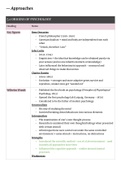
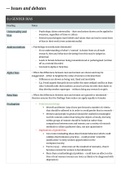
5.1 ORIGINS OF PSYCHOLOGY
Heading Notes
Key figures Rene Descartes
- French philosopher (1596-1650)
- Cartesian dualism → mind and body are independent from each
other
- “I think, therefore I am”
John Locke
- (1632-1704)
- Empiricism → the idea that knowledge can be obtained purely via
your senses (and no one inherits instincts or knowledge)
- Later influenced the behaviourist approach - measured and
observed things to make discoveries
Charles Darwin
- (1809-1882)
- Evolution → stronger and more adaptive genes survive and
reproduce, weaker ones get ‘weeded out’
Wilhelm Wundt - Published the first book on psychology (Principles of Physiological
Psychology, 1873)
- Opened the first psychology lab (Leipzig, Germany - 1879)
- Considered to be the father of modern psychology
Structuralism
- His way of studying the mind
- Involved breaking down behaviours into various elements
Introspection
- The examination of one’s own thought process
- Researchers examined their own thoughts/feelings when presented
with certain stimuli
- All introspections were carried out under the same controlled
environment → same stimuli + instructions, no distractions
Strengths
+ Introduced the scientific method + use of a lab environment - used
in nearly all approaches since then
+ Influenced the cognitive approach - studies internal mental
processes
Weaknesses
, - His method is extremely subjective and none of his theories can be
proven
- He only tested a few people - cannot be generalised
5.2 THE PSYCHODYNAMIC APPROACH
Heading Notes
Key assumptions - Unconscious mind - the driving force behind our behaviour. Can
only fix problematic behaviour through accessing it
- Instincts/drives - motivate our behaviour, born with them
- Early childhood experiences - make us who we are - the first five
years of our life are most important for shaping our adult
personality
Parts of the mind Conscious
- What we’re aware of, thoughts and perceptions
- The part we can access
Pre-conscious
- Memories and stored knowledge
- Can access but not as prominent
Unconscious
- Deepest level, role is to hold unpleasant memories
- Drives and motivates all behaviour (not aware of it)
Tripartite theory The id
- Present from birth, most primitive
- Pleasure principle
- Contains unconscious desires and instincts
The Ego
- Develops at 18 months - 3 years
- Reality principle
- Mediator between id and superego (reduces conflicts through
defence mechanisms)
The Superego
- Develops at 3-6 years
- Morality principle
- Acts as a conscience/helps to form a moral code, feels guilt
Defence - Unconscious strategies used to manage conflict between the id and
mechanisms superego
- Have to be strong to sufficiently reduce anxiety
Repression
5.1 ORIGINS OF PSYCHOLOGY
Heading Notes
Key figures Rene Descartes
- French philosopher (1596-1650)
- Cartesian dualism → mind and body are independent from each
other
- “I think, therefore I am”
John Locke
- (1632-1704)
- Empiricism → the idea that knowledge can be obtained purely via
your senses (and no one inherits instincts or knowledge)
- Later influenced the behaviourist approach - measured and
observed things to make discoveries
Charles Darwin
- (1809-1882)
- Evolution → stronger and more adaptive genes survive and
reproduce, weaker ones get ‘weeded out’
Wilhelm Wundt - Published the first book on psychology (Principles of Physiological
Psychology, 1873)
- Opened the first psychology lab (Leipzig, Germany - 1879)
- Considered to be the father of modern psychology
Structuralism
- His way of studying the mind
- Involved breaking down behaviours into various elements
Introspection
- The examination of one’s own thought process
- Researchers examined their own thoughts/feelings when presented
with certain stimuli
- All introspections were carried out under the same controlled
environment → same stimuli + instructions, no distractions
Strengths
+ Introduced the scientific method + use of a lab environment - used
in nearly all approaches since then
+ Influenced the cognitive approach - studies internal mental
processes
Weaknesses
, - His method is extremely subjective and none of his theories can be
proven
- He only tested a few people - cannot be generalised
5.2 THE PSYCHODYNAMIC APPROACH
Heading Notes
Key assumptions - Unconscious mind - the driving force behind our behaviour. Can
only fix problematic behaviour through accessing it
- Instincts/drives - motivate our behaviour, born with them
- Early childhood experiences - make us who we are - the first five
years of our life are most important for shaping our adult
personality
Parts of the mind Conscious
- What we’re aware of, thoughts and perceptions
- The part we can access
Pre-conscious
- Memories and stored knowledge
- Can access but not as prominent
Unconscious
- Deepest level, role is to hold unpleasant memories
- Drives and motivates all behaviour (not aware of it)
Tripartite theory The id
- Present from birth, most primitive
- Pleasure principle
- Contains unconscious desires and instincts
The Ego
- Develops at 18 months - 3 years
- Reality principle
- Mediator between id and superego (reduces conflicts through
defence mechanisms)
The Superego
- Develops at 3-6 years
- Morality principle
- Acts as a conscience/helps to form a moral code, feels guilt
Defence - Unconscious strategies used to manage conflict between the id and
mechanisms superego
- Have to be strong to sufficiently reduce anxiety
Repression