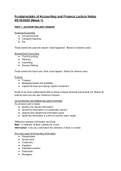
Fundamentals of Accounting and Finance Lecture Notes
05/10/2020 (Week 1)
PART 1: ACCOUNTING AND FINANCE
Financial Accounting
● Annual Accounts
● Company reporting
● Tax
Tends toward the past and reports ‘what happened’. Mainly for external users.
Management Accounting
● Cost Accounting
● Planning
● Controlling
● Decision Making
Tends toward the future and ‘what could happen’. Mainly for internal users
Finance
● Treasury
● Managing Assets and Liabilities
● Capital structure and raising Capital investment
Tends to be more mathematical (this is where complex financial instruments sit). Mainly for
internal users but can also influence investors.
ACCOUNTING INFORMATION AND SYSTEMS
It’s all about user’s needs
● identify and capture information
● record the information in a systematic manner
● analyse and interpret the information given
● report the information in a form to suit the users’ needs
Difference between Information and Data:
Data - a collection of facts, useless for a user
Information - how you understand the collection of facts in context
The main users of Accounting Information
● Shareholders
● Government
● Customers
● Suppliers
● Potential Investors
● Employees
● Managers
,PART 2: MANAGEMENT ACCOUNTING - COST ACCOUNTING
Cost Classification
Cost unit - (usually a product) what is being costed
Direct cost - cost that can be traced in full to a cost unit (e.g materials, labour, expenses)
Prime cost - sum of direct costs
Indirect cost/ Overheads - cost that cannot be traced in full to a cost unit (e.g production,
selling and distribution, administration)
Fixed cost - costs that do not change with level of activity
Stepped fixed cost - costs that change at certain levels of activity
Variable costs - as activity rises so do variable costs
Semi-variable or Semi Fixed costs - fixed element combined with variable element
PROFIT = REVENUE - (Fixed cost + Variable cost)
REVENUE = QUANTITY x PRICE
Treatment of Fixed Overheads
1. Absorption Costing - Share them out into the products, and the budgets and profit
statements
2. Marginal Costing - Just wait until you get the bill and write them off against overall
profit
Absorption Costing
,Marginal Costing
Contribution - the difference between the sales price and the variable cost.
“Contribution towards fixed costs and profits”
Unit contribution = Selling Price - unit variable costs
Total contribution = Total revenue - total variable costs
Total profit = total contribution - fixed costs
, PART 3: MANAGEMENT ACCOUNTING – COST VOLUME PROFIT (CVP) AND BREAK
EVEN ANALYSIS
Cost Volume Profit (CVP) uses ‘contribution’ to determine how many units of an item must
be sold, at a particular set price, in order to make a specified profit
Profit = (Revenue - VC) - FC
Profit = Contribution - FC
Break even :
0 = Contribution - FC
FC = Contribution or TR = TC
FC = (Contribution per unit) x n.o units
:. FC/(Cont per unit) = Number of units to break even
To find the units required for a particular target profit the calculation becomes:
Units required = [Fixed cost + required profit] / Contribution per unit
Margin of Safety:
Margin of Safety - the amount at which anticipated sales can fall before the firm makes a
loss.
MOS = Budgeted sales - Break Even Point (Can be a percentage of budgeted sales or units)
Contribution/ Sales ratio:
Contribution / sales (C/S) ratio - the proportion of the selling price that contributes to fixed
overheads and profit.
Used to find the break-even point in terms of sales revenue rather than in units.
C/S ratio = cont per unit / selling price per unit or Total contribution / total revenue
C/S ratio = Fixed Costs/ Break even revenue
05/10/2020 (Week 1)
PART 1: ACCOUNTING AND FINANCE
Financial Accounting
● Annual Accounts
● Company reporting
● Tax
Tends toward the past and reports ‘what happened’. Mainly for external users.
Management Accounting
● Cost Accounting
● Planning
● Controlling
● Decision Making
Tends toward the future and ‘what could happen’. Mainly for internal users
Finance
● Treasury
● Managing Assets and Liabilities
● Capital structure and raising Capital investment
Tends to be more mathematical (this is where complex financial instruments sit). Mainly for
internal users but can also influence investors.
ACCOUNTING INFORMATION AND SYSTEMS
It’s all about user’s needs
● identify and capture information
● record the information in a systematic manner
● analyse and interpret the information given
● report the information in a form to suit the users’ needs
Difference between Information and Data:
Data - a collection of facts, useless for a user
Information - how you understand the collection of facts in context
The main users of Accounting Information
● Shareholders
● Government
● Customers
● Suppliers
● Potential Investors
● Employees
● Managers
,PART 2: MANAGEMENT ACCOUNTING - COST ACCOUNTING
Cost Classification
Cost unit - (usually a product) what is being costed
Direct cost - cost that can be traced in full to a cost unit (e.g materials, labour, expenses)
Prime cost - sum of direct costs
Indirect cost/ Overheads - cost that cannot be traced in full to a cost unit (e.g production,
selling and distribution, administration)
Fixed cost - costs that do not change with level of activity
Stepped fixed cost - costs that change at certain levels of activity
Variable costs - as activity rises so do variable costs
Semi-variable or Semi Fixed costs - fixed element combined with variable element
PROFIT = REVENUE - (Fixed cost + Variable cost)
REVENUE = QUANTITY x PRICE
Treatment of Fixed Overheads
1. Absorption Costing - Share them out into the products, and the budgets and profit
statements
2. Marginal Costing - Just wait until you get the bill and write them off against overall
profit
Absorption Costing
,Marginal Costing
Contribution - the difference between the sales price and the variable cost.
“Contribution towards fixed costs and profits”
Unit contribution = Selling Price - unit variable costs
Total contribution = Total revenue - total variable costs
Total profit = total contribution - fixed costs
, PART 3: MANAGEMENT ACCOUNTING – COST VOLUME PROFIT (CVP) AND BREAK
EVEN ANALYSIS
Cost Volume Profit (CVP) uses ‘contribution’ to determine how many units of an item must
be sold, at a particular set price, in order to make a specified profit
Profit = (Revenue - VC) - FC
Profit = Contribution - FC
Break even :
0 = Contribution - FC
FC = Contribution or TR = TC
FC = (Contribution per unit) x n.o units
:. FC/(Cont per unit) = Number of units to break even
To find the units required for a particular target profit the calculation becomes:
Units required = [Fixed cost + required profit] / Contribution per unit
Margin of Safety:
Margin of Safety - the amount at which anticipated sales can fall before the firm makes a
loss.
MOS = Budgeted sales - Break Even Point (Can be a percentage of budgeted sales or units)
Contribution/ Sales ratio:
Contribution / sales (C/S) ratio - the proportion of the selling price that contributes to fixed
overheads and profit.
Used to find the break-even point in terms of sales revenue rather than in units.
C/S ratio = cont per unit / selling price per unit or Total contribution / total revenue
C/S ratio = Fixed Costs/ Break even revenue