Behavioural Approach to explaining phobias
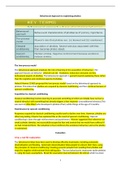
The two-process model
The behavioural approach emphasis the role of learning in the acquisition of behaviour. The
approach focuses on behavior- what we can see. Avoidance, endurance and panic are key
behavioural aspects of phobias. The behavioural approach is geared towards explaining these rather
than the cognitive and emotional aspects of phobias.
Hobert Mowrer (1960) proposed the two-process model based on the behavioural approach to
phobias. This states that phobias are acquired by classical conditioning and then continue because of
operant conditioning.
Acquisition by classical conditioning
Classical conditioning involves learning to associate something of which we initially have no fear (a
neutral stimulus) with something that already triggers a fear response (unconditioned stimulus).This
was seen in Little Albert who developed a phobia of furry white things at the age of 9 months.
Maintenance by operant conditioning
Responses acquired by classical conditioning usually tend to decline over time. However, phobias are
often long lasting. Mowrer has explained this as the result of operant conditioning. Operant
conditioning is done through reinforcement and punishment. Mowrer suggested that whenever we
avoid a phobic stimulus, we successfully escape the fear and anxiety that we would have suffered if
we had remained there. The reduction in fear reinforces the avoidance behaviour and so the phobia
is maintained.
Evaluation
It has a real-life explanation
The behaviourist ideas have been used to develop effective treatments, including systematic
desensitisation and flooding. Systematic desensitisation helps people to unlearn their fears, using
the principles of classical conditioning. Flooding prevents people from avoiding their phobias and
stops the negative reinforcement from taking place. The two behaviourist treatments tackle phobias
by using the basic assumptions. Break the association learned between the stimuli which has been
1
The two-process model
The behavioural approach emphasis the role of learning in the acquisition of behaviour. The
approach focuses on behavior- what we can see. Avoidance, endurance and panic are key
behavioural aspects of phobias. The behavioural approach is geared towards explaining these rather
than the cognitive and emotional aspects of phobias.
Hobert Mowrer (1960) proposed the two-process model based on the behavioural approach to
phobias. This states that phobias are acquired by classical conditioning and then continue because of
operant conditioning.
Acquisition by classical conditioning
Classical conditioning involves learning to associate something of which we initially have no fear (a
neutral stimulus) with something that already triggers a fear response (unconditioned stimulus).This
was seen in Little Albert who developed a phobia of furry white things at the age of 9 months.
Maintenance by operant conditioning
Responses acquired by classical conditioning usually tend to decline over time. However, phobias are
often long lasting. Mowrer has explained this as the result of operant conditioning. Operant
conditioning is done through reinforcement and punishment. Mowrer suggested that whenever we
avoid a phobic stimulus, we successfully escape the fear and anxiety that we would have suffered if
we had remained there. The reduction in fear reinforces the avoidance behaviour and so the phobia
is maintained.
Evaluation
It has a real-life explanation
The behaviourist ideas have been used to develop effective treatments, including systematic
desensitisation and flooding. Systematic desensitisation helps people to unlearn their fears, using
the principles of classical conditioning. Flooding prevents people from avoiding their phobias and
stops the negative reinforcement from taking place. The two behaviourist treatments tackle phobias
by using the basic assumptions. Break the association learned between the stimuli which has been
1