

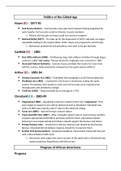
Politics of the Gilded Age
Hayes (R) – 1877-81
Civil Service Reform – Civil servants must pass tests instead of being appointed by
party loyalty. Civil servants could not donate to party members
o Reform did not pass as Hayes could not convince congress
Railroad Strike (1877) – To make up for the depression of 1873, railroads cut wages
repeatedly leading to the largest labour strike. Hayes was prepared to send troops.
o Businesses praised him and presidency was seen to be pro-business
Garfield (R) – 1881
Post Office Reform (1880) – Profiteering rings stole millions of dollars through bogus
contracts called ‘star routes. Thomas Brady the ringleader was convicted in 1883
Increased Federal Authority - Customs house provided the income for more than
half the country, federal authority stamped out the spoils system within it
Arthur (R) – 1881-84
Chinese Exclusion Act (1882) – Prohibited the immigration of all Chinese labourers
Pendleton Act (1883) – Created the Civil Service Commission ending the spoils
system. Promotions were based on merit and civil servants were retained even
through party and presidency change
Tariff Act (1883) – Reduced tariffs by an average of 1.47%
Cleveland (D) – 1885-89
Mugwumps (1884) – Republican reformers united to form the ‘mugwumps’. They
were happy to support a pro-reform democrat such as Cleveland. Cleveland won
with a 25,000-vote majority and 37 votes in the electoral college
Foran Act (1885) – Banned foreign contract labour
Texas Seed Bill Veto (1887) – After a drought ruined crops in several Texas counties,
congress appropriated $10,000 to purchase seeds for them, Cleaveland vetoed
believing it was inappropriate and citizens should support themselves and others.
Private Pension Veto – Pensions for civil war veterans was denied by the Pension
Bureau, Cleveland did not believe congress should try to overrule them
Further Civil Service Reform – Retained republican civil servants if they did their job
well, reduced federal staff count.
o Democrats were angry they were not part of the spoils and so Cleveland later
replaced partisan Republicans with Democrats
Progress of African Americans
Progress
, Northern states did pass civil right statues to tackle Jim crow laws
o Punishment was weak
o Statues were weak
Emancipation allows blacks to move, population increased from 4.4m to 7.9
between 1870 and 1900. Job opportunities improved from cotton picking to
machinery.
Sharecropping gave labourers a sense of control in their work
o They were in heavy debt to landowners leaving them with little money
o Natural disasters such as Boll Weevils destroyed crops
No segregation is the northern states
Education Bill (1882) – millions of dollars were given to southern state schools to
educate black and white students
o Was rejected by congress
Black students in the US doubled between the 1877 and 1887 and by the 1890s
segregated schools started disappearing
o Only 40% were enrolled
o Black schools had poor infrastructure compared to white schools often
closing so students could pick cotton
No Progress
Jim Crow Laws (1887) - Enforced public segregation in redeemer democrat ran
states
First Ghetto (1880) - Formed in New York due to the doubling of black population
leading to northern whites to share the same social Darwinism theories that the
south did
Influx of African Americans fuelled concepts of social Darwinism; African Americans
were perceived as uncivilised, poorly educated and subhuman in comparison to
white
Banned from trade unions
Between 1882 and 1890, 2,500 African Americans had been lynched by the KKK
Supreme court ruling (1883) - public places did not statutory protection against
racial discrimination
Executive branches did not see the social mobility of African Americans as a political
challenge leading them to neglect them
15th Amendment was circumvented by democrats in southern states by
disenfranchising voters through gender and property ownership
Economics Social Government and Politics
Immigration
Old immigrants (Pre 1870s) New immigrants (Post 1870s)
Hayes (R) – 1877-81
Civil Service Reform – Civil servants must pass tests instead of being appointed by
party loyalty. Civil servants could not donate to party members
o Reform did not pass as Hayes could not convince congress
Railroad Strike (1877) – To make up for the depression of 1873, railroads cut wages
repeatedly leading to the largest labour strike. Hayes was prepared to send troops.
o Businesses praised him and presidency was seen to be pro-business
Garfield (R) – 1881
Post Office Reform (1880) – Profiteering rings stole millions of dollars through bogus
contracts called ‘star routes. Thomas Brady the ringleader was convicted in 1883
Increased Federal Authority - Customs house provided the income for more than
half the country, federal authority stamped out the spoils system within it
Arthur (R) – 1881-84
Chinese Exclusion Act (1882) – Prohibited the immigration of all Chinese labourers
Pendleton Act (1883) – Created the Civil Service Commission ending the spoils
system. Promotions were based on merit and civil servants were retained even
through party and presidency change
Tariff Act (1883) – Reduced tariffs by an average of 1.47%
Cleveland (D) – 1885-89
Mugwumps (1884) – Republican reformers united to form the ‘mugwumps’. They
were happy to support a pro-reform democrat such as Cleveland. Cleveland won
with a 25,000-vote majority and 37 votes in the electoral college
Foran Act (1885) – Banned foreign contract labour
Texas Seed Bill Veto (1887) – After a drought ruined crops in several Texas counties,
congress appropriated $10,000 to purchase seeds for them, Cleaveland vetoed
believing it was inappropriate and citizens should support themselves and others.
Private Pension Veto – Pensions for civil war veterans was denied by the Pension
Bureau, Cleveland did not believe congress should try to overrule them
Further Civil Service Reform – Retained republican civil servants if they did their job
well, reduced federal staff count.
o Democrats were angry they were not part of the spoils and so Cleveland later
replaced partisan Republicans with Democrats
Progress of African Americans
Progress
, Northern states did pass civil right statues to tackle Jim crow laws
o Punishment was weak
o Statues were weak
Emancipation allows blacks to move, population increased from 4.4m to 7.9
between 1870 and 1900. Job opportunities improved from cotton picking to
machinery.
Sharecropping gave labourers a sense of control in their work
o They were in heavy debt to landowners leaving them with little money
o Natural disasters such as Boll Weevils destroyed crops
No segregation is the northern states
Education Bill (1882) – millions of dollars were given to southern state schools to
educate black and white students
o Was rejected by congress
Black students in the US doubled between the 1877 and 1887 and by the 1890s
segregated schools started disappearing
o Only 40% were enrolled
o Black schools had poor infrastructure compared to white schools often
closing so students could pick cotton
No Progress
Jim Crow Laws (1887) - Enforced public segregation in redeemer democrat ran
states
First Ghetto (1880) - Formed in New York due to the doubling of black population
leading to northern whites to share the same social Darwinism theories that the
south did
Influx of African Americans fuelled concepts of social Darwinism; African Americans
were perceived as uncivilised, poorly educated and subhuman in comparison to
white
Banned from trade unions
Between 1882 and 1890, 2,500 African Americans had been lynched by the KKK
Supreme court ruling (1883) - public places did not statutory protection against
racial discrimination
Executive branches did not see the social mobility of African Americans as a political
challenge leading them to neglect them
15th Amendment was circumvented by democrats in southern states by
disenfranchising voters through gender and property ownership
Economics Social Government and Politics
Immigration
Old immigrants (Pre 1870s) New immigrants (Post 1870s)


