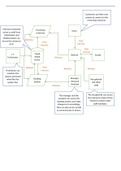
The multi-store model of memory
1
, Sensory Register
A stimulus from the environment will pass into the sensory registers. So, this part of memory is not 1
store but several, in fact for each of our 5 senses. The 2 main stores are called iconic memory (visual
information is coded visually) and echoic memory (sound-or auditory-information is coded acoustically).
Material in the sensory registers only lasts very briefly (less than half a second). The capacity is very
high, over hundred million cells in one eye, each storing data.
Key process is attention, otherwise it will not go into the memory system.
Short-term memory (STM)
It is a limited capacity store. Its capacity is between 5 to 9 items (7 +- 2) though research suggests its
likely to be 5. Information is coded acoustically and lasts about 30 seconds unless it is rehearsed.
Maintenance rehearsal= when we repeat and rehearse material to ourselves again and again. We can
keep information in our STMs as long as we rehearse it. If we rehearse it long enough, it passes into our
long-term memory (LTM).
2
1
, Sensory Register
A stimulus from the environment will pass into the sensory registers. So, this part of memory is not 1
store but several, in fact for each of our 5 senses. The 2 main stores are called iconic memory (visual
information is coded visually) and echoic memory (sound-or auditory-information is coded acoustically).
Material in the sensory registers only lasts very briefly (less than half a second). The capacity is very
high, over hundred million cells in one eye, each storing data.
Key process is attention, otherwise it will not go into the memory system.
Short-term memory (STM)
It is a limited capacity store. Its capacity is between 5 to 9 items (7 +- 2) though research suggests its
likely to be 5. Information is coded acoustically and lasts about 30 seconds unless it is rehearsed.
Maintenance rehearsal= when we repeat and rehearse material to ourselves again and again. We can
keep information in our STMs as long as we rehearse it. If we rehearse it long enough, it passes into our
long-term memory (LTM).
2