Stanley Cavell - Notes and afterthoughts on the opening of Wittgenstein’s Investigations
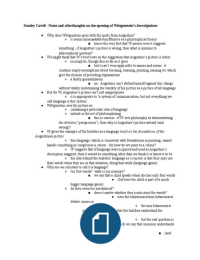
● Why does Wittgenstein open with the quote from Augustine?
○ it seems unremarkable/inoffensive as a philosophical theory
■ hence the very fact that W pauses over it suggests
something - if Augustine’s picture is wrong, then what is immune to
philosophical question?
● We might think that W’s beef rests on the suggestion that Augustine’s picture is either:
○ incomplete, though fine as far as it goes
■ but it isn’t even applicable to names and nouns. it
contains empty assumptions about teaching, learning, pointing, naming etc which
give the illusion of providing explanations
○ a faulty generalization
■ no. Augustine can’t defend himself against this charge
without totally undermining the validity of his picture as a picture of all language
● But for W, Augustine’s picture isn’t just inappropriate
○ it is appropriate to ‘a system of communication, but not everything we
call language is this system’
● Wittgenstein sees the picture as:
○ containing a particular idea of language
○ natural in the act of philosophizing
■ this is curious - if W sees philosophy as demonstrating
the obvious (‘perspicuous’), then why is Augustine’s picture natural (and
wrong)?
● W gives the example of the builders as a language build on the foundations of the
Augustinian picture
○ this language, which is consistent with foundations in pointing, cannot
handle something as complex as a colour - for how do we point to a colour?
○ W suggests that if language were acquired and used as Augustine’s
description suggests, then it would be something other than we think it or know it to be
○ the idea behind the builders’ language as complete is that they only use
their words when they are in that situation, doing that work (language-game)
● Why are we reluctant to call it a language?
○ too few words? what is our measure?
■ we say that a child speaks when she has only four words
● (but here the child is part of a much
bigger language game)
○ do they seem too mechanical?
■ does it matter whether they understand the words?
● here the behaviourist/non-behaviourist
debate comes in
○ the non-behaviourist
must show in virtue of what the builders understand the
commands
○ but the real question is
of the circumstances in which we say that someone understands
(grammar)
■ (and
● Why does Wittgenstein open with the quote from Augustine?
○ it seems unremarkable/inoffensive as a philosophical theory
■ hence the very fact that W pauses over it suggests
something - if Augustine’s picture is wrong, then what is immune to
philosophical question?
● We might think that W’s beef rests on the suggestion that Augustine’s picture is either:
○ incomplete, though fine as far as it goes
■ but it isn’t even applicable to names and nouns. it
contains empty assumptions about teaching, learning, pointing, naming etc which
give the illusion of providing explanations
○ a faulty generalization
■ no. Augustine can’t defend himself against this charge
without totally undermining the validity of his picture as a picture of all language
● But for W, Augustine’s picture isn’t just inappropriate
○ it is appropriate to ‘a system of communication, but not everything we
call language is this system’
● Wittgenstein sees the picture as:
○ containing a particular idea of language
○ natural in the act of philosophizing
■ this is curious - if W sees philosophy as demonstrating
the obvious (‘perspicuous’), then why is Augustine’s picture natural (and
wrong)?
● W gives the example of the builders as a language build on the foundations of the
Augustinian picture
○ this language, which is consistent with foundations in pointing, cannot
handle something as complex as a colour - for how do we point to a colour?
○ W suggests that if language were acquired and used as Augustine’s
description suggests, then it would be something other than we think it or know it to be
○ the idea behind the builders’ language as complete is that they only use
their words when they are in that situation, doing that work (language-game)
● Why are we reluctant to call it a language?
○ too few words? what is our measure?
■ we say that a child speaks when she has only four words
● (but here the child is part of a much
bigger language game)
○ do they seem too mechanical?
■ does it matter whether they understand the words?
● here the behaviourist/non-behaviourist
debate comes in
○ the non-behaviourist
must show in virtue of what the builders understand the
commands
○ but the real question is
of the circumstances in which we say that someone understands
(grammar)
■ (and