Animal Cloning and Developmental Genetics
Animal Cloning
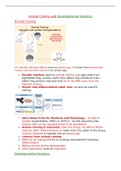
UV radiation destroys DNA to leave an empty egg. Cell taken from animal pole,
nucleus removed & is injected into empty egg.
Genetic markers used for animal cloning: e.g. egg came from
pigmented frog, nucleus came from albino frog (recessive trait) –
albino frog product indicates that all of the DNA came from the
injected nucleus.
Shown that differentiated adult cells can also be used for
cloning:
2012 Nobel Prize for Medicine and Physiology – Sir John B.
Gurdon (experiments 1960’s & 1970’s) – for the discovery that
mature cells can be reprogrammed to be pluripotent.
Animal cloning in mammals: Dolly the sheep, Ian Wilmut Roslin
Institute 1997. Differentiated cell taken from the udder of the sheep,
nucleus removed & injected into an empty egg.
Lessons from animal cloning:
1. DNA can be reprogrammed to undergo development following
differentiation
2. DNA is not lost during development
3. Gene expression must be regulated
Developmental Genetics
, Genetic screen = a technique used to identify and study an
interesting phenotype within a mutated population.
Which model organisms?- Yeast, Drosophila, Zebrafish
3 key steps: genetic screening is an example of Forward
Genetics
1. GENERATE THE MUTANTS:
Offspring phenotypically 1/16
normal phenotypically
mutant
Some phenotypically mutant offspring
Following mutagenisis of the males, females & males breed and offspring
hatch - F1 generation. Often, mutation leads to a recessive phenotype, so
it isn’t possible to tell from looking at the offspring which ones have a
mutated gene (they are heterozygous/carriers). Each F1 offspring is bred
with a wild-type (normal) partner to give the F2 generation (still not
possible to tell which F2 offspring contain mutated gene). F2 offspring are
inbred to give F3 generation. Possible to see which offspring contain
mutated gene by looking at the phenotype of the F2 offspring – some
families may contain no mutated individuals as they didn’t inherit a
mutated sperm from the original mutagenised male. Families which
contain mutated offspring must have inherited 2 copies of the mutated
gene (1 from each parent).
Drosophila are well suited to genetic screens:
- Quick generation time
- Simple genome (13,000 genes, 4 chromosomes)
- Small and cheap to maintain
- Easy to see the phenotype
Drosophila genetics:
- 7 homeotic mutations: mutations that convert one structure into
another
- Head: labial (lab), Deformed (Dfd)
- Thorax: Sex combs reduced (SCR), Antennapedia (Antp),
Ultrabithorax (Ubx)
- Abdomen: abdominal A (abdA), Abdominal B (AbdB)
- Genes normally given the same name as the mutant
Animal Cloning
UV radiation destroys DNA to leave an empty egg. Cell taken from animal pole,
nucleus removed & is injected into empty egg.
Genetic markers used for animal cloning: e.g. egg came from
pigmented frog, nucleus came from albino frog (recessive trait) –
albino frog product indicates that all of the DNA came from the
injected nucleus.
Shown that differentiated adult cells can also be used for
cloning:
2012 Nobel Prize for Medicine and Physiology – Sir John B.
Gurdon (experiments 1960’s & 1970’s) – for the discovery that
mature cells can be reprogrammed to be pluripotent.
Animal cloning in mammals: Dolly the sheep, Ian Wilmut Roslin
Institute 1997. Differentiated cell taken from the udder of the sheep,
nucleus removed & injected into an empty egg.
Lessons from animal cloning:
1. DNA can be reprogrammed to undergo development following
differentiation
2. DNA is not lost during development
3. Gene expression must be regulated
Developmental Genetics
, Genetic screen = a technique used to identify and study an
interesting phenotype within a mutated population.
Which model organisms?- Yeast, Drosophila, Zebrafish
3 key steps: genetic screening is an example of Forward
Genetics
1. GENERATE THE MUTANTS:
Offspring phenotypically 1/16
normal phenotypically
mutant
Some phenotypically mutant offspring
Following mutagenisis of the males, females & males breed and offspring
hatch - F1 generation. Often, mutation leads to a recessive phenotype, so
it isn’t possible to tell from looking at the offspring which ones have a
mutated gene (they are heterozygous/carriers). Each F1 offspring is bred
with a wild-type (normal) partner to give the F2 generation (still not
possible to tell which F2 offspring contain mutated gene). F2 offspring are
inbred to give F3 generation. Possible to see which offspring contain
mutated gene by looking at the phenotype of the F2 offspring – some
families may contain no mutated individuals as they didn’t inherit a
mutated sperm from the original mutagenised male. Families which
contain mutated offspring must have inherited 2 copies of the mutated
gene (1 from each parent).
Drosophila are well suited to genetic screens:
- Quick generation time
- Simple genome (13,000 genes, 4 chromosomes)
- Small and cheap to maintain
- Easy to see the phenotype
Drosophila genetics:
- 7 homeotic mutations: mutations that convert one structure into
another
- Head: labial (lab), Deformed (Dfd)
- Thorax: Sex combs reduced (SCR), Antennapedia (Antp),
Ultrabithorax (Ubx)
- Abdomen: abdominal A (abdA), Abdominal B (AbdB)
- Genes normally given the same name as the mutant