
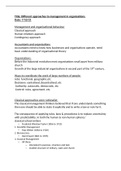
Title: Different approaches to management in organisations
Date: 7/10/21
Management and organisational behaviour
Classical approach
Human relations approach
Contingency approach
Accountants and organisations
Accountants need to know how businesses and organisations operate, need
basic understanding of organisational theory
Organisations:
Before the industrial revolution most organisations small apart from military
church
Growth of the large industrial organisations in second part of the 19 th century.
Ways to coordinate the work of large numbers of people:
Jobs: functional, geographic,etc
Decisions: centralised, decentralised, etc
Authority: autocratic, democratic, etc
Control: rules, agreement, etc.
Classical approaches were rationalist-
The classical management thinkers believed that if one understands something
then one should be able to state it explicitly and to write a law or rule for it.
The consequence of applying rules, laws & procedures is to replace uncertainty
with predictability, in both the human & non-human spheres.’
classical school writers
• Frederick Winslow Taylor (1856 to 1915)
1. Scientific Management
• Max Weber (1864 to 1920)
2. Bureaucracy
• Henri Fayol (1841 to 1925)
3. Classical Management
• All three:
– interested in purpose, structure and task
– studied structure of military, state and church
, scientific management (Taylor)
is concerned with management of the workforce to achieve:
efficiency
standardisation
the organisation as a machine
problem at the time:
• c Frederick Winslow Taylor (1856 to 1915)
1. Scientific Management
• Max Weber (1864 to 1920)
2. Bureaucracy
• Henri Fayol (1841 to 1925)
3. Classical Management
• All three:
– interested in purpose, structure and task
– studied structure of military, state and church
can we increase productivity with the people we have and need (individual
workers):
1.by employing a clear structure of the organisation (technical structuring)
2. by paying them so they produce more (incentives for higher levels of output)
• Frederick Winslow Taylor (1856 to 1915)
1. Scientific Management
• Max Weber (1864 to 1920)
2. Bureaucracy
• Henri Fayol (1841 to 1925)
3. Classical Management
• All three:
– interested in purpose, structure and task
– studied structure of military, state and church
–
Taylor’s Bethlehem steel corporation studies (1/2)
Was a management consultant to find most efficient methods for co-
ordinating and controlling work
Taylor’s Bethlehem steel corporation studies (2/2)
• Tale of a pig-iron worker ‘Schmidt’, high priced man (placed a high value
on money, but had limited mental ability)
– Followed detailed instructions, when to pick up, walk, rest, - no
‘talk back’
Date: 7/10/21
Management and organisational behaviour
Classical approach
Human relations approach
Contingency approach
Accountants and organisations
Accountants need to know how businesses and organisations operate, need
basic understanding of organisational theory
Organisations:
Before the industrial revolution most organisations small apart from military
church
Growth of the large industrial organisations in second part of the 19 th century.
Ways to coordinate the work of large numbers of people:
Jobs: functional, geographic,etc
Decisions: centralised, decentralised, etc
Authority: autocratic, democratic, etc
Control: rules, agreement, etc.
Classical approaches were rationalist-
The classical management thinkers believed that if one understands something
then one should be able to state it explicitly and to write a law or rule for it.
The consequence of applying rules, laws & procedures is to replace uncertainty
with predictability, in both the human & non-human spheres.’
classical school writers
• Frederick Winslow Taylor (1856 to 1915)
1. Scientific Management
• Max Weber (1864 to 1920)
2. Bureaucracy
• Henri Fayol (1841 to 1925)
3. Classical Management
• All three:
– interested in purpose, structure and task
– studied structure of military, state and church
, scientific management (Taylor)
is concerned with management of the workforce to achieve:
efficiency
standardisation
the organisation as a machine
problem at the time:
• c Frederick Winslow Taylor (1856 to 1915)
1. Scientific Management
• Max Weber (1864 to 1920)
2. Bureaucracy
• Henri Fayol (1841 to 1925)
3. Classical Management
• All three:
– interested in purpose, structure and task
– studied structure of military, state and church
can we increase productivity with the people we have and need (individual
workers):
1.by employing a clear structure of the organisation (technical structuring)
2. by paying them so they produce more (incentives for higher levels of output)
• Frederick Winslow Taylor (1856 to 1915)
1. Scientific Management
• Max Weber (1864 to 1920)
2. Bureaucracy
• Henri Fayol (1841 to 1925)
3. Classical Management
• All three:
– interested in purpose, structure and task
– studied structure of military, state and church
–
Taylor’s Bethlehem steel corporation studies (1/2)
Was a management consultant to find most efficient methods for co-
ordinating and controlling work
Taylor’s Bethlehem steel corporation studies (2/2)
• Tale of a pig-iron worker ‘Schmidt’, high priced man (placed a high value
on money, but had limited mental ability)
– Followed detailed instructions, when to pick up, walk, rest, - no
‘talk back’


