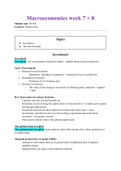
Macroeconomics week 7 + 8
Module code: EC108
Lecturer: Natalie Chen
Topics
● Investment
● The IS-LM model
Investment
Investment
Investment - the accumulation of physical capital - tangible things used in production
Types of investment:
1. Business fixed investment
- Businesses’ spending on equipment + structures for use in production
2. Residential investment
- Purchases of new housing units
3. Inventory investment
- The value of the change in inventories of finished goods, materials + supplies
+ WIP
How firms make investment decisions:
- Consider what the cost and benefits are
- Investment occurs to bring the capital stock to its desired level / to make up for capital
lost through depreciation
- Investment decisions by firms depend on current sales (more sales = more
investment), real interest rate (cost of investing), expectations about the future
(recession = not going to invest)
- Firms need to decide what is the optimal capital stock
The optimal stock of capital
The optimal stock of capital - static analysis where firms decide what is their optimal level
of capital today
Marginal productivity of capital (MPK):
- Amount of extra output that can be gained when an additional unit of capital is
installed (return)
- Represented by the slope of the production function
, - If you use small amounts of capital, the marginal productivity will be high and vice
versa (1 worker + 1 computer vs 1 worker + 10 computers, adding 1 will not help
much w 10 computers)
- Labour input is constant so focus only on capital
Funding investment:
- With resources that could be instead be invested in financial assets = opp cost of the
investment (1 + r)
- By borrowing - marginal cost of investment (1 + r)
Module code: EC108
Lecturer: Natalie Chen
Topics
● Investment
● The IS-LM model
Investment
Investment
Investment - the accumulation of physical capital - tangible things used in production
Types of investment:
1. Business fixed investment
- Businesses’ spending on equipment + structures for use in production
2. Residential investment
- Purchases of new housing units
3. Inventory investment
- The value of the change in inventories of finished goods, materials + supplies
+ WIP
How firms make investment decisions:
- Consider what the cost and benefits are
- Investment occurs to bring the capital stock to its desired level / to make up for capital
lost through depreciation
- Investment decisions by firms depend on current sales (more sales = more
investment), real interest rate (cost of investing), expectations about the future
(recession = not going to invest)
- Firms need to decide what is the optimal capital stock
The optimal stock of capital
The optimal stock of capital - static analysis where firms decide what is their optimal level
of capital today
Marginal productivity of capital (MPK):
- Amount of extra output that can be gained when an additional unit of capital is
installed (return)
- Represented by the slope of the production function
, - If you use small amounts of capital, the marginal productivity will be high and vice
versa (1 worker + 1 computer vs 1 worker + 10 computers, adding 1 will not help
much w 10 computers)
- Labour input is constant so focus only on capital
Funding investment:
- With resources that could be instead be invested in financial assets = opp cost of the
investment (1 + r)
- By borrowing - marginal cost of investment (1 + r)