Exploring our junctions…
1) In what general ways do cells interact to form tissues?
Animal tissues fall into 2 broad categories of cellular organisation:
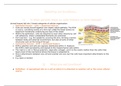
Δ Epithelial tissues – cells = dominant feature
Cells are closely bound together into sheets called epithelia. The ECM
is scarce, consisting mainly of a thin mat called the basal lamina (or
basement membrane) underlying one face of the sheet.
Within the epithelium, cells are attached to each other directly by cell-
cell adhesions, where cytoskeletal filaments are anchored.
Form barriers – e.g. the epidermis covering the skin, forming a barrier
between body and external environment, but also all sorts of other
structures such as the lining of the gut.
Δ Connective tissues – ECM = dominant feature
ECM is plentiful and cells are sparsely distributed within it. However,
the ECM is both secreted by and signals to the mesenchymal cells within.
The matrix is rich in fibrous polymers, especially collagen, and it is the matrix (rather than the cells) that
bears most of the mechanical stress the tissue is subjected to.
Direct attachments between one cell and another are rare, but the cells have important attachments to the
matrix.
E.g. bone or tendon
2) What are cell junctions?
Δ Definition : A specialised site on a cell at which it is attached to another cell or the extra cellular
matrix
, Δ All of these cell junction components were identified in the early days of electron microscopy (electron dense
so easy to see), creating a potential confusion because they were named because of their appearance under
the TEM, without knowledge of the underlying molecular basis.
Basis of cell-cell interactions is a homophilic mechanism – same =transmembrane receptor protein in the
plasma membrane of both cells that mediates cell-cell interaction
By contrast, cell-ECM interactions would involve heterophillic rather than homophilic mechanisms (different
protein receptors in the cell compared to the ECM)
3) What are the major types of cell junction and what are their
functions?
Cell junctions can be classified into 4 functional groups (each
with a different molecular basis):
Similar principle of recognition of partners - - either like-for-like in nearby
cells, or binding to ECM components.
Δ Anchoring junctions: transmit stresses and are tethered to
cytoskeletal filaments inside the cell. Link cells together or to the
ECM.
Actin filament attachment sites:
1. Adherens junctions – cell-cell junctions
2. Focal adhesions – cell-matrix junctions
Intermediate filament attachment sites:
1. Desmosomes – cell-cell junctions
2. Hemidesmosomes – cell-matrix junctions
Δ Occluding junctions: seal the gaps between cells in epithelia so as to make the cell sheet into an
impermeable (or selectively permeable) barrier. Also maintain cell polarity (distinction between apical and
basolateral surfaces).
1. Tight junctions (vertebrates)
2. Septate junctions (invertebrates)
1) In what general ways do cells interact to form tissues?
Animal tissues fall into 2 broad categories of cellular organisation:
Δ Epithelial tissues – cells = dominant feature
Cells are closely bound together into sheets called epithelia. The ECM
is scarce, consisting mainly of a thin mat called the basal lamina (or
basement membrane) underlying one face of the sheet.
Within the epithelium, cells are attached to each other directly by cell-
cell adhesions, where cytoskeletal filaments are anchored.
Form barriers – e.g. the epidermis covering the skin, forming a barrier
between body and external environment, but also all sorts of other
structures such as the lining of the gut.
Δ Connective tissues – ECM = dominant feature
ECM is plentiful and cells are sparsely distributed within it. However,
the ECM is both secreted by and signals to the mesenchymal cells within.
The matrix is rich in fibrous polymers, especially collagen, and it is the matrix (rather than the cells) that
bears most of the mechanical stress the tissue is subjected to.
Direct attachments between one cell and another are rare, but the cells have important attachments to the
matrix.
E.g. bone or tendon
2) What are cell junctions?
Δ Definition : A specialised site on a cell at which it is attached to another cell or the extra cellular
matrix
, Δ All of these cell junction components were identified in the early days of electron microscopy (electron dense
so easy to see), creating a potential confusion because they were named because of their appearance under
the TEM, without knowledge of the underlying molecular basis.
Basis of cell-cell interactions is a homophilic mechanism – same =transmembrane receptor protein in the
plasma membrane of both cells that mediates cell-cell interaction
By contrast, cell-ECM interactions would involve heterophillic rather than homophilic mechanisms (different
protein receptors in the cell compared to the ECM)
3) What are the major types of cell junction and what are their
functions?
Cell junctions can be classified into 4 functional groups (each
with a different molecular basis):
Similar principle of recognition of partners - - either like-for-like in nearby
cells, or binding to ECM components.
Δ Anchoring junctions: transmit stresses and are tethered to
cytoskeletal filaments inside the cell. Link cells together or to the
ECM.
Actin filament attachment sites:
1. Adherens junctions – cell-cell junctions
2. Focal adhesions – cell-matrix junctions
Intermediate filament attachment sites:
1. Desmosomes – cell-cell junctions
2. Hemidesmosomes – cell-matrix junctions
Δ Occluding junctions: seal the gaps between cells in epithelia so as to make the cell sheet into an
impermeable (or selectively permeable) barrier. Also maintain cell polarity (distinction between apical and
basolateral surfaces).
1. Tight junctions (vertebrates)
2. Septate junctions (invertebrates)