Long-Term Memory
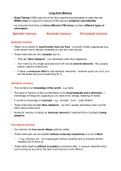
• Endel Tulving (1985) was one of the rst cognitive psychologists to state that the
MSM’s view on long-term memory (LTM) was too simplistic and in exible.
• He proposed that there are three di erent LTM stores contains di erent types of
information:
Episodic memory Semantic memory Procedural memory
Episodic memory:
• Refers to our ability to recall events from our lives - a record of daily happenings (e.g.
most recent visit to dentist, breakfast you ate this morning etc).
• These memories are very complex due to:
- They are ‘time-stamped’ - you remember when they happened.
- Your memory of a single episode/event will include several elements - like: people,
places, objects, behaviours.
- It takes a conscious e ort to real episodic memories - however quick you do it, you
are still aware that you’re searching for it.
Semantic memory:
• This contains our knowledge of the world - e.g. facts.
• This type of memory is like a combination of an encyclopaedia and a dictionary →
knowledge of things like: applying to uni, taste of an orange, meaning of words.
• It contains knowledge of concepts - e.g. ‘animals’, ‘love’, ‘Justin Bieber’.
• These memories are not ‘time-stamped’ - we don’t usually remember when we rst
learnt about these facts.
• Semantic memory contains an immense amount of material that is constantly being
added to.
Procedural memory:
• Our memory for how we do things (actions, skills).
• These memories can be recalled without conscious awareness or a lot of e ort.
• → e.g. driving a car - we change gear without recalling how or indicate without
realising we’ve done so.
• These skills might be di cult to explain to someone else - if trying to describe what
you’re doing as you drive, the task could become more di cult.
ffffi fffi ffi fffl ff fi
• Endel Tulving (1985) was one of the rst cognitive psychologists to state that the
MSM’s view on long-term memory (LTM) was too simplistic and in exible.
• He proposed that there are three di erent LTM stores contains di erent types of
information:
Episodic memory Semantic memory Procedural memory
Episodic memory:
• Refers to our ability to recall events from our lives - a record of daily happenings (e.g.
most recent visit to dentist, breakfast you ate this morning etc).
• These memories are very complex due to:
- They are ‘time-stamped’ - you remember when they happened.
- Your memory of a single episode/event will include several elements - like: people,
places, objects, behaviours.
- It takes a conscious e ort to real episodic memories - however quick you do it, you
are still aware that you’re searching for it.
Semantic memory:
• This contains our knowledge of the world - e.g. facts.
• This type of memory is like a combination of an encyclopaedia and a dictionary →
knowledge of things like: applying to uni, taste of an orange, meaning of words.
• It contains knowledge of concepts - e.g. ‘animals’, ‘love’, ‘Justin Bieber’.
• These memories are not ‘time-stamped’ - we don’t usually remember when we rst
learnt about these facts.
• Semantic memory contains an immense amount of material that is constantly being
added to.
Procedural memory:
• Our memory for how we do things (actions, skills).
• These memories can be recalled without conscious awareness or a lot of e ort.
• → e.g. driving a car - we change gear without recalling how or indicate without
realising we’ve done so.
• These skills might be di cult to explain to someone else - if trying to describe what
you’re doing as you drive, the task could become more di cult.
ffffi fffi ffi fffl ff fi