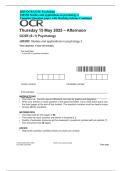
‘No ‘vale of soul making’ can justify the extent of evil and suffering we see in
the world today.’ Discuss.
The value of soul-making was proposed by an English philosopher named
John Hick. He argues that God left the world deliberately unfinished to ensure
that humans with free will would train themselves to grow into the likeness of
God. He argues that we are spiritually immature and need to act in ways to
grow into the likeness of God. However, Whether this world left undone to
make/build our soul was a good choice by an omniscient God, or if the evil
and suffering that came about cannot justify the choice will be discussed in
this essay. I believe that idea of the ‘vale of soul making’ theodicy is just not
convincing enough to justify the extent of evil and suffering we see in this
world today.
The soul-making theodicy argues that this world is where your soul is made to
develop and grow into the likeness of God: becoming good. The idea is
supported by the biblical quote “let us make man in our image, in our likeness”.
Now, this can only be made possible with free will which essentially is the idea
that we are not God’s little pets and he is not our owner. We have the option of
trying to become like God or doing bad (moral evil). Hick argued that God had
to give us free will because love has to be earned not forced. This argument
can be seen as logically accurate as humans do have that choice of doing
good or bad. It also persuasively shows that God is omnibenevolent in the
sense that we were not created like robots but have a choice. Therefore, this
freedom crucially presented in the ‘vale of soul making’ can justify the extent
of suffering and evil we see today as it explains that we choose what to do with
our actions. We are solely responsible not God, for the bad actions that we see
in the world today. However, as an omniscient God, shouldn't one know that
some humans would still choose to do bad? This convincingly criticises the
idea of a ‘vale of soul-making’ justifying evil and suffering as God creating the
world undone could be seen, in some ways, as setting it up to be filled with evil.
God would have known that people would use their freedom to choose selfish
actions resulting in moral evil. This is significant as it shows how God may have
deliberately ignored this outcome and let evil and suffering continue. Thus,
the idea of a ‘vale of soul making’ does not justify the extent of evil and
suffering in the world today.
The argument to which ‘the extent of evil and suffering’ can be justified by the
soul-making theodicy can be raised up for debate. Dostoevsky disagrees with
Hick’s ‘vale of soul making’ theodicy as he argues “that the price to pay for our
freedom is too high”. He uses a story about a boy who was punished by
getting mauled by hunting dogs after one of the dogs, who was playing with
the little boy, broke their leg. The hunting dog couldn't fulfil their job and was
seen as useless which justified the Master’s evil punishment. Also, recently an
18-year-old boy entered an elementary school in texas and shot 19 children
and two adults. Both these events can be described as truly evil and caused
immense suffering to the loved ones of the victims. This successfully points out
the flaws of a ‘vale of soul making’ world as these people who have committed
these horrendous acts have not grown or trained to become the likeness of
the world today.’ Discuss.
The value of soul-making was proposed by an English philosopher named
John Hick. He argues that God left the world deliberately unfinished to ensure
that humans with free will would train themselves to grow into the likeness of
God. He argues that we are spiritually immature and need to act in ways to
grow into the likeness of God. However, Whether this world left undone to
make/build our soul was a good choice by an omniscient God, or if the evil
and suffering that came about cannot justify the choice will be discussed in
this essay. I believe that idea of the ‘vale of soul making’ theodicy is just not
convincing enough to justify the extent of evil and suffering we see in this
world today.
The soul-making theodicy argues that this world is where your soul is made to
develop and grow into the likeness of God: becoming good. The idea is
supported by the biblical quote “let us make man in our image, in our likeness”.
Now, this can only be made possible with free will which essentially is the idea
that we are not God’s little pets and he is not our owner. We have the option of
trying to become like God or doing bad (moral evil). Hick argued that God had
to give us free will because love has to be earned not forced. This argument
can be seen as logically accurate as humans do have that choice of doing
good or bad. It also persuasively shows that God is omnibenevolent in the
sense that we were not created like robots but have a choice. Therefore, this
freedom crucially presented in the ‘vale of soul making’ can justify the extent
of suffering and evil we see today as it explains that we choose what to do with
our actions. We are solely responsible not God, for the bad actions that we see
in the world today. However, as an omniscient God, shouldn't one know that
some humans would still choose to do bad? This convincingly criticises the
idea of a ‘vale of soul-making’ justifying evil and suffering as God creating the
world undone could be seen, in some ways, as setting it up to be filled with evil.
God would have known that people would use their freedom to choose selfish
actions resulting in moral evil. This is significant as it shows how God may have
deliberately ignored this outcome and let evil and suffering continue. Thus,
the idea of a ‘vale of soul making’ does not justify the extent of evil and
suffering in the world today.
The argument to which ‘the extent of evil and suffering’ can be justified by the
soul-making theodicy can be raised up for debate. Dostoevsky disagrees with
Hick’s ‘vale of soul making’ theodicy as he argues “that the price to pay for our
freedom is too high”. He uses a story about a boy who was punished by
getting mauled by hunting dogs after one of the dogs, who was playing with
the little boy, broke their leg. The hunting dog couldn't fulfil their job and was
seen as useless which justified the Master’s evil punishment. Also, recently an
18-year-old boy entered an elementary school in texas and shot 19 children
and two adults. Both these events can be described as truly evil and caused
immense suffering to the loved ones of the victims. This successfully points out
the flaws of a ‘vale of soul making’ world as these people who have committed
these horrendous acts have not grown or trained to become the likeness of