Taylor’s Notes Further Organic Summary Page
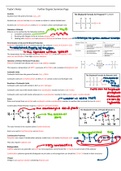
Alcohols The Displayed Formula for Propanol C3H7OH
Alcohols have the general formula CnH2n+1OH
Alcohols are saturated as they do not contain a carbon to carbon double bond
Alcohols are not hydrocarbons as they do not contain carbon and hydrogen only
Oxidation of Ethanol
Ethanol can be oxidised by the following methods:
1. Complete combustion
2. Reacting with Oxygen in the air to form ethanoic acid
3. Heating with sulphuric acid and potassium dichromate to form ethanoic acid
Fermentation of Glucose Ethanol Production
Anaerobic respiration of yeast converts glucose into ethanol: C6H12O6 2C2H5OH + 2CO2
The enzymes in the yeast catalyse this reaction
The temperature for this reaction should be more than 35°C, it too low enzymes in the
yeast are not effective, if too high enzymes denature
Hydration of Ethene Ethanol Production
Ethanol is formed from ethene and steam in an addition reaction
This requires a temperature of 300°C, a pressure of 60-70atm and a catalyst of phosphoric acid
Carboxylic Acids
Carboxylic Acids have the general formula CnH2n+1COOH The Displayed Formula for Butanoic Acid:
Carboxylic acids are not hydrocarbons as they do not contain carbon and hydrogen only
Reactions of Carboxylic Acids
Carboxylic acids react with metals to form a salt + hydrogen
Carboxylic acids react with metals oxides in a neutralisation reaction to form a salt + water
Carboxylic acids react with metal carbonates in a neutralisation reaction to form a salt + water + carbon dioxide
Esters
Esters are formed from an alcohol and a carboxylic acid in a condensation reaction (a reaction that involved the loss of water)
Condensation Polymerisation requires a sulphuric acid (acid catalyst)
The Displayed Formula of Propyl Ethanoate is
The ester formed in the reaction above is ethyl ethanoate
Esters are used in food flavourings and perfumes
Condensation Polymers
Polyesters are a type of condensation polymer made from a diol and a dicarboxylic acid
They also require sulphuric acid
Biodegradable
Addition polymers are generally very inert as microorganisms cannot break the C-C bonds in each strand of the polymer
Condensation polymers generally biodegrade much easier as microorganisms can break the C-O or C-N bonds in their structures
Vinegar
Vinegar is an aqueous solution containing ethanoic acid
Alcohols The Displayed Formula for Propanol C3H7OH
Alcohols have the general formula CnH2n+1OH
Alcohols are saturated as they do not contain a carbon to carbon double bond
Alcohols are not hydrocarbons as they do not contain carbon and hydrogen only
Oxidation of Ethanol
Ethanol can be oxidised by the following methods:
1. Complete combustion
2. Reacting with Oxygen in the air to form ethanoic acid
3. Heating with sulphuric acid and potassium dichromate to form ethanoic acid
Fermentation of Glucose Ethanol Production
Anaerobic respiration of yeast converts glucose into ethanol: C6H12O6 2C2H5OH + 2CO2
The enzymes in the yeast catalyse this reaction
The temperature for this reaction should be more than 35°C, it too low enzymes in the
yeast are not effective, if too high enzymes denature
Hydration of Ethene Ethanol Production
Ethanol is formed from ethene and steam in an addition reaction
This requires a temperature of 300°C, a pressure of 60-70atm and a catalyst of phosphoric acid
Carboxylic Acids
Carboxylic Acids have the general formula CnH2n+1COOH The Displayed Formula for Butanoic Acid:
Carboxylic acids are not hydrocarbons as they do not contain carbon and hydrogen only
Reactions of Carboxylic Acids
Carboxylic acids react with metals to form a salt + hydrogen
Carboxylic acids react with metals oxides in a neutralisation reaction to form a salt + water
Carboxylic acids react with metal carbonates in a neutralisation reaction to form a salt + water + carbon dioxide
Esters
Esters are formed from an alcohol and a carboxylic acid in a condensation reaction (a reaction that involved the loss of water)
Condensation Polymerisation requires a sulphuric acid (acid catalyst)
The Displayed Formula of Propyl Ethanoate is
The ester formed in the reaction above is ethyl ethanoate
Esters are used in food flavourings and perfumes
Condensation Polymers
Polyesters are a type of condensation polymer made from a diol and a dicarboxylic acid
They also require sulphuric acid
Biodegradable
Addition polymers are generally very inert as microorganisms cannot break the C-C bonds in each strand of the polymer
Condensation polymers generally biodegrade much easier as microorganisms can break the C-O or C-N bonds in their structures
Vinegar
Vinegar is an aqueous solution containing ethanoic acid