30.10.19
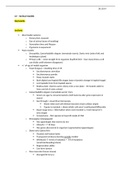
L4 – Animal models
Keywords:
Lecture:
Ideal model systems:
o Money (fed, cleaned)
o Size of animal (ease of handling)
o Generation time and lifespan
o If genome is sequenced
Main models
o Drosophila, Caenorhabditis elegans (nematode worm), Danio rerio (zebra fish) and
Arabidopsis (plant)
o Primary cells – come straight from organism (hayflick limit – how many times a cell
can divide until telomere disappears)
+/- of egs of model organism
o Yeast (fungus) = doubling time of 3h
Saccharomyces cerevisiae
Saccharomyces pombe
Many mutant stains
Both diploid and haploid life stages (ease of protein change in haploid stage)
a/α haploids form from haploid spores
Replica plate- impress same colony onto a new plate – ID mutants (able to
have control of same colony)
o Caenorhabditis elegans (nematode worm) 1mm
Grown on agar & consume bacteria (GM bacteria alter gene expression in
worm)
See through = visual ID w/microscopy
Shows what each cell division becomes (track cellular origin)
If gene is mutated = shows which cells aren’t synthesized/differently
Dauer stage larva = hibernation when overcrowded/↓ food instead of 4
larva stages
Connectome – first species to have EM made of CNS
o Drosopgila melangogaster
Has appendages that worms do not
Lifecycle = 7-10 days
Hox genes discovered in organism (segmentation/appendages)
o Danio rerio (zebra fish)
Cleaned and heated tanks
Transparent embryos develop outside mother
Withstand ↑ levels of radiation = ↑# of mutations
(viral/interbreeding/chem)
Regeneration ability
Can form tumors
o Mus musculus (house mouse)
Diverged 80 mil y/a
L4 – Animal models
Keywords:
Lecture:
Ideal model systems:
o Money (fed, cleaned)
o Size of animal (ease of handling)
o Generation time and lifespan
o If genome is sequenced
Main models
o Drosophila, Caenorhabditis elegans (nematode worm), Danio rerio (zebra fish) and
Arabidopsis (plant)
o Primary cells – come straight from organism (hayflick limit – how many times a cell
can divide until telomere disappears)
+/- of egs of model organism
o Yeast (fungus) = doubling time of 3h
Saccharomyces cerevisiae
Saccharomyces pombe
Many mutant stains
Both diploid and haploid life stages (ease of protein change in haploid stage)
a/α haploids form from haploid spores
Replica plate- impress same colony onto a new plate – ID mutants (able to
have control of same colony)
o Caenorhabditis elegans (nematode worm) 1mm
Grown on agar & consume bacteria (GM bacteria alter gene expression in
worm)
See through = visual ID w/microscopy
Shows what each cell division becomes (track cellular origin)
If gene is mutated = shows which cells aren’t synthesized/differently
Dauer stage larva = hibernation when overcrowded/↓ food instead of 4
larva stages
Connectome – first species to have EM made of CNS
o Drosopgila melangogaster
Has appendages that worms do not
Lifecycle = 7-10 days
Hox genes discovered in organism (segmentation/appendages)
o Danio rerio (zebra fish)
Cleaned and heated tanks
Transparent embryos develop outside mother
Withstand ↑ levels of radiation = ↑# of mutations
(viral/interbreeding/chem)
Regeneration ability
Can form tumors
o Mus musculus (house mouse)
Diverged 80 mil y/a