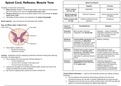
Spinal Cord, Reflexes, Muscle Tone Spinal Cord Nuclei
Supplies Function
Formation of dorsal and ventral roots
● Motor neurons develop in the basal plate region. Axons grow out of the anterior Phrenic nucleus Diaphragm Breathing
part of the spinal cord to form the ventral spinal nerve roots (C3, C4, C5)
● Sensory neurons grow into the posterior aspect of the cord, forming the dorsal
Spinal Accessory SCM and Trapezius Head turning and shoulder
spinal nerve roots Nucleus (C5, C6) shrugging
● Cell bodies of these neurons are contained in the dorsal root ganglia
Onuf’s nucleus (S2, External urethral and anal Continence
Spinal segment : area of the spinal cord associated with vertebra S3, S4) sphincter
Gray and White matter in Spinal Cord
Types of Coordinated by: Example
movement
Voluntary Most complex movement Speaking → highly coordinated
Movement Originates in the frontal lobe sequential contractions of muscles
in the larynx, tongue, thoracic
cage, and diaphragm
Rhythmic Central pattern generators and Walking, breathing
Movement maintained by subcortical
structures (eg. brainstem, spinal
cord) with no contribution from
the cerebral hemispheres/cortex
● Gray matter is divided into :
○ Dorsal horn (sensory) Reflexive Simplest type of motor response Some reflexes are more
○ Ventral horn (motor) Movement Consists of a sensory nerve, complicated than others and
interneuron, and motor nerve involves multiple nerve cells over
They are rapid/autonomic several spinal segments or involve
Laminae : longitudinal columns supplying a particular functional muscle group spanning responses to a particular sensory both sides of the body (limb
more than one spinal segment stimuli withdrawal reflex)
● This is divided into zones (laminae of Rexed) labeled I-X
○ I-VI from dorsal horn Postural Descending (reticulospinal) Autonomic responses to
○ VII and X form mid-region of the spinal cord Movement projections from the brainstem unexpected changes in bodily
○ VIII and IX form the anterior horn to the spinal cord position (which are detected by
vestibular apparatus and
● Laminae are arranged so innervating axial/limb girdle muscles are close to the proprioceptors) to help keep the
midline and distal limb muscles are lateral center of gravity to prevent falls
● Eg. Neurons supplying flexor groups are closer to dorsal horn
Central Pattern Generators → used for semi-automatic actions (eg. walking, chewing,
breathing)
● Can be selected and recruited by descending projections from the brain
(command neurons) but are able to operate independently and autonomously
● Projections from the brain can be used to modify activity in the CPG and alter the
patterns of movement generated (eg. different gait patterns)
, 2 predominant cell types in the cerebellum
Cerebellum 1. Purkinje Cells : huge neurons with dendritic tree on a single plane (not 3D)
*The cerebellum doesn’t generate movement. 2. Granule cells : abundant cell type
Why does cerebellar damage cause clumsiness and poor coordination? Because Cerebellar outputs follow one pathway :
the cerebellum gathers information and ‘advises’ motor areas of the frontal lobe to 1. Purkinje cells send inhibitory (GABAergic) neurons to deep cerebellar cells
improve smoothness, precision, and coordination of movements 2. Deep cerebellar cells send out excitatory (Glutaminergic) neurons to the
thalamus
The cerebellum can coordinate rapid, on-line refinement of ballistic movements (eg. 3. Thalamic cells send axons to the cerebral cortex along with the vestibular
returning a serve in tennis). How does it do this? nucleus/reticular formation
1. Feedback comparator 2 excitatory inputs go to the cerebellar Purkinje cells
● Cerebral cortex send information about the intended movements down the spine
Parallel Fibers : fibers from granule cells Climbing Fibers : fibers that climb
via alpha-MNs to move a muscle perpendicular to the Purkinje dendritic around Purkinje cell axons and wrap
● Simultaneously, the cerebellum receives sensory information (from tree (running from cerebral cortex to around the cell body
visual/auditory systems and proprioceptors) inferior olive)
● The cerebellum compares the two information and looks for discrepancies to
ultimately send efferent ‘error signals’ to the frontal lobe to correct its movement 1 million parallel fibers per Purkinje Cell 1 climbing fiber per Purkinje cell
● However, it is too slow to work for rapid, ballistic movements
Each synapse 1-2 times with Purkinje cell This fiber synapses with the purkinje cell
multiple times
2. Feed-forward Comparator
● Cerebral cortex sends a copy of APs to the muscle and cerebellum Many parallel fibers activating the Purkinje Activation of one climibc fiber can activate
● Cerebellum contains a map of muscles/joints of the body, which can then tree are needed to fire an AP Purkinje tree to fire an AP
compare it to the APs before the action is carried out
● Cerebellum can signal back to the cerebral cortex to correct the action before it Cerebellar learning → when someone does an action, the cortex sends impulses along
has begun to correct its movement parallel fibers to the cerebellum, activating Purkinje cells
1. If the action is unsuccessful → only parallel fiber stimulation goes to cerebellum
The Cerebellum has 3 functional domains 2. If the action is successful → limbic system is activated, giving a sense of reward.
1. Spino-cerebellum : modulates descending motor systems in the brainstem This also activates climbing fibers from the inferior olive, which stimulates both
2. Vestibulo-cerebellum : regulates balance and eye movements Purkinje and parallel fibers
3. Cerebro-cerebellum : involved in high level planning of movement and
regulation of motor programs 3 Cerebellar lesion symptoms
1. Hypotonia : uncoordinated muscle contraction
Cerebro-cerebellar pathway 2. Postural ataxia : can’t keep stable posture (ie. swaying)
1. Corticopontine fibers project from the cerebral 3. Intention (action) tremor : overshooting/oscillating
cortex to the basilar pons where they synapse with voluntary movement (ie. finger to nose)
pontocerebellar fibers
2. Pontocerebellar fibers project to the cerebellum What happens physically with damage to the basal ganglia?
3. Purkinje cell axons project from the cerebellum and Involuntary/slowed muscle movement, muscle rigidity/spasms
synapse at the dentate nucleus (Parkinson’s), emotional/cognitive/behavioral dysfunction
4. Fibers from the dentate nucleus synapse with
ventrolateral thalamic nucleus Pyramidal Weakness : weakness that spares the antigravity muscles (UMN syndrome)
5. These fibers then project back to the cerebral and the brain can’t dampen down antagonist muscles via interneurons
cortex
Supplies Function
Formation of dorsal and ventral roots
● Motor neurons develop in the basal plate region. Axons grow out of the anterior Phrenic nucleus Diaphragm Breathing
part of the spinal cord to form the ventral spinal nerve roots (C3, C4, C5)
● Sensory neurons grow into the posterior aspect of the cord, forming the dorsal
Spinal Accessory SCM and Trapezius Head turning and shoulder
spinal nerve roots Nucleus (C5, C6) shrugging
● Cell bodies of these neurons are contained in the dorsal root ganglia
Onuf’s nucleus (S2, External urethral and anal Continence
Spinal segment : area of the spinal cord associated with vertebra S3, S4) sphincter
Gray and White matter in Spinal Cord
Types of Coordinated by: Example
movement
Voluntary Most complex movement Speaking → highly coordinated
Movement Originates in the frontal lobe sequential contractions of muscles
in the larynx, tongue, thoracic
cage, and diaphragm
Rhythmic Central pattern generators and Walking, breathing
Movement maintained by subcortical
structures (eg. brainstem, spinal
cord) with no contribution from
the cerebral hemispheres/cortex
● Gray matter is divided into :
○ Dorsal horn (sensory) Reflexive Simplest type of motor response Some reflexes are more
○ Ventral horn (motor) Movement Consists of a sensory nerve, complicated than others and
interneuron, and motor nerve involves multiple nerve cells over
They are rapid/autonomic several spinal segments or involve
Laminae : longitudinal columns supplying a particular functional muscle group spanning responses to a particular sensory both sides of the body (limb
more than one spinal segment stimuli withdrawal reflex)
● This is divided into zones (laminae of Rexed) labeled I-X
○ I-VI from dorsal horn Postural Descending (reticulospinal) Autonomic responses to
○ VII and X form mid-region of the spinal cord Movement projections from the brainstem unexpected changes in bodily
○ VIII and IX form the anterior horn to the spinal cord position (which are detected by
vestibular apparatus and
● Laminae are arranged so innervating axial/limb girdle muscles are close to the proprioceptors) to help keep the
midline and distal limb muscles are lateral center of gravity to prevent falls
● Eg. Neurons supplying flexor groups are closer to dorsal horn
Central Pattern Generators → used for semi-automatic actions (eg. walking, chewing,
breathing)
● Can be selected and recruited by descending projections from the brain
(command neurons) but are able to operate independently and autonomously
● Projections from the brain can be used to modify activity in the CPG and alter the
patterns of movement generated (eg. different gait patterns)
, 2 predominant cell types in the cerebellum
Cerebellum 1. Purkinje Cells : huge neurons with dendritic tree on a single plane (not 3D)
*The cerebellum doesn’t generate movement. 2. Granule cells : abundant cell type
Why does cerebellar damage cause clumsiness and poor coordination? Because Cerebellar outputs follow one pathway :
the cerebellum gathers information and ‘advises’ motor areas of the frontal lobe to 1. Purkinje cells send inhibitory (GABAergic) neurons to deep cerebellar cells
improve smoothness, precision, and coordination of movements 2. Deep cerebellar cells send out excitatory (Glutaminergic) neurons to the
thalamus
The cerebellum can coordinate rapid, on-line refinement of ballistic movements (eg. 3. Thalamic cells send axons to the cerebral cortex along with the vestibular
returning a serve in tennis). How does it do this? nucleus/reticular formation
1. Feedback comparator 2 excitatory inputs go to the cerebellar Purkinje cells
● Cerebral cortex send information about the intended movements down the spine
Parallel Fibers : fibers from granule cells Climbing Fibers : fibers that climb
via alpha-MNs to move a muscle perpendicular to the Purkinje dendritic around Purkinje cell axons and wrap
● Simultaneously, the cerebellum receives sensory information (from tree (running from cerebral cortex to around the cell body
visual/auditory systems and proprioceptors) inferior olive)
● The cerebellum compares the two information and looks for discrepancies to
ultimately send efferent ‘error signals’ to the frontal lobe to correct its movement 1 million parallel fibers per Purkinje Cell 1 climbing fiber per Purkinje cell
● However, it is too slow to work for rapid, ballistic movements
Each synapse 1-2 times with Purkinje cell This fiber synapses with the purkinje cell
multiple times
2. Feed-forward Comparator
● Cerebral cortex sends a copy of APs to the muscle and cerebellum Many parallel fibers activating the Purkinje Activation of one climibc fiber can activate
● Cerebellum contains a map of muscles/joints of the body, which can then tree are needed to fire an AP Purkinje tree to fire an AP
compare it to the APs before the action is carried out
● Cerebellum can signal back to the cerebral cortex to correct the action before it Cerebellar learning → when someone does an action, the cortex sends impulses along
has begun to correct its movement parallel fibers to the cerebellum, activating Purkinje cells
1. If the action is unsuccessful → only parallel fiber stimulation goes to cerebellum
The Cerebellum has 3 functional domains 2. If the action is successful → limbic system is activated, giving a sense of reward.
1. Spino-cerebellum : modulates descending motor systems in the brainstem This also activates climbing fibers from the inferior olive, which stimulates both
2. Vestibulo-cerebellum : regulates balance and eye movements Purkinje and parallel fibers
3. Cerebro-cerebellum : involved in high level planning of movement and
regulation of motor programs 3 Cerebellar lesion symptoms
1. Hypotonia : uncoordinated muscle contraction
Cerebro-cerebellar pathway 2. Postural ataxia : can’t keep stable posture (ie. swaying)
1. Corticopontine fibers project from the cerebral 3. Intention (action) tremor : overshooting/oscillating
cortex to the basilar pons where they synapse with voluntary movement (ie. finger to nose)
pontocerebellar fibers
2. Pontocerebellar fibers project to the cerebellum What happens physically with damage to the basal ganglia?
3. Purkinje cell axons project from the cerebellum and Involuntary/slowed muscle movement, muscle rigidity/spasms
synapse at the dentate nucleus (Parkinson’s), emotional/cognitive/behavioral dysfunction
4. Fibers from the dentate nucleus synapse with
ventrolateral thalamic nucleus Pyramidal Weakness : weakness that spares the antigravity muscles (UMN syndrome)
5. These fibers then project back to the cerebral and the brain can’t dampen down antagonist muscles via interneurons
cortex