2. Education
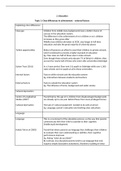
Topic 1: Class differences in achievement – external factors
Explaining class differences
Class gap Children from middle-class backgrounds have a better chance of
success in the education system.
The difference in the achievement of m/c children vs w/c children
increases as they grow older
Middle-class children do better at GCSE, stay longer in full-time
education and take the great majority of university places
Tuition opportunities Better-off parents can afford to send their children to private schools,
which is believed to provide a higher standard of education
Eg. Class sizes are half of those seen in state schools
Even though these schools only educate 7% of Britain’s children, they
account for nearly half of those who enter elite universities (Oxbridge)
Sutton Trust (2011) In a 3-year period, Eton sent 211 pupils to Oxbridge while over 1,300
state schools sent no pupils at all to these universities
Internal factors Factors within schools and the education system
Eg. Interactions between students and teachers
External factors Factors outside the education system
Eg. The influence of home, background and wider society
Cultural deprivation
Centre of Longitudinal Found that by the age of 3, children from disadvantaged backgrounds
Studies (2007) are already up to one year behind those from more privileged homes
Cultural deprivation The lack of ‘cultural equipment’ needed to do well at school
Eg. Language, parent’s education and working-class subculture
Language
Language This is a crucial part of the education process, so the way that parents
communicate with their child is essential to their cognitive
(intellectual) development
Hubbs-Tait et al (2002) Found that where parents use language that challenges their children
to evaluate their own understanding or abilities, their cognitive
performance improves
Eg. Asking “what do you think?”
By contrast, less educated parents tend to use language that only
requires simple descriptive statements, therefore resulting in lower
, performance
Eg. Asking “what’s this animal called?”
Feinstein (2008) Found that educated parents are more inclined to use challenging
language with their child
They are also more likely to praise their children which encourages
their child to develop their own sense of competence
Bereiter and Engelmann They claim that the language used in lower-class homes is deficient
(1966) Eg. Communicating by gestures, single words or disjointed phrases
Result Children fail to develop the necessary language skills.
They grow up incapable of abstract thinking and unable to use
language to explain, describe, enquire or compare – thus making them
unable to take advantage of the opportunities that school offers
Speech Codes
Bernstein (1975) Identifies the differences between w/c and m/c language that
influences achievement
He distinguishes 2 types of speech code – restricted and elaborated
The restricted code Typically used by the working-class
It has a limited vocabulary and is based on the use of short, unfinished,
grammatically simple sentences. Also, it is context-bound meaning the
speaker assumes the listener shares the same experiences.
The elaborated code Typically used by the middle-class
It has a wider vocabulary and is based on longer, grammatically
complex sentences. Also, it is context-free meaning the speaker does
not assume shared experiences of the listener but utilises language to
explicitly outline meanings.
Result The differences in speech codes give the middle-class children an
advantage at school because the elaborated code is featured in the
classroom.
Eg. By teachers, in textbooks and crucially the exams
For this reason, it is understood to be the ‘correct’ way to
communicate and a more effective tool for proper reasoning
Early socialisation into the elaborated speech code means that middle-
class students are already fluent when they start school, unlike
working-class peers who then are excluded/delayed in educational
success.
Critics Critics of the theory suggest Bernstein is a cultural deprivation theorist,
suggesting he ignores other factors.
However, Bernstein acknowledges the impact of both internal and
external factors. His main view however is that the education system is
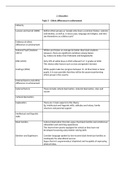
Topic 1: Class differences in achievement – external factors
Explaining class differences
Class gap Children from middle-class backgrounds have a better chance of
success in the education system.
The difference in the achievement of m/c children vs w/c children
increases as they grow older
Middle-class children do better at GCSE, stay longer in full-time
education and take the great majority of university places
Tuition opportunities Better-off parents can afford to send their children to private schools,
which is believed to provide a higher standard of education
Eg. Class sizes are half of those seen in state schools
Even though these schools only educate 7% of Britain’s children, they
account for nearly half of those who enter elite universities (Oxbridge)
Sutton Trust (2011) In a 3-year period, Eton sent 211 pupils to Oxbridge while over 1,300
state schools sent no pupils at all to these universities
Internal factors Factors within schools and the education system
Eg. Interactions between students and teachers
External factors Factors outside the education system
Eg. The influence of home, background and wider society
Cultural deprivation
Centre of Longitudinal Found that by the age of 3, children from disadvantaged backgrounds
Studies (2007) are already up to one year behind those from more privileged homes
Cultural deprivation The lack of ‘cultural equipment’ needed to do well at school
Eg. Language, parent’s education and working-class subculture
Language
Language This is a crucial part of the education process, so the way that parents
communicate with their child is essential to their cognitive
(intellectual) development
Hubbs-Tait et al (2002) Found that where parents use language that challenges their children
to evaluate their own understanding or abilities, their cognitive
performance improves
Eg. Asking “what do you think?”
By contrast, less educated parents tend to use language that only
requires simple descriptive statements, therefore resulting in lower
, performance
Eg. Asking “what’s this animal called?”
Feinstein (2008) Found that educated parents are more inclined to use challenging
language with their child
They are also more likely to praise their children which encourages
their child to develop their own sense of competence
Bereiter and Engelmann They claim that the language used in lower-class homes is deficient
(1966) Eg. Communicating by gestures, single words or disjointed phrases
Result Children fail to develop the necessary language skills.
They grow up incapable of abstract thinking and unable to use
language to explain, describe, enquire or compare – thus making them
unable to take advantage of the opportunities that school offers
Speech Codes
Bernstein (1975) Identifies the differences between w/c and m/c language that
influences achievement
He distinguishes 2 types of speech code – restricted and elaborated
The restricted code Typically used by the working-class
It has a limited vocabulary and is based on the use of short, unfinished,
grammatically simple sentences. Also, it is context-bound meaning the
speaker assumes the listener shares the same experiences.
The elaborated code Typically used by the middle-class
It has a wider vocabulary and is based on longer, grammatically
complex sentences. Also, it is context-free meaning the speaker does
not assume shared experiences of the listener but utilises language to
explicitly outline meanings.
Result The differences in speech codes give the middle-class children an
advantage at school because the elaborated code is featured in the
classroom.
Eg. By teachers, in textbooks and crucially the exams
For this reason, it is understood to be the ‘correct’ way to
communicate and a more effective tool for proper reasoning
Early socialisation into the elaborated speech code means that middle-
class students are already fluent when they start school, unlike
working-class peers who then are excluded/delayed in educational
success.
Critics Critics of the theory suggest Bernstein is a cultural deprivation theorist,
suggesting he ignores other factors.
However, Bernstein acknowledges the impact of both internal and
external factors. His main view however is that the education system is