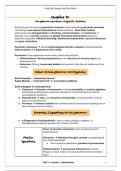
19.1 POPULATIONS IN ECOSYSTEMS
Sunday, 13 February 2022
13:54
Habitat - Place where an organism normally lives.
Population - Group of individuals of the same species which occupy the same habitat
at a given time.
Community - All the populations of different species living in a habitat at a given
time.
Ecological niche - How an organism fits into the habitat.
Ecosystem - A dynamic system made up of a community and all the non-living
components of its environment.
19.2 VARIATION IN POPULATION SIZE
Sunday, 13 February 2022
14:27
Population size is the total number of individuals of one species in a habitat.
Biotic factors - Living factors.
Abiotic factors - Non-living factors.
Populations cannot continue to grow indefinitely because factors, such as food
availability, will limit growth as population size increases.
● Eventually there will become limiting factors, limiting population size.
Carrying capacity - The size of a population an ecosystem can support and be
sustained over a long period of time.
● Can vary and be influenced as a result of abiotic factors and biotic factors, like
competition or predation.
The abiotic factors that influence the size of the population are:
● Temperature - Each species has a different optimum temperature. Body
temperature, enzymes.
● Light - Photosynthesis, source of energy for most ecosystems, more light,
greater carrying capacity for plants, therefore greater carrying capacity for
animals which feed on plants.
● pH - Enzymes have optimum pH, area with appropriate pH, all enzymes can
function.
● Water & humidity - Xerophytes, transpiration, adaptations.
, 19.3 COMPETITION
Sunday, 13 February 2022
15:53
Intraspecific competition - Individuals of the same species compete for resources.
The availability of these resources determine the size of the population.
Population increases when resources are plentiful.
● There will therefore be more organisms competing for the same amount of
resources, such as space and food. More intraspecific competition.
● The resources become limiting, resulting in the population decreasing.
● As population is smaller, less competition for resources, allowing population
to grow again.
Interspecific competition - Individuals of different species compete for resources.
Resources for both populations are reduced and so both population sizes will be
limited.
One species may have a competitive advantage over the other.
● The population size of this species will increase, and the other will decrease.
● If the conditions remain the same, it'll lead to the removal of the less adapted
species.
● Competitive exclusion principle.
Sunday, 13 February 2022
13:54
Habitat - Place where an organism normally lives.
Population - Group of individuals of the same species which occupy the same habitat
at a given time.
Community - All the populations of different species living in a habitat at a given
time.
Ecological niche - How an organism fits into the habitat.
Ecosystem - A dynamic system made up of a community and all the non-living
components of its environment.
19.2 VARIATION IN POPULATION SIZE
Sunday, 13 February 2022
14:27
Population size is the total number of individuals of one species in a habitat.
Biotic factors - Living factors.
Abiotic factors - Non-living factors.
Populations cannot continue to grow indefinitely because factors, such as food
availability, will limit growth as population size increases.
● Eventually there will become limiting factors, limiting population size.
Carrying capacity - The size of a population an ecosystem can support and be
sustained over a long period of time.
● Can vary and be influenced as a result of abiotic factors and biotic factors, like
competition or predation.
The abiotic factors that influence the size of the population are:
● Temperature - Each species has a different optimum temperature. Body
temperature, enzymes.
● Light - Photosynthesis, source of energy for most ecosystems, more light,
greater carrying capacity for plants, therefore greater carrying capacity for
animals which feed on plants.
● pH - Enzymes have optimum pH, area with appropriate pH, all enzymes can
function.
● Water & humidity - Xerophytes, transpiration, adaptations.
, 19.3 COMPETITION
Sunday, 13 February 2022
15:53
Intraspecific competition - Individuals of the same species compete for resources.
The availability of these resources determine the size of the population.
Population increases when resources are plentiful.
● There will therefore be more organisms competing for the same amount of
resources, such as space and food. More intraspecific competition.
● The resources become limiting, resulting in the population decreasing.
● As population is smaller, less competition for resources, allowing population
to grow again.
Interspecific competition - Individuals of different species compete for resources.
Resources for both populations are reduced and so both population sizes will be
limited.
One species may have a competitive advantage over the other.
● The population size of this species will increase, and the other will decrease.
● If the conditions remain the same, it'll lead to the removal of the less adapted
species.
● Competitive exclusion principle.