Taylor Notes Gaseous Equilibria
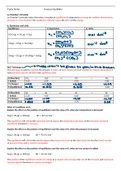
Le Chatelier’s Principle
Le Chatelier’s principle states that when a reaction at equilibrium is subjected to a change in condition (temperature,
pressure or concentration), the equilibrium shifts to reduce the effect of the change
Kc Expression and Units
Equilibrium Kc Expression Kc Units
SO2Cl2(g) ⇌ SO2(g) + Cl2(g)
2H2(g) + CO(g) ⇌ CH3OH(g)
3H2(g) + CO2(g) ⇌ CH3OH(g) + H2O(g)
RICE Technique
This technique is used to calculate the amount, in moles, of each compound of an equilibrium mixture at equilibrium
from a limited selection of initial and equilibrium data
R (Reaction) CH4 + H 2O ⇌ CO + 3H 2
I (Initial) 2.00 2.00 0.00 0.00
C (Change)
E (Equilibrium) 3.60
R (Reaction) W + 2X ⇌ 2Y + 2Z
I (Initial) 2.50 4.00 0.00 0.500
C (Change)
E (Equilibrium) 1.75
Effect of Conditions on Kc
Explain the effect on the position of equilibrium and the value of K c when the temperature is decreased
N2(g) + 3H2(g) ⇌ 2NH3(g) ΔH = -92.4 kJ mol-1
The equilibrium will shift to the right hand side to oppose the temperature decrease as the forwards reaction is
exothermic therefore Kc increases
Explain the effect on the position of equilibrium and the value of K c when the pressure is increased
N2(g) + 3H2(g) ⇌ 2NH3(g) ΔH = -92.4 kJ mol-1
The equilibrium will shift to the right to oppose the pressure increase as the right-hand side has the fewest number
of gaseous moles, but Kc remains unchanged
Explain the effect on the position of equilibrium and the value of K c when an iron catalyst is added
N2(g) + 3H2(g) ⇌ 2NH3(g) ΔH = -92.4 kJ mol-1
The position of the equilibrium would not change as a catalyst only increases the rate of the forwards and backwards
reaction equally therefore Kc remains unchanged
Le Chatelier’s Principle
Le Chatelier’s principle states that when a reaction at equilibrium is subjected to a change in condition (temperature,
pressure or concentration), the equilibrium shifts to reduce the effect of the change
Kc Expression and Units
Equilibrium Kc Expression Kc Units
SO2Cl2(g) ⇌ SO2(g) + Cl2(g)
2H2(g) + CO(g) ⇌ CH3OH(g)
3H2(g) + CO2(g) ⇌ CH3OH(g) + H2O(g)
RICE Technique
This technique is used to calculate the amount, in moles, of each compound of an equilibrium mixture at equilibrium
from a limited selection of initial and equilibrium data
R (Reaction) CH4 + H 2O ⇌ CO + 3H 2
I (Initial) 2.00 2.00 0.00 0.00
C (Change)
E (Equilibrium) 3.60
R (Reaction) W + 2X ⇌ 2Y + 2Z
I (Initial) 2.50 4.00 0.00 0.500
C (Change)
E (Equilibrium) 1.75
Effect of Conditions on Kc
Explain the effect on the position of equilibrium and the value of K c when the temperature is decreased
N2(g) + 3H2(g) ⇌ 2NH3(g) ΔH = -92.4 kJ mol-1
The equilibrium will shift to the right hand side to oppose the temperature decrease as the forwards reaction is
exothermic therefore Kc increases
Explain the effect on the position of equilibrium and the value of K c when the pressure is increased
N2(g) + 3H2(g) ⇌ 2NH3(g) ΔH = -92.4 kJ mol-1
The equilibrium will shift to the right to oppose the pressure increase as the right-hand side has the fewest number
of gaseous moles, but Kc remains unchanged
Explain the effect on the position of equilibrium and the value of K c when an iron catalyst is added
N2(g) + 3H2(g) ⇌ 2NH3(g) ΔH = -92.4 kJ mol-1
The position of the equilibrium would not change as a catalyst only increases the rate of the forwards and backwards
reaction equally therefore Kc remains unchanged