
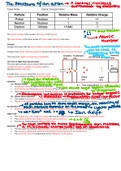
Taylor Notes Atomic Structure Notes
The Atomic Number is the number of Protons in the Nucleus
The Mass Number is the total number of Protons and Neutrons in the atom
Isotopes
Isotopes are atoms with the same number of protons, but different numbers of neutrons
Isotopes have similar chemical properties because they have the same electronic structure
They may have slightly varying physical properties
The Time of Flight Mass Spectrometer
The mass spectrometer can be used to determine all the
isotopes present in a sample of an element and to
therefore identify elements
It needs to be a vacuum otherwise air particle would
register on the detector and the ions could lose their charge
Ionisation
(a) Electron Impact
A vaporised sample is injected at low pressure
A hot electron gun fires high energy electrons at the sample
This knocks out an outer electron Forming positive ions with different charges
(b) Electro Spray Ionisation
The sample is dissolved in a volatile, polar solvent and is injected through a fine hypodermic needle giving a fine mist
The tip of the needle has a high voltage, at the tip of the needle, the sample molecule gains a proton
Acceleration
Positive ions are accelerated by an electric field to a constant electric energy
Flight Tube
The Positive Ions with smaller m/z values will have the same KE as those with larger m/z and will move faster
The heavier particles take longer to move through the drift area
The ions are distinguished by different flight times
Detection
The ions reach the detector and generate a small current, which is fed to a computer for analysis
The current is produced by electrons transferring from the detector to the positive ions
The size of the current is proportional to the abundance of the species
The Atomic Number is the number of Protons in the Nucleus
The Mass Number is the total number of Protons and Neutrons in the atom
Isotopes
Isotopes are atoms with the same number of protons, but different numbers of neutrons
Isotopes have similar chemical properties because they have the same electronic structure
They may have slightly varying physical properties
The Time of Flight Mass Spectrometer
The mass spectrometer can be used to determine all the
isotopes present in a sample of an element and to
therefore identify elements
It needs to be a vacuum otherwise air particle would
register on the detector and the ions could lose their charge
Ionisation
(a) Electron Impact
A vaporised sample is injected at low pressure
A hot electron gun fires high energy electrons at the sample
This knocks out an outer electron Forming positive ions with different charges
(b) Electro Spray Ionisation
The sample is dissolved in a volatile, polar solvent and is injected through a fine hypodermic needle giving a fine mist
The tip of the needle has a high voltage, at the tip of the needle, the sample molecule gains a proton
Acceleration
Positive ions are accelerated by an electric field to a constant electric energy
Flight Tube
The Positive Ions with smaller m/z values will have the same KE as those with larger m/z and will move faster
The heavier particles take longer to move through the drift area
The ions are distinguished by different flight times
Detection
The ions reach the detector and generate a small current, which is fed to a computer for analysis
The current is produced by electrons transferring from the detector to the positive ions
The size of the current is proportional to the abundance of the species


