Biology Internal Assessment
How is the width to height ratio of the limpet
Patella vulgata affected by the angle (degrees) of
the slope of rock that it lives on, on a North Devon
rocky shore?
,Background research
Lee Bay
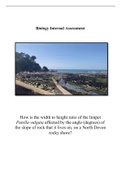
Lee Bay is a rocky shore in North Devon, near Ilfracombe. The bay is very long
and has a gently sloping gradient, with a freshwater stream running directly
down the centre. The shore is very exposed, but it is tucked around a corner on
the eastern side, so it has some degree of shelter. On the lower shore, there is an
abundance of jagged rocks, the majority of which are Morte Slates – a silvery-
grey type of slate containing some sandstone and siltstone [1]. The jagged rocks
are home to a great number of limpets, and their rock faces have a range of
different inclinations, making them ideal to carry out my investigation on.
As an environment, I think the complexity of the North Devon coast is
misunderstood and underappreciated. A great deal of ecology practicals tend to
be carried out in the typical forest or grassland environments, but I think the
rocky shore has a lot of interesting components, particularly its abiotic gradient
as you go down towards the sea.
Limpets
Limpets are dome-shaped aquatic snails that live in marine environments,
predominantly in the intertidal zone [2]. They are herbivorous and feed on the
algae of the rocks they are attached to through their downward facing mouths
[3]. When the tide comes in, limpets move around on their muscular foot and
scrape algae off rocks to digest by using their radula - a kind of rough tongue
with teeth on their underside. They return to exactly the same spot after feeding
and clamp back down when the tide goes back out [4].
There are three species of limpet found on the shores of the United Kingdom:
Patella vulgata (the common limpet), Patella depressa (the black-footed
limpet) and Patella ulssiponensis (the China limpet). My investigation will be
focused on Patella vulgata because, as its colloquial name suggests, it is the
most abundant on the rocky shore. Moreover, its greyish conical shell is also
easily distinguishable from the other two species when using a key.
The feature of limpets that is most relevant to my investigation is the muscular
foot. Found on the underside of the limpet, the muscular foot applies suction to
the substrate and, in conjunction with an adhesive mucus that is secreted, forms
an incredibly strong bond [2]. This bond allows limpets to hold on to rock with
a force of more than 330 N/sq.in [5].
2
, The attachment of limpets to their home rock is of significance for several
reasons. The first relates to water conservation. Being in the intertidal zone,
limpets must be able to survive both in and out of water. During low tide, they
are at risk of desiccation. To stop this, they clamp down using their muscular
foot and create a tight seal, which prevents water loss and drying out in the sun.
They also reduce their metabolism in order to reduce their consumption of
water [6].
The second reason is that it is of paramount importance that the limpet does not
get dislodged from the rock; they cannot easily reattach and, if overturned, they
cannot right themselves. The strong clamp limpets make with their substrate
must be strong enough to withstand the powerful forces of wave action, among
other disturbances such as predation.
In general, I am more interested in animal biology than plant biology, which
investigating Patella vulgata allows me to do. Moreover, as a Higher-Level
Physics student, I am fascinated by how creatures of all different species have
evolved biological ways to counteract the commanding forces of nature.
Hypothesis
As the angle of the slope of the rock face increases (i.e. the rock face becomes
steeper), the width to height ratio of the limpets will increase; in other words,
their shape will become flatter and less conical. I predict that the width to height
ratio will increase because, as the rock face they are attached to gets steeper,
they will need a more powerful seal to clamp on against the continuous force of
gravity. To achieve this, it would be necessary for the limpet to become wider at
the bottom. This is because the wider limpet will have a greater area of
attachment to its substrate, allowing a greater area for the adhesive mucus to act
and for the muscular foot to apply suction.
It is worth expressing that since the limpets I will be measuring are located on
the leeward side of the rocks - the more sheltered side that faces the land - the
possible effects of wave exposure on the limpets’ shapes will be less significant.
Therefore, I hypothesise that the differences in width to height ratio will be
solely down to the slope of the rock face and natural variation.
3
How is the width to height ratio of the limpet
Patella vulgata affected by the angle (degrees) of
the slope of rock that it lives on, on a North Devon
rocky shore?
,Background research
Lee Bay
Lee Bay is a rocky shore in North Devon, near Ilfracombe. The bay is very long
and has a gently sloping gradient, with a freshwater stream running directly
down the centre. The shore is very exposed, but it is tucked around a corner on
the eastern side, so it has some degree of shelter. On the lower shore, there is an
abundance of jagged rocks, the majority of which are Morte Slates – a silvery-
grey type of slate containing some sandstone and siltstone [1]. The jagged rocks
are home to a great number of limpets, and their rock faces have a range of
different inclinations, making them ideal to carry out my investigation on.
As an environment, I think the complexity of the North Devon coast is
misunderstood and underappreciated. A great deal of ecology practicals tend to
be carried out in the typical forest or grassland environments, but I think the
rocky shore has a lot of interesting components, particularly its abiotic gradient
as you go down towards the sea.
Limpets
Limpets are dome-shaped aquatic snails that live in marine environments,
predominantly in the intertidal zone [2]. They are herbivorous and feed on the
algae of the rocks they are attached to through their downward facing mouths
[3]. When the tide comes in, limpets move around on their muscular foot and
scrape algae off rocks to digest by using their radula - a kind of rough tongue
with teeth on their underside. They return to exactly the same spot after feeding
and clamp back down when the tide goes back out [4].
There are three species of limpet found on the shores of the United Kingdom:
Patella vulgata (the common limpet), Patella depressa (the black-footed
limpet) and Patella ulssiponensis (the China limpet). My investigation will be
focused on Patella vulgata because, as its colloquial name suggests, it is the
most abundant on the rocky shore. Moreover, its greyish conical shell is also
easily distinguishable from the other two species when using a key.
The feature of limpets that is most relevant to my investigation is the muscular
foot. Found on the underside of the limpet, the muscular foot applies suction to
the substrate and, in conjunction with an adhesive mucus that is secreted, forms
an incredibly strong bond [2]. This bond allows limpets to hold on to rock with
a force of more than 330 N/sq.in [5].
2
, The attachment of limpets to their home rock is of significance for several
reasons. The first relates to water conservation. Being in the intertidal zone,
limpets must be able to survive both in and out of water. During low tide, they
are at risk of desiccation. To stop this, they clamp down using their muscular
foot and create a tight seal, which prevents water loss and drying out in the sun.
They also reduce their metabolism in order to reduce their consumption of
water [6].
The second reason is that it is of paramount importance that the limpet does not
get dislodged from the rock; they cannot easily reattach and, if overturned, they
cannot right themselves. The strong clamp limpets make with their substrate
must be strong enough to withstand the powerful forces of wave action, among
other disturbances such as predation.
In general, I am more interested in animal biology than plant biology, which
investigating Patella vulgata allows me to do. Moreover, as a Higher-Level
Physics student, I am fascinated by how creatures of all different species have
evolved biological ways to counteract the commanding forces of nature.
Hypothesis
As the angle of the slope of the rock face increases (i.e. the rock face becomes
steeper), the width to height ratio of the limpets will increase; in other words,
their shape will become flatter and less conical. I predict that the width to height
ratio will increase because, as the rock face they are attached to gets steeper,
they will need a more powerful seal to clamp on against the continuous force of
gravity. To achieve this, it would be necessary for the limpet to become wider at
the bottom. This is because the wider limpet will have a greater area of
attachment to its substrate, allowing a greater area for the adhesive mucus to act
and for the muscular foot to apply suction.
It is worth expressing that since the limpets I will be measuring are located on
the leeward side of the rocks - the more sheltered side that faces the land - the
possible effects of wave exposure on the limpets’ shapes will be less significant.
Therefore, I hypothesise that the differences in width to height ratio will be
solely down to the slope of the rock face and natural variation.
3