4.1.5.6 Monopoly and monopoly power
A monopoly is when there is only one firm in the market. In 1985, Microsoft could have been
considered a monopoly because it was the only operating system that could be used for computers -
closest example of a pure monopoly (100% market
share) but this is very rare in real life.
A legal monopoly is one where a firm has over 25%
market share like Tesco which controls 29% of the
supermarket industry.
3 simplifying assumptions:
• Only one firm in the market
• They want to maximize profit
• There are high barriers to entry - patents
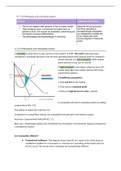
A monopolist will seek to maximise profits by setting
output where MR = MC.
This will be at output Qm and Price Pm.
Compared to a competitive market, the monopolist increases price and reduces output.
Red area = Supernormal Profit (AR-AC) * Q
Blue area = Deadweight welfare loss (combined loss of producer and consumer surplus) compared to
a competitive market.
Are monopolies efficient?
• Productively inefficient - The diagram shows that MC isn’t equal to AC at the long run
equilibrium position for a monopoly (i.e. the firm isn’t operating at the lowest point on
the AC curve). This means that a monopoly isn’t productively efficient.
A monopoly is when there is only one firm in the market. In 1985, Microsoft could have been
considered a monopoly because it was the only operating system that could be used for computers -
closest example of a pure monopoly (100% market
share) but this is very rare in real life.
A legal monopoly is one where a firm has over 25%
market share like Tesco which controls 29% of the
supermarket industry.
3 simplifying assumptions:
• Only one firm in the market
• They want to maximize profit
• There are high barriers to entry - patents
A monopolist will seek to maximise profits by setting
output where MR = MC.
This will be at output Qm and Price Pm.
Compared to a competitive market, the monopolist increases price and reduces output.
Red area = Supernormal Profit (AR-AC) * Q
Blue area = Deadweight welfare loss (combined loss of producer and consumer surplus) compared to
a competitive market.
Are monopolies efficient?
• Productively inefficient - The diagram shows that MC isn’t equal to AC at the long run
equilibrium position for a monopoly (i.e. the firm isn’t operating at the lowest point on
the AC curve). This means that a monopoly isn’t productively efficient.