Conduct Disorder in Adolescence
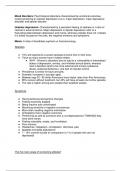
, • Most violent crimes are committed by a small group of men who show an early onset
and life-long pattern of antisocial behaviour.
• Robust finding that has been shown in many countries and in many studies
• Different countries have different cultures, education, class and prison systems. In all
countries it has been found that about 5% of people commit 60-70% of violent crimes
committed by men.
• In criminology, these men have been referred to as life-course persistent offenders
• In psychology, we refer to them as antisocial personality disorder - one of 10 PD’s in
the DSM 5, only PD to have a childhood antecedent to meet diagnostic criteria.
Conduct disorder
• Characterised by a “repetitive and persistent pattern of behaviour in which the basic
rights of others or major age-appropriate societal norms or rules are violated”
resulting in a clinically significant impairment in functioning.
Includes:
• Aggression to people and animals
• Destruction of property
• Deceitfulness and theft
• Violation of rules
Diagnostic criteria fall into two categories : overt (destruction of property and aggression)
and covert (deceitfulness and violation of rules)
15 symptoms of CD, to be diagnosed, 3 criteria need to have been met in the last 12 months
and 1 of those have to be met in the last 6 months.
CD has avery heterogenous population - present clinically differently, but all have th esame
diagnosis.
DSM-5 Diagnostic Criteria for CD: Subtypes and specifiers
Age of onset: At least 1 problem with CD before age 10 - Childhood onset vs Adolescent-
onset
Severity: Mild, Moderate, Severe
New Specifier added with DSM 5: With Limited Prosocial Emotions (CU traits)
• Lack of remorse or guilt
• Callous, lack of empathy
• Lack of concern about performance in important activities
• Shallow or deficient affect
• To have CU traits, 2 of these symptoms need to be present for at least 12 months
Prevalence of CD
● The worldwide prevalence estimated to be 2–2.5%, with a prevalence of 3–4% in boys and
1–2% in girls
● Robust – been found across different countries
● CD is approximately twice as common in males as in females, and this finding has been
observed across geographical regions
, • Most violent crimes are committed by a small group of men who show an early onset
and life-long pattern of antisocial behaviour.
• Robust finding that has been shown in many countries and in many studies
• Different countries have different cultures, education, class and prison systems. In all
countries it has been found that about 5% of people commit 60-70% of violent crimes
committed by men.
• In criminology, these men have been referred to as life-course persistent offenders
• In psychology, we refer to them as antisocial personality disorder - one of 10 PD’s in
the DSM 5, only PD to have a childhood antecedent to meet diagnostic criteria.
Conduct disorder
• Characterised by a “repetitive and persistent pattern of behaviour in which the basic
rights of others or major age-appropriate societal norms or rules are violated”
resulting in a clinically significant impairment in functioning.
Includes:
• Aggression to people and animals
• Destruction of property
• Deceitfulness and theft
• Violation of rules
Diagnostic criteria fall into two categories : overt (destruction of property and aggression)
and covert (deceitfulness and violation of rules)
15 symptoms of CD, to be diagnosed, 3 criteria need to have been met in the last 12 months
and 1 of those have to be met in the last 6 months.
CD has avery heterogenous population - present clinically differently, but all have th esame
diagnosis.
DSM-5 Diagnostic Criteria for CD: Subtypes and specifiers
Age of onset: At least 1 problem with CD before age 10 - Childhood onset vs Adolescent-
onset
Severity: Mild, Moderate, Severe
New Specifier added with DSM 5: With Limited Prosocial Emotions (CU traits)
• Lack of remorse or guilt
• Callous, lack of empathy
• Lack of concern about performance in important activities
• Shallow or deficient affect
• To have CU traits, 2 of these symptoms need to be present for at least 12 months
Prevalence of CD
● The worldwide prevalence estimated to be 2–2.5%, with a prevalence of 3–4% in boys and
1–2% in girls
● Robust – been found across different countries
● CD is approximately twice as common in males as in females, and this finding has been
observed across geographical regions