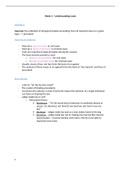
Week 3 – Understanding Cases
Definition
Case law: the collection of all legal principles emanating from all reported cases on a given
topic --> precedent
Case law procedures
- Must be a cause of action in civil cases
- Must be a charge/indictment in criminal cases
- Facts are matched to legal principles during the analysis
- The facts must be proved in court
o Balance of probabilities for civil cases
o Beyond reasonable doubt for criminal cases
- Usually, issues of law, not fact form the basis of an appeal
- The analysis of these issues in an appeal forms the basis of “law reports” and thus of
precedent.
Stare Decisis
- Latin for “let the decision stand”
- The system of binding precedents
- Constrains the judiciary in that it limits the impact the decision of a single individual
can have on shaping the law
- Judge-made law or not?
o Declarative theory
Blackstone – “if it be found that [a] decision is manifestly absurd or
unjust, it is declared, not that [it] was bad law, but that it was not
law”
Bentham – Judges make law just as a man makes laws for his dog
Ramshaw – judge-made law not as making new law but like musical
improvisation – must be familiar with notes, riffs etc to be able to
improvise new music
1
, Ratio Decidendi
- The material facts of the case, plus the decision made in relation to those facts
- Binding element of the judicial decision
- The legal rule and associated reasoning for the decision
- Can be very difficult to define, let alone find in a case. It’s not always present and
even if it is, it can be hard to identify.
o Donoghue v Stevenson
Clear ratio: A manufacturer owes their ultimate consumer a duty to
take reasonable care in the production of the product they sell them
Obiter: Lord Atkin’s “Neighbor Principle” - but couldn’t it be argued it
became the ratio through its later application by the courts?
Obiter Dictum
- A thing said “by the way”
- Persuasive but NOT binding
- A statement not directly related to the material facts of the case
- Could arise in the case of:
o A hypothetical
o A minority judgement
- What is obiter in one decision might become crucial in another
Material Facts
- Facts that aid in proving the course of action or charge in a case
Applying the precedent
- Is there a similarity in the material facts of precedent and the new case?
- Statement of principle in the precedent
- Decide if there are sufficient similarities between the cases to apply the precedent
Example: Donoghue V Stevenson compared to Grant v Australian Knitting Mills
- Both products had a “hidden and latent defect”
- Donoghue didn’t have a claim in contract, but Grant did – yet this was considered an
immaterial fact
- So, yes precedent applies
- Precedents can stretch or contract significantly and their emphasis can change
- Precedent can be:
o Applied
Where a court accepts the reasoning of a previous decision
o Distinguished
Generally, the same court but different facts
o Overruled
2
Definition
Case law: the collection of all legal principles emanating from all reported cases on a given
topic --> precedent
Case law procedures
- Must be a cause of action in civil cases
- Must be a charge/indictment in criminal cases
- Facts are matched to legal principles during the analysis
- The facts must be proved in court
o Balance of probabilities for civil cases
o Beyond reasonable doubt for criminal cases
- Usually, issues of law, not fact form the basis of an appeal
- The analysis of these issues in an appeal forms the basis of “law reports” and thus of
precedent.
Stare Decisis
- Latin for “let the decision stand”
- The system of binding precedents
- Constrains the judiciary in that it limits the impact the decision of a single individual
can have on shaping the law
- Judge-made law or not?
o Declarative theory
Blackstone – “if it be found that [a] decision is manifestly absurd or
unjust, it is declared, not that [it] was bad law, but that it was not
law”
Bentham – Judges make law just as a man makes laws for his dog
Ramshaw – judge-made law not as making new law but like musical
improvisation – must be familiar with notes, riffs etc to be able to
improvise new music
1
, Ratio Decidendi
- The material facts of the case, plus the decision made in relation to those facts
- Binding element of the judicial decision
- The legal rule and associated reasoning for the decision
- Can be very difficult to define, let alone find in a case. It’s not always present and
even if it is, it can be hard to identify.
o Donoghue v Stevenson
Clear ratio: A manufacturer owes their ultimate consumer a duty to
take reasonable care in the production of the product they sell them
Obiter: Lord Atkin’s “Neighbor Principle” - but couldn’t it be argued it
became the ratio through its later application by the courts?
Obiter Dictum
- A thing said “by the way”
- Persuasive but NOT binding
- A statement not directly related to the material facts of the case
- Could arise in the case of:
o A hypothetical
o A minority judgement
- What is obiter in one decision might become crucial in another
Material Facts
- Facts that aid in proving the course of action or charge in a case
Applying the precedent
- Is there a similarity in the material facts of precedent and the new case?
- Statement of principle in the precedent
- Decide if there are sufficient similarities between the cases to apply the precedent
Example: Donoghue V Stevenson compared to Grant v Australian Knitting Mills
- Both products had a “hidden and latent defect”
- Donoghue didn’t have a claim in contract, but Grant did – yet this was considered an
immaterial fact
- So, yes precedent applies
- Precedents can stretch or contract significantly and their emphasis can change
- Precedent can be:
o Applied
Where a court accepts the reasoning of a previous decision
o Distinguished
Generally, the same court but different facts
o Overruled
2