Week 8 – Human Rights
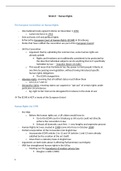
The European Convention on Human Rights
- International treaty signed in Rome on November 4 1950
o Came into force in 1953
- Sets out basic civil and political rights
- Enforced by European Court of Human Rights (ECtHR) in Strasbourg
- States that have ratified the convention are part of the European Council
- UK Pre-Convention
o Argument that by upholding the common law, some human rights are
already upheld.
Rights and freedoms are traditionally considered to be protected by
the idea that individual subjects can do anything that isn’t specifically
forbidden by law – “negative theory of rights”
o This would mean that Parliament has the power to limit people’s liberty at
any time by passing new legislation, without having introduced specific
human rights obligations.
The ECHR changed this
- Absolute rights, meaning that all ratified states must follow them
o Art 2,3,4.7 and 14
- Derogative rights, meaning states can suspend or “opt out” of certain rights under
particular circumstances
o Eg: right to fair trial can be derogated for instance in the state of war
The ECHR is NOT a treaty of the European Union!
Human Rights Act 1998
- Pre-HRA
o Before the human rights act, a UK citizen would have to
Go to the ECHR court in Strasburg as UK courts could not directly
enforce the convention in law
Exhaust all domestic court first --> very lengthy and expensive process
- Human Rights Act was created in 1998 (come into force in October 2000)
- Partial incorporation of the Convention into English law
o Incorporates ECHR articles 2 to 12 and 14 (articles 1 and 13 were already
satisfied by the creation of the act itself)
o Gives them a statutory basis in English law
- Arguments on both sides about it affecting Parliamentary sovereignty
- HRA has strengthened human rights in the UK by
o Marking out the boundaries of modern privacy law
Douglas v Hello! (2001)
1
, Douglases awarded compensation for violation of privacy by
Hello!
Ok! succeeded in proving a breach of confidence by Hello!
Wainwright v Home Office (2003)
Campbell v MGN (2004)
Privacy law issue
Art 8 v Art 10
o Clarified rights relating to personal identity, same-sex marriage & family life
Bellinger v Bellinger (2003)
Section 11(c) of Matrimonial Causes Act 1973 declared
incompatible with Convention Art 8 & 12
o Influenced legal debate about the right to life
Conjoined Twins: Surgical Separation (2000)
o Defined the scope of executive and legislative power in regard to detention
Enforceability & Application
- Section 6 – “it is unlawful for public authorities to act in a way that is incompatible
with Convention rights”
o What is a public authority?
Any local and central government, the police, the NHS, the courts
Section 6(b) – a private body can be considered a public if it
“performs function of a public nature” and is decided on a case-by
case basis
Type 1: public authority in every way
Type 2: public only in relation to certain of its functions, which
will only need to comply in regard to those specific functions
o YL v Birmingham City Council (2007)
narrow approach to defining public functions: a
privately-owned care home which
accommodates and cares for residents placed
and paid for by a local authority does not
perform a 'function of a public nature’.
- Vertical effect only, no horizontal effect, meaning rights can’t directly be enforced
on individuals
o The Courts are considered public bodies and need to uphold the Conventions
rights in legal proceedings between parties. HRA is therefore indirectly
enforceable on individuals, through the court’s decisions.
Douglas v Hello!
- HRA has a wide geographical application, beyond the physical boundaries of the UK,
to places where effective control
o R (Al-Skeini) v Secretary of State for Defense (2007) – Iraqi civilians arrested
and detained by British soldiers are protected by the HRA
o Smith v Ministry of Defense (2013) – HRA applies to British soldiers serving
abroad
2
The European Convention on Human Rights
- International treaty signed in Rome on November 4 1950
o Came into force in 1953
- Sets out basic civil and political rights
- Enforced by European Court of Human Rights (ECtHR) in Strasbourg
- States that have ratified the convention are part of the European Council
- UK Pre-Convention
o Argument that by upholding the common law, some human rights are
already upheld.
Rights and freedoms are traditionally considered to be protected by
the idea that individual subjects can do anything that isn’t specifically
forbidden by law – “negative theory of rights”
o This would mean that Parliament has the power to limit people’s liberty at
any time by passing new legislation, without having introduced specific
human rights obligations.
The ECHR changed this
- Absolute rights, meaning that all ratified states must follow them
o Art 2,3,4.7 and 14
- Derogative rights, meaning states can suspend or “opt out” of certain rights under
particular circumstances
o Eg: right to fair trial can be derogated for instance in the state of war
The ECHR is NOT a treaty of the European Union!
Human Rights Act 1998
- Pre-HRA
o Before the human rights act, a UK citizen would have to
Go to the ECHR court in Strasburg as UK courts could not directly
enforce the convention in law
Exhaust all domestic court first --> very lengthy and expensive process
- Human Rights Act was created in 1998 (come into force in October 2000)
- Partial incorporation of the Convention into English law
o Incorporates ECHR articles 2 to 12 and 14 (articles 1 and 13 were already
satisfied by the creation of the act itself)
o Gives them a statutory basis in English law
- Arguments on both sides about it affecting Parliamentary sovereignty
- HRA has strengthened human rights in the UK by
o Marking out the boundaries of modern privacy law
Douglas v Hello! (2001)
1
, Douglases awarded compensation for violation of privacy by
Hello!
Ok! succeeded in proving a breach of confidence by Hello!
Wainwright v Home Office (2003)
Campbell v MGN (2004)
Privacy law issue
Art 8 v Art 10
o Clarified rights relating to personal identity, same-sex marriage & family life
Bellinger v Bellinger (2003)
Section 11(c) of Matrimonial Causes Act 1973 declared
incompatible with Convention Art 8 & 12
o Influenced legal debate about the right to life
Conjoined Twins: Surgical Separation (2000)
o Defined the scope of executive and legislative power in regard to detention
Enforceability & Application
- Section 6 – “it is unlawful for public authorities to act in a way that is incompatible
with Convention rights”
o What is a public authority?
Any local and central government, the police, the NHS, the courts
Section 6(b) – a private body can be considered a public if it
“performs function of a public nature” and is decided on a case-by
case basis
Type 1: public authority in every way
Type 2: public only in relation to certain of its functions, which
will only need to comply in regard to those specific functions
o YL v Birmingham City Council (2007)
narrow approach to defining public functions: a
privately-owned care home which
accommodates and cares for residents placed
and paid for by a local authority does not
perform a 'function of a public nature’.
- Vertical effect only, no horizontal effect, meaning rights can’t directly be enforced
on individuals
o The Courts are considered public bodies and need to uphold the Conventions
rights in legal proceedings between parties. HRA is therefore indirectly
enforceable on individuals, through the court’s decisions.
Douglas v Hello!
- HRA has a wide geographical application, beyond the physical boundaries of the UK,
to places where effective control
o R (Al-Skeini) v Secretary of State for Defense (2007) – Iraqi civilians arrested
and detained by British soldiers are protected by the HRA
o Smith v Ministry of Defense (2013) – HRA applies to British soldiers serving
abroad
2