U2 - Particles and radiation
What affects the stability of No. of neutrons (i.e., the more neutrons, the less stable) ∵ the strong
the isotope and why? nuclear force can no longer hold the nucleus together.
How do you find specific Divide the charge (C) of the object by its mass (kg).
charge?
What does the strong ● Holds electrostatically repelling nucleons together.
nuclear force / strong ● Carried by gluons.
interaction do and what is it
carried by?
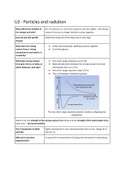
What does strong nuclear ● Very short range attraction up to 3 fm.
force give rise to, to what, at ● Balanced attraction between the strong nuclear force and
which distances, and why? electrostatic force at 1.5 fm.
● Very short range repulsion under 0.5 fm.
● This is all between individual nucleons.
The very short range repulsion prevents nucleons collapsing into
singularities.
Above 3 fm, the strength of the strong nuclear force drops and the strength of the electrostatic force
takes over ∴ decreased stability.
Give 4 properties of alpha Highly ionising due to size; low penetration due to size; charge of +2;
particles amu of ≃4.
Why were neutrinos To account for conservation of energy and momentum in beta decay.
hypothesised?
, What happens on the quark- ● A down quark in the nuclide decays into up quark whilst
level of beta minus decay? emitting a W- boson (1).
● The W- boson decays into a beta minus particle and anti
electron neutrino (1).
What problems do beta ● Beta minus decays solves too many neutrons.
minus and beta plus decay ● Beta plus decay solves too many protons.
solve?
Give 3 properties of gamma High frequency; very penetrating; not so ionising.
rays
What is ionisation energy The minimum energy required to remove an electron from its
defined as? GROUND STATE to form an ion.
What is an electron volt The energy of an electron when accelerated through a p.d. of 1 V.
defined as?
How do particles and their In all their properties (i.e., charge, lepton number, baryon number,
antiparticles differ? and strangeness) except for rest mass.
What is annihilation? When a particle and its antiparticle meet and annihilate converting
their mass into energy in the form of photons.
These particles are moving in opposite directions to conserve
momentum.
What is the equation used
for annihilation and why?
As two particles make two photons.
What is pair production? When a photon interacts with an atom (1) and has enough energy to
produce a particle and its antiparticle.
What affects the stability of No. of neutrons (i.e., the more neutrons, the less stable) ∵ the strong
the isotope and why? nuclear force can no longer hold the nucleus together.
How do you find specific Divide the charge (C) of the object by its mass (kg).
charge?
What does the strong ● Holds electrostatically repelling nucleons together.
nuclear force / strong ● Carried by gluons.
interaction do and what is it
carried by?
What does strong nuclear ● Very short range attraction up to 3 fm.
force give rise to, to what, at ● Balanced attraction between the strong nuclear force and
which distances, and why? electrostatic force at 1.5 fm.
● Very short range repulsion under 0.5 fm.
● This is all between individual nucleons.
The very short range repulsion prevents nucleons collapsing into
singularities.
Above 3 fm, the strength of the strong nuclear force drops and the strength of the electrostatic force
takes over ∴ decreased stability.
Give 4 properties of alpha Highly ionising due to size; low penetration due to size; charge of +2;
particles amu of ≃4.
Why were neutrinos To account for conservation of energy and momentum in beta decay.
hypothesised?
, What happens on the quark- ● A down quark in the nuclide decays into up quark whilst
level of beta minus decay? emitting a W- boson (1).
● The W- boson decays into a beta minus particle and anti
electron neutrino (1).
What problems do beta ● Beta minus decays solves too many neutrons.
minus and beta plus decay ● Beta plus decay solves too many protons.
solve?
Give 3 properties of gamma High frequency; very penetrating; not so ionising.
rays
What is ionisation energy The minimum energy required to remove an electron from its
defined as? GROUND STATE to form an ion.
What is an electron volt The energy of an electron when accelerated through a p.d. of 1 V.
defined as?
How do particles and their In all their properties (i.e., charge, lepton number, baryon number,
antiparticles differ? and strangeness) except for rest mass.
What is annihilation? When a particle and its antiparticle meet and annihilate converting
their mass into energy in the form of photons.
These particles are moving in opposite directions to conserve
momentum.
What is the equation used
for annihilation and why?
As two particles make two photons.
What is pair production? When a photon interacts with an atom (1) and has enough energy to
produce a particle and its antiparticle.