
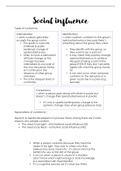
Social influence
Types of conformity
Internalisation Identification
= when a person genuinely = when a person conforms to the group’s
accepts the group norms. opinions/behaviours because there’s
> This results in a private something about the group they value
(internal) & public
(external) change of > They identify with the group, so
opinion/behaviour they want to be a part of it
> Likely to have a permanent > It may mean they publicly change
attitude change as the opinions/behaviours to achieve
change has been the goal of being a part of the
internalised (is now part of group EVEN IF they don’t privately
the way the person thinks) agree with what the group stands
& it continues in the for
absence of other group > It can also occur when someone
members conforms to the demands of a
> This is the deepest level of given social role in society (e.g.
conformity teacher)
Compliance
= when a person goes along with others in public but
doesn’t change their opinions/behaviours in private
> It’s only a superficial/temporary change & the
opinions change stops when group pressure stops
Explanations of conformity –
Deutsch & Gerard developed a 2-process theory stating there are 2 main
reasons why people conform
• The need to be right – informational social influence (ISI)
• The need to be liked – normative social influence (NSI)
ISI
> When a person conforms because they have the
desire to be right, they look to others who they
believe may have more info – it’s about who has the
better info; you or the rest of the group
> It occurs when a person is unsure of a situation
(don’t know what’s right/wrong) or lacks knowledge
& is associated with internalisation
> It’s a cognitive process (as it’s what you think)
, NSI
> Where a person conforms to fit in with the group because they don’t want to
be left out – its about following ‘normal’ or typical behaviour for a social
group.
> People prefer to gain social approval rather than be rejected
> Its emotional based rather than a cognitive process
> It’s more likely to happen with strangers, but can occur with friends if you feel
concerned about social approval
> It may be more pronounced in stressful situations where people have a
greater need for social support
> Tends to lead to compliance – temporary change
AO3
AO3
In support, Lucas et al (2006) asked ppts
In support, Jeness (1932) asked ppts to
to give answers to maths problems that
privately guess the no. of jellybeans in a
were easy, hard or difficult. There was a
jar. Ppts then discussed this in a group
greater conformity to incorrect answers
(either large or several smaller groups),
when the question was more difficult,
discovering in this chat that estimates
therefore showing people conform
varied widely. The groups then made
when they are unsure of the correct
estimates. Ppts then made a 2nd private
answer.
estimate. It was found that ppts’
estimates tended to be closer to the
AO3 groups estimate in their 2nd private
In support, Fein et al (2007) estimate, therefore showing that people
demonstrated how judgements of conform when they’re unsure of the right
candidate performance in US election answer.
debates could be influenced by the
knowledge of other people’s reactions.
Ppts saw what their fellow ppts’ AO3
reactions on a screen were In support, Linkenbach & Perkins (2003)
(supposedly) during the debate. This found that teenagers exposed to the
produced large shifts message that most of their peers did not
in ppt’s judgements of candidate smoke were less likely to start smoking,
performance, therefore showing how therefore supporting the influence of
we’re influenced by other when we’re normative social influence.
unsure of the correct info.
AO3
AO3 However, NSI does not affect everyone,
people who are less concerned by being
In support Schultz (2008) found that liked are less affected by NSI. People who
hotel guests exposed to normative have a greater need to be liked are
messages that 75% of guests reused known as Afflilators, they have a need for
their towels each day (rather than affiliation. Mcghee (1967) found that
request clean ones) reduced their own students with a high need were more
towel usage by 25%. This shows that likely to conform showing individual
people shape their behaviour out of a differences in the way people respond.
desire to fit in with the group despite
being strangers.
Types of conformity
Internalisation Identification
= when a person genuinely = when a person conforms to the group’s
accepts the group norms. opinions/behaviours because there’s
> This results in a private something about the group they value
(internal) & public
(external) change of > They identify with the group, so
opinion/behaviour they want to be a part of it
> Likely to have a permanent > It may mean they publicly change
attitude change as the opinions/behaviours to achieve
change has been the goal of being a part of the
internalised (is now part of group EVEN IF they don’t privately
the way the person thinks) agree with what the group stands
& it continues in the for
absence of other group > It can also occur when someone
members conforms to the demands of a
> This is the deepest level of given social role in society (e.g.
conformity teacher)
Compliance
= when a person goes along with others in public but
doesn’t change their opinions/behaviours in private
> It’s only a superficial/temporary change & the
opinions change stops when group pressure stops
Explanations of conformity –
Deutsch & Gerard developed a 2-process theory stating there are 2 main
reasons why people conform
• The need to be right – informational social influence (ISI)
• The need to be liked – normative social influence (NSI)
ISI
> When a person conforms because they have the
desire to be right, they look to others who they
believe may have more info – it’s about who has the
better info; you or the rest of the group
> It occurs when a person is unsure of a situation
(don’t know what’s right/wrong) or lacks knowledge
& is associated with internalisation
> It’s a cognitive process (as it’s what you think)
, NSI
> Where a person conforms to fit in with the group because they don’t want to
be left out – its about following ‘normal’ or typical behaviour for a social
group.
> People prefer to gain social approval rather than be rejected
> Its emotional based rather than a cognitive process
> It’s more likely to happen with strangers, but can occur with friends if you feel
concerned about social approval
> It may be more pronounced in stressful situations where people have a
greater need for social support
> Tends to lead to compliance – temporary change
AO3
AO3
In support, Lucas et al (2006) asked ppts
In support, Jeness (1932) asked ppts to
to give answers to maths problems that
privately guess the no. of jellybeans in a
were easy, hard or difficult. There was a
jar. Ppts then discussed this in a group
greater conformity to incorrect answers
(either large or several smaller groups),
when the question was more difficult,
discovering in this chat that estimates
therefore showing people conform
varied widely. The groups then made
when they are unsure of the correct
estimates. Ppts then made a 2nd private
answer.
estimate. It was found that ppts’
estimates tended to be closer to the
AO3 groups estimate in their 2nd private
In support, Fein et al (2007) estimate, therefore showing that people
demonstrated how judgements of conform when they’re unsure of the right
candidate performance in US election answer.
debates could be influenced by the
knowledge of other people’s reactions.
Ppts saw what their fellow ppts’ AO3
reactions on a screen were In support, Linkenbach & Perkins (2003)
(supposedly) during the debate. This found that teenagers exposed to the
produced large shifts message that most of their peers did not
in ppt’s judgements of candidate smoke were less likely to start smoking,
performance, therefore showing how therefore supporting the influence of
we’re influenced by other when we’re normative social influence.
unsure of the correct info.
AO3
AO3 However, NSI does not affect everyone,
people who are less concerned by being
In support Schultz (2008) found that liked are less affected by NSI. People who
hotel guests exposed to normative have a greater need to be liked are
messages that 75% of guests reused known as Afflilators, they have a need for
their towels each day (rather than affiliation. Mcghee (1967) found that
request clean ones) reduced their own students with a high need were more
towel usage by 25%. This shows that likely to conform showing individual
people shape their behaviour out of a differences in the way people respond.
desire to fit in with the group despite
being strangers.


