Cell Structure
06 October 2020 11:34
How Do We Define a Cell?
• Cells can only arise from pre-existing cells
• A cell is the smallest unit of life
• A cell is basically a bag within which the chemical reactions required for life, occur
• The membrane around the outside of this bag allows the controlled movement of
materials both into and out of the cell. It is said to be partially permeable
• If the membrane could not control entry and exit of materials, life could not occur as the
cell contents would simply mix freely with the outside materials through diffusion
Many Organisms Are Unicellular
• This means that a single cell has to perform all the necessary functions for survival (the 8
characteristics of living organisms)
• With the advances made in microscopy, we have now seen that cells are complex units
that can act alone in single celled organisms, or unite to form part of a tissue or organ in
multicellular organisms
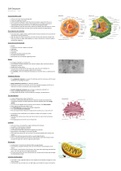
Structures Found in Animal Cells
• Nucleus
• Endoplasmic reticulum (rough and smooth)
• Golgi body
• Mitochondria
• Lysosomes
• Cell surface membrane (with microvilli)
• Centrioles and centrosomes
• Microtubules and microtubule organising centres
Nucleus
• The largest organelle in an animal cell
• Surrounded by a double membrane, the nuclear envelope, often continuous with the
endoplasmic reticulum
• Studded with nuclear pores
• Chromosomes are kept within the nucleus and, unless the cell is dividing, the
chromosomes are only very loosely coiled to form chromatin
• The nucleolus, is the site of ribosome manufacture, and is often seen as a darkly stained
area
Endoplasmic Reticulum
• The endoplasmic reticulum is a system of membranes which is continuous with the outer
membrane surrounding the nucleus
• Rough endoplasmic reticulum has ribosomes attached
• Ribosomes are made of two subunits, are the site of protein formation, tiny (25 nm in
diameter), and have no membrane, they are made of RNA
• Smooth endoplasmic reticulum does not have any ribosomes attached to it
• It has a completely different function from RER
• It makes lipids and steroids, such as cholesterol, oestrogen, and testosterone
The Golgi Apparatus
• A stack of flattened sacs under constant flux
• The stack is continuously being formed at one end from vesicles arriving from the
endoplasmic reticulum, and the vesicles leave from the opposite side to form Golgi
vesicles
• The stack of sacs together plus the vesicles may be known as the Golgi complex
• There may be more than one stack in a cell
• The Golgi apparatus processes and packages polypeptides
• This is post-translational modification
• Then to transport these molecules in Golgi vesicles to other parts, or out of, the cell
• An example of their modification is the addition of sugars to the protein, to make
glycoproteins
• They may also remove some amino acids from proteins to make a final, functioning
molecule
• The Golgi apparatus is also the source of lysosomes
Lysosomes
• Little round sacs, surrounded by a single membrane (still a bilayer)
• Usually 0.1-0.5 micrometres in diameter
• A bag of hydrolytic (digestive) enzymes
• The membrane keeps the contents from digesting the cell itself
• Responsible for the breakdown of old cell organelles
• May break down whole cells, such as those in the mammary glands after lactation has
ceased
• White blood cells have lysosomes which are used to digest bacteria
• There is a special lysosome (an acrosome) in the head of a sperm which helps it break
through the tough outer wall of an egg during fertilisation
Mitochondria
• Usually about 1 micrometre in diameter (often sausage shaped)
• Surrounded by a double membrane, the inner one of which is heavily folded to form
cristae
• The number of mitochondria varies between cells, those with a high energy demand have
more, liver cells may have up to 2000 mitochondria
• The more you exercise, the more mitochondria your muscle cells will have (and the larger
the mitochondria will be)
Centrioles and Microtubules
• A centriole is a tiny organelle made up of nine triplets of microtubules arranged as a short,
hollow cylinder
• In animal cells, two centrioles occur at right angles, just outside the nucleus, forming the
06 October 2020 11:34
How Do We Define a Cell?
• Cells can only arise from pre-existing cells
• A cell is the smallest unit of life
• A cell is basically a bag within which the chemical reactions required for life, occur
• The membrane around the outside of this bag allows the controlled movement of
materials both into and out of the cell. It is said to be partially permeable
• If the membrane could not control entry and exit of materials, life could not occur as the
cell contents would simply mix freely with the outside materials through diffusion
Many Organisms Are Unicellular
• This means that a single cell has to perform all the necessary functions for survival (the 8
characteristics of living organisms)
• With the advances made in microscopy, we have now seen that cells are complex units
that can act alone in single celled organisms, or unite to form part of a tissue or organ in
multicellular organisms
Structures Found in Animal Cells
• Nucleus
• Endoplasmic reticulum (rough and smooth)
• Golgi body
• Mitochondria
• Lysosomes
• Cell surface membrane (with microvilli)
• Centrioles and centrosomes
• Microtubules and microtubule organising centres
Nucleus
• The largest organelle in an animal cell
• Surrounded by a double membrane, the nuclear envelope, often continuous with the
endoplasmic reticulum
• Studded with nuclear pores
• Chromosomes are kept within the nucleus and, unless the cell is dividing, the
chromosomes are only very loosely coiled to form chromatin
• The nucleolus, is the site of ribosome manufacture, and is often seen as a darkly stained
area
Endoplasmic Reticulum
• The endoplasmic reticulum is a system of membranes which is continuous with the outer
membrane surrounding the nucleus
• Rough endoplasmic reticulum has ribosomes attached
• Ribosomes are made of two subunits, are the site of protein formation, tiny (25 nm in
diameter), and have no membrane, they are made of RNA
• Smooth endoplasmic reticulum does not have any ribosomes attached to it
• It has a completely different function from RER
• It makes lipids and steroids, such as cholesterol, oestrogen, and testosterone
The Golgi Apparatus
• A stack of flattened sacs under constant flux
• The stack is continuously being formed at one end from vesicles arriving from the
endoplasmic reticulum, and the vesicles leave from the opposite side to form Golgi
vesicles
• The stack of sacs together plus the vesicles may be known as the Golgi complex
• There may be more than one stack in a cell
• The Golgi apparatus processes and packages polypeptides
• This is post-translational modification
• Then to transport these molecules in Golgi vesicles to other parts, or out of, the cell
• An example of their modification is the addition of sugars to the protein, to make
glycoproteins
• They may also remove some amino acids from proteins to make a final, functioning
molecule
• The Golgi apparatus is also the source of lysosomes
Lysosomes
• Little round sacs, surrounded by a single membrane (still a bilayer)
• Usually 0.1-0.5 micrometres in diameter
• A bag of hydrolytic (digestive) enzymes
• The membrane keeps the contents from digesting the cell itself
• Responsible for the breakdown of old cell organelles
• May break down whole cells, such as those in the mammary glands after lactation has
ceased
• White blood cells have lysosomes which are used to digest bacteria
• There is a special lysosome (an acrosome) in the head of a sperm which helps it break
through the tough outer wall of an egg during fertilisation
Mitochondria
• Usually about 1 micrometre in diameter (often sausage shaped)
• Surrounded by a double membrane, the inner one of which is heavily folded to form
cristae
• The number of mitochondria varies between cells, those with a high energy demand have
more, liver cells may have up to 2000 mitochondria
• The more you exercise, the more mitochondria your muscle cells will have (and the larger
the mitochondria will be)
Centrioles and Microtubules
• A centriole is a tiny organelle made up of nine triplets of microtubules arranged as a short,
hollow cylinder
• In animal cells, two centrioles occur at right angles, just outside the nucleus, forming the