Capacitance
Capacitors
● Electrical components in which charge is separated
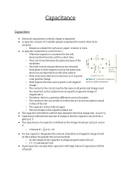
● A capacitor consists of 2 metallic planets separated from each other by an
insulator
○ Known as a dielectric such as air, paper, ceramic or mica
● A capacitor connected to a cell of e.m.f. 𝜺
○ When the capacitor is connected to the cell,
electrons flow from the cell for a short time
○ They can’t travel between the plates because of the
insulation
○ The brief current means electrons are removed
from plate A of the capacitor and at the same time,
electrons are deposited into the other plate B
○ Plate A becomes deficient in electrons so it acquires
a net positive charge
○ Plate B gains electrons and acquires a net negative
charge
○ The current in the circuit must be the same at all points and charge must
be conserved, so the 2 plates have an equal but opposite charge of
magnitude Q
○ Therefore, there is a potential difference across the plates
○ The current in the circuit falls to 0 when the p.d. across the plates is equal
to the 𝜺 of the cell
○ The capacitor is then fully charged
○ The net charge on the capacitor plates is 0
● The capacitor is therefore a device that separates electrical charge into -Q and +Q
● Capacitance indicates the amount of charge Q that the capacitor can store for a
given p.d. V
● The capacitance of a capacitor is defined as the charge stored per unit p.d. across
it
𝑄
○ C (farads F) = 𝑉 or Q = VC
● For any capacitor, the greater the amount of positive and negative charge stored
on the 2 plates, the greater the p.d. across them
○ So the charge on the capacitor is always proportional to the p.d.
○ 1 F = 1 Coulomb per Volt
● Supercapacitors are specialist capacitors with high values of capacitance (1000s
of farads)
, ○ Unlike rechargeable batteries that
degrade over time, supercapacitors can
be charged over and over again
● For 2 or more capacitors in parallel:
○ The p.d. across each capacitor is the
same
○ Electrical charge is conserved, therefore
the total charge stored is equal to the
sum of the individual charges stored by
the capacitors
■ Q = Q1 + Q2 + … + Qn
○ The total capacitance is the sum of the individual capacitances of the
capacitors
■ C = C1 + C2 + … + Cn
● All the capacitors in series store the same
charge
● This is true when they have different
capacitors
● The cell is connected to the left hand plate of
the capacitor of capacitance C1 and to the
right hand plate of the capacitor of
capacitance C2
○ These plates acquire equal and
opposite charges as electrons flow to and from these plates
○ The middle 2 plates are not connected to the cell because of the presence
of the dielectric layers, but transfer of electrons between these plates
ensures that they also acquire charge Q of the same magnitude
○ The overall charge of each capacitor is 0 but the magnitude of the charge
on each plate is Q
● For 2 or more capacitors in series:
○ According to Kirchoff’s 2nd law, the total p.d. across the combination os the
sum of the individual p.d.s across the capacitors
■ V = V1 + V2 + … + Vn
○ The charge Q stored by each capacitor is the same
○ The total capacitance C is given by the equation
Capacitors
● Electrical components in which charge is separated
● A capacitor consists of 2 metallic planets separated from each other by an
insulator
○ Known as a dielectric such as air, paper, ceramic or mica
● A capacitor connected to a cell of e.m.f. 𝜺
○ When the capacitor is connected to the cell,
electrons flow from the cell for a short time
○ They can’t travel between the plates because of the
insulation
○ The brief current means electrons are removed
from plate A of the capacitor and at the same time,
electrons are deposited into the other plate B
○ Plate A becomes deficient in electrons so it acquires
a net positive charge
○ Plate B gains electrons and acquires a net negative
charge
○ The current in the circuit must be the same at all points and charge must
be conserved, so the 2 plates have an equal but opposite charge of
magnitude Q
○ Therefore, there is a potential difference across the plates
○ The current in the circuit falls to 0 when the p.d. across the plates is equal
to the 𝜺 of the cell
○ The capacitor is then fully charged
○ The net charge on the capacitor plates is 0
● The capacitor is therefore a device that separates electrical charge into -Q and +Q
● Capacitance indicates the amount of charge Q that the capacitor can store for a
given p.d. V
● The capacitance of a capacitor is defined as the charge stored per unit p.d. across
it
𝑄
○ C (farads F) = 𝑉 or Q = VC
● For any capacitor, the greater the amount of positive and negative charge stored
on the 2 plates, the greater the p.d. across them
○ So the charge on the capacitor is always proportional to the p.d.
○ 1 F = 1 Coulomb per Volt
● Supercapacitors are specialist capacitors with high values of capacitance (1000s
of farads)
, ○ Unlike rechargeable batteries that
degrade over time, supercapacitors can
be charged over and over again
● For 2 or more capacitors in parallel:
○ The p.d. across each capacitor is the
same
○ Electrical charge is conserved, therefore
the total charge stored is equal to the
sum of the individual charges stored by
the capacitors
■ Q = Q1 + Q2 + … + Qn
○ The total capacitance is the sum of the individual capacitances of the
capacitors
■ C = C1 + C2 + … + Cn
● All the capacitors in series store the same
charge
● This is true when they have different
capacitors
● The cell is connected to the left hand plate of
the capacitor of capacitance C1 and to the
right hand plate of the capacitor of
capacitance C2
○ These plates acquire equal and
opposite charges as electrons flow to and from these plates
○ The middle 2 plates are not connected to the cell because of the presence
of the dielectric layers, but transfer of electrons between these plates
ensures that they also acquire charge Q of the same magnitude
○ The overall charge of each capacitor is 0 but the magnitude of the charge
on each plate is Q
● For 2 or more capacitors in series:
○ According to Kirchoff’s 2nd law, the total p.d. across the combination os the
sum of the individual p.d.s across the capacitors
■ V = V1 + V2 + … + Vn
○ The charge Q stored by each capacitor is the same
○ The total capacitance C is given by the equation