

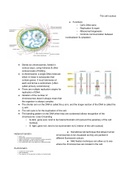
The cell nucleus
● Functions
○ Cell’s DNA store
○ Replication & repair
○ Ribosomal biogenesis
○ Controls communication between
nucleoplasm & cytoplasm.
● Stored as chromosomes, folded in
various ways, using histones & other
various levels of folding.
● A chromosome; a single DNA molecule
which in linear in eukaryotes that
contain genes. It must telomeres at
each end & has a centromere [ often
called primary constrictions]
● There are multiple replication origins for
replication of DNA.
● Variation of the number of
chromosomes doesn’t always mean that
the organism is always complex.
● The shorter arm on the DNA is called the p arm, and the longer section of the DNA is called the
q -arm
● The cell cycle is for the duplication of the cell;
● The banding pattern on the DNA when they are condensed allows recognition of the
chromosome. Uses G-banding
○ G-dark, gene poor, tend to be heterochromatin rich [around the periphery of the cell
nucleus]
○ G -light, gene rich, tend to be euchromatin rich [ interior of the cell nucleus]
● Sometimes lab technique that allows human
chromosomes to be visualized as they are painted in
different fluorescent colours.
● Mild fixation technique can allow us to see
where the chromosomes are located in the cell.
● Functions
○ Cell’s DNA store
○ Replication & repair
○ Ribosomal biogenesis
○ Controls communication between
nucleoplasm & cytoplasm.
● Stored as chromosomes, folded in
various ways, using histones & other
various levels of folding.
● A chromosome; a single DNA molecule
which in linear in eukaryotes that
contain genes. It must telomeres at
each end & has a centromere [ often
called primary constrictions]
● There are multiple replication origins for
replication of DNA.
● Variation of the number of
chromosomes doesn’t always mean that
the organism is always complex.
● The shorter arm on the DNA is called the p arm, and the longer section of the DNA is called the
q -arm
● The cell cycle is for the duplication of the cell;
● The banding pattern on the DNA when they are condensed allows recognition of the
chromosome. Uses G-banding
○ G-dark, gene poor, tend to be heterochromatin rich [around the periphery of the cell
nucleus]
○ G -light, gene rich, tend to be euchromatin rich [ interior of the cell nucleus]
● Sometimes lab technique that allows human
chromosomes to be visualized as they are painted in
different fluorescent colours.
● Mild fixation technique can allow us to see
where the chromosomes are located in the cell.


