

Membrane structure & synthesis
● Cell has many different membranes, with various functions.
● Membranes are made from bilayers, phospholipids
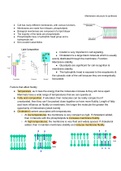
● Biological membranes are composed of a lipid bilayer
● The majority of the lipids are phospholipids
● Phospholipids have a hydrophilic head group and a
hydrophobic tail
● Non-covalent assemblies
● Inositol is very important in cell signaling.
● Cholesterol is a large black molecule which is usually
evenly distributed through the membrane. Function;
Membrane stability
● Glycolipids are significant for cell recognition &
membrane stability.
● The hydrophilic head is exposed to the exoplasmic &
the cytosolic side of the cell because they are energetically
favourable.
Factors that affect fluidity
● Temperature; as it rises the energy that the molecules increase & they will move apart.
Mammals have a wide range of temperatures that we can operate at.
● Fatty acid composition; if saturated, then molecules can be really compact but if
unsaturated, then they can’t be packed close together so have more fluidity. Length of fatty
acid have influence on fluidity on membrane, the longer the molecule the greater the
opportunity of interactions [weak bonds]
● Cholesterol content associated with temperatures;
○ At low temperatures; the membrane is very compact so rigid. If cholesterol added,
then it interacts with the phospholipids & increases membrane fluidity.
○ At high temperatures; the membrane is very fluid and widely spaced. If cholesterol
added, then it maintain membrane stability and reduces membrane fluidity.
● Cell has many different membranes, with various functions.
● Membranes are made from bilayers, phospholipids
● Biological membranes are composed of a lipid bilayer
● The majority of the lipids are phospholipids
● Phospholipids have a hydrophilic head group and a
hydrophobic tail
● Non-covalent assemblies
● Inositol is very important in cell signaling.
● Cholesterol is a large black molecule which is usually
evenly distributed through the membrane. Function;
Membrane stability
● Glycolipids are significant for cell recognition &
membrane stability.
● The hydrophilic head is exposed to the exoplasmic &
the cytosolic side of the cell because they are energetically
favourable.
Factors that affect fluidity
● Temperature; as it rises the energy that the molecules increase & they will move apart.
Mammals have a wide range of temperatures that we can operate at.
● Fatty acid composition; if saturated, then molecules can be really compact but if
unsaturated, then they can’t be packed close together so have more fluidity. Length of fatty
acid have influence on fluidity on membrane, the longer the molecule the greater the
opportunity of interactions [weak bonds]
● Cholesterol content associated with temperatures;
○ At low temperatures; the membrane is very compact so rigid. If cholesterol added,
then it interacts with the phospholipids & increases membrane fluidity.
○ At high temperatures; the membrane is very fluid and widely spaced. If cholesterol
added, then it maintain membrane stability and reduces membrane fluidity.


