

Unit 9: Human Regulation & Reproduction
C: Understand the role of hormones in the regulation and control of the reproductive system
The reproductive system work together to produce an offspring, and is a set of organs. Fluids,
hormones, and pheromones which are non-living substances are crucial to the reproductive
system. In a women the reproductive system includes the uterus, the cervix, the vagina, and
the fallopian tube. In a man the reproductive system includes the penis, the testes, and the
prostate.
Structure and function of the reproductive system
The male reproductive system
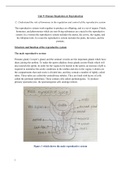
Prostate gland, Cowper’s gland, and the seminal vesicles are the important glands which have
ducts joining the urethra. To make the sperm alkaline, those glands secrete fluids which will
also nourish the sperm. In order for the vagina to be hostile to the sperm, an increase of pH is
required to neutralise the acidic conditions in the urethra and also in the vagina. Lobules are
the compartments that each testis is divided into, and they contain a number of tightly coiled
tubes. These tubes are called the seminiferous tubules. They are lined with layers of cells
called the germinal epithelium. These contain cells called spermatogonia. To produce
primary spermatocytes, the spermatogonia cells undergo mitosis.
Figure 1 which shows the male reproductive system
1
C: Understand the role of hormones in the regulation and control of the reproductive system
The reproductive system work together to produce an offspring, and is a set of organs. Fluids,
hormones, and pheromones which are non-living substances are crucial to the reproductive
system. In a women the reproductive system includes the uterus, the cervix, the vagina, and
the fallopian tube. In a man the reproductive system includes the penis, the testes, and the
prostate.
Structure and function of the reproductive system
The male reproductive system
Prostate gland, Cowper’s gland, and the seminal vesicles are the important glands which have
ducts joining the urethra. To make the sperm alkaline, those glands secrete fluids which will
also nourish the sperm. In order for the vagina to be hostile to the sperm, an increase of pH is
required to neutralise the acidic conditions in the urethra and also in the vagina. Lobules are
the compartments that each testis is divided into, and they contain a number of tightly coiled
tubes. These tubes are called the seminiferous tubules. They are lined with layers of cells
called the germinal epithelium. These contain cells called spermatogonia. To produce
primary spermatocytes, the spermatogonia cells undergo mitosis.
Figure 1 which shows the male reproductive system
1


