Question:
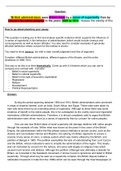
‘British administrators were driven more by a sense of superiority than by
concern for native peoples in the years 1890 to 1914.’ Assess the validity of this
How to go about planning your essay:
This question is asking you to find and analyse specific evidence which supports the influence of
‘a sense of superiority’ in the behaviour of administrators (which would include viceroys and
consul-generals as well as lesser officials). You also need to consider examples of genuinely
altruistic behaviour where concern for the natives is shown.
You need to show balance, but with a clear overall judgement and line of argument.
Consider: different British administrators, different regions of the Empire, and the entire
timeframe of 1890-1914.
One way to do this is to think thematically. Come up with 3-4 themes which you can use to
compare and contrast with. Consider:
- Belief in racial superiority
- Belief in cultural superiority
- Belief in the right of economic exploitation
- Repression
- Reform
- Development
- Political Representation
Answer:
During the period spanning between 1890 and 1914, British administrators were prominent
in areas of imperial interest, such as India, South Africa, and Egypt. These roles were taken by
men who were driven by an overriding sense of superiority. Although at times there was some
evidence of benefit to the native people, this is far outweighed by the overtly racist and imperialist
motivations of British administrators. Therefore, it is almost completely valid to argue that British
administrators were driven more by a sense of superiority than by concern for native peoples.
One can see how British ideas of racial superiority did damage relations with native people
through the example of India. Within what was known as the jewel in the crown of the British
Empire, the administrators within the Raj utilised various methods to ensure control, such as the
division and rule between Hindus and Muslims, the splicing of military regiments to ensure a
scarcity of any sense of union, a railway system which was mainly utilised by the British, and
partition of Bengal in 1905. The partition exemplifies the lack of understanding from Lord Curzon
and the British, whose motivations were to simplify the administration of the region. This clearly
was not motivated by concern for the natives, who were split largely on religious lines which
caused much tension and distress. Although the partition of Bengal was ultimately a disaster for
Britain, as it resulted in the Swadeshi movement, it shows Curzon’s ignorance and belief in British
superiority. Through what may be seen as a superiority complex, the British dispute fuelled a
nationalist movement in India from the 1890s which can be seen through the Kaal Newspaper (it
‘British administrators were driven more by a sense of superiority than by
concern for native peoples in the years 1890 to 1914.’ Assess the validity of this
How to go about planning your essay:
This question is asking you to find and analyse specific evidence which supports the influence of
‘a sense of superiority’ in the behaviour of administrators (which would include viceroys and
consul-generals as well as lesser officials). You also need to consider examples of genuinely
altruistic behaviour where concern for the natives is shown.
You need to show balance, but with a clear overall judgement and line of argument.
Consider: different British administrators, different regions of the Empire, and the entire
timeframe of 1890-1914.
One way to do this is to think thematically. Come up with 3-4 themes which you can use to
compare and contrast with. Consider:
- Belief in racial superiority
- Belief in cultural superiority
- Belief in the right of economic exploitation
- Repression
- Reform
- Development
- Political Representation
Answer:
During the period spanning between 1890 and 1914, British administrators were prominent
in areas of imperial interest, such as India, South Africa, and Egypt. These roles were taken by
men who were driven by an overriding sense of superiority. Although at times there was some
evidence of benefit to the native people, this is far outweighed by the overtly racist and imperialist
motivations of British administrators. Therefore, it is almost completely valid to argue that British
administrators were driven more by a sense of superiority than by concern for native peoples.
One can see how British ideas of racial superiority did damage relations with native people
through the example of India. Within what was known as the jewel in the crown of the British
Empire, the administrators within the Raj utilised various methods to ensure control, such as the
division and rule between Hindus and Muslims, the splicing of military regiments to ensure a
scarcity of any sense of union, a railway system which was mainly utilised by the British, and
partition of Bengal in 1905. The partition exemplifies the lack of understanding from Lord Curzon
and the British, whose motivations were to simplify the administration of the region. This clearly
was not motivated by concern for the natives, who were split largely on religious lines which
caused much tension and distress. Although the partition of Bengal was ultimately a disaster for
Britain, as it resulted in the Swadeshi movement, it shows Curzon’s ignorance and belief in British
superiority. Through what may be seen as a superiority complex, the British dispute fuelled a
nationalist movement in India from the 1890s which can be seen through the Kaal Newspaper (it