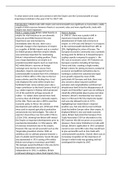
To what extent were trade and commerce with the Empire and the Commonwealth of major
importance to Britain in the years 1947 to 1967? (25)
Introduction: initially trade with empire and commonwealth was significant as it provided a stable
supply of vital resources however America’s economic value and more significantly, trade with
empire was more important
Point 1: empire trade Britain relied heavily on Point 2: Europe
empire for vital resources to com domestic In 1960-67, there was a greater shift in
pressures post WW2 however this new importance towards Europe and an
importance was only temporary. abandonment of trade and commerce in
Immediately after the war, there was a empire. In 1954 and 1965 Britain’s % of exports
dramatic change in the importance of empire to the commonwealth declined from 48% to
as a supplier of British imports and as a market 28%, highlighting the value of Europe. The
for British produce therefore empire initially European Economic Community was a symbolic
was extremely important for maintaining turning point for Britain as it showed Europe’s
Britain’s international trading position. There trading capacity compared to empire’s - the
was a large dependency on empire as it EEC was an economic union 1957 between six
provided essential imports (such as meat from European countries including W.Germany,
NZ) whilst Britain’s reserves of foreign France and Italy, creating a single market.
exchange were too low to source from Britain’s desire for joining involved a cocktail of
elsewhere. Imports and exports from the economic and political motivations due to
commonwealth increased from 45% of Britain’s wanting to achieve the sustained and rapid
total in 1948 to 48% in 1954. Due to the fact econ growth enjoyed by most of EEC,
many colonies used the Sterling Area, it not particularly W.Germany and Italy; there was
only displayed the unity within empire but also concerns about long term political
facilitated trade. Some colonies were also a exclusion and marginalization as Britain had
major contributor to the Hard Currency Pool ($) already been hard hit by the disappearance of
e.g. rubber exports in Malaya which produced empire and Macmillan’s govt was not willing to
1/3 of the worlds tin ad huge amounts of stand idly whilst global players grew next door.
rubber – its rubber alone earned more hard However, Britain’s membership was vetoed
currency than all of Britain’s domestic exports twice in 1963 and 1967 (by Charles De Gaule)
to the USA. There was also a shift to assertive and was only allowed to join in 1973 -
economic policy in Africa- the colonial highlighting how weak Britain’s imperial
development and welfare acts (1940 and 1945) position was. Not only did it prove to Britain
were used to expand agricultural production trade lied within Europe rather than empire, it
and promote new technologies. The value of displayed Britain’s new and weak economic
exports in East Africa rose from £30m 1946 to status. Britain had joined the European Free
£123m 1956, showing how Britain still viewed Trade Association 1959 an alternative to the
the Empire as important developments prior to EEC however this did not prove as successful.
eventual decolonisation. In 1956 approx. 58% However, there minor limitations to trade with
of overseas investment was in the empire. Europe. Britain’s application in 1961 contained
However this was not all successful such as the concerns over some EEC rules; they would have
Tanganyika groundnut scheme 1948- an to give up benefits such as free trade with
ambitious aim to cultivate peanuts however a commonwealth countries. Overall, there was an
lack of suitable land/machinery meant the plan increasing recognition of the importance of
was abandoned in 1951 costing £49m whilst Europe in which trade was growing and had
Britain was trying to reconstruct post WW2. outstripped the empire by 1967.
The damage caused by Britain in the area led to
increased nationalism and eventually
independence in 1961. In addition, Britain
continued ratioing to reduce food imports from
importance to Britain in the years 1947 to 1967? (25)
Introduction: initially trade with empire and commonwealth was significant as it provided a stable
supply of vital resources however America’s economic value and more significantly, trade with
empire was more important
Point 1: empire trade Britain relied heavily on Point 2: Europe
empire for vital resources to com domestic In 1960-67, there was a greater shift in
pressures post WW2 however this new importance towards Europe and an
importance was only temporary. abandonment of trade and commerce in
Immediately after the war, there was a empire. In 1954 and 1965 Britain’s % of exports
dramatic change in the importance of empire to the commonwealth declined from 48% to
as a supplier of British imports and as a market 28%, highlighting the value of Europe. The
for British produce therefore empire initially European Economic Community was a symbolic
was extremely important for maintaining turning point for Britain as it showed Europe’s
Britain’s international trading position. There trading capacity compared to empire’s - the
was a large dependency on empire as it EEC was an economic union 1957 between six
provided essential imports (such as meat from European countries including W.Germany,
NZ) whilst Britain’s reserves of foreign France and Italy, creating a single market.
exchange were too low to source from Britain’s desire for joining involved a cocktail of
elsewhere. Imports and exports from the economic and political motivations due to
commonwealth increased from 45% of Britain’s wanting to achieve the sustained and rapid
total in 1948 to 48% in 1954. Due to the fact econ growth enjoyed by most of EEC,
many colonies used the Sterling Area, it not particularly W.Germany and Italy; there was
only displayed the unity within empire but also concerns about long term political
facilitated trade. Some colonies were also a exclusion and marginalization as Britain had
major contributor to the Hard Currency Pool ($) already been hard hit by the disappearance of
e.g. rubber exports in Malaya which produced empire and Macmillan’s govt was not willing to
1/3 of the worlds tin ad huge amounts of stand idly whilst global players grew next door.
rubber – its rubber alone earned more hard However, Britain’s membership was vetoed
currency than all of Britain’s domestic exports twice in 1963 and 1967 (by Charles De Gaule)
to the USA. There was also a shift to assertive and was only allowed to join in 1973 -
economic policy in Africa- the colonial highlighting how weak Britain’s imperial
development and welfare acts (1940 and 1945) position was. Not only did it prove to Britain
were used to expand agricultural production trade lied within Europe rather than empire, it
and promote new technologies. The value of displayed Britain’s new and weak economic
exports in East Africa rose from £30m 1946 to status. Britain had joined the European Free
£123m 1956, showing how Britain still viewed Trade Association 1959 an alternative to the
the Empire as important developments prior to EEC however this did not prove as successful.
eventual decolonisation. In 1956 approx. 58% However, there minor limitations to trade with
of overseas investment was in the empire. Europe. Britain’s application in 1961 contained
However this was not all successful such as the concerns over some EEC rules; they would have
Tanganyika groundnut scheme 1948- an to give up benefits such as free trade with
ambitious aim to cultivate peanuts however a commonwealth countries. Overall, there was an
lack of suitable land/machinery meant the plan increasing recognition of the importance of
was abandoned in 1951 costing £49m whilst Europe in which trade was growing and had
Britain was trying to reconstruct post WW2. outstripped the empire by 1967.
The damage caused by Britain in the area led to
increased nationalism and eventually
independence in 1961. In addition, Britain
continued ratioing to reduce food imports from