Discuss free will and determinism. Refer to at least 2 topics you have studied in your answer. 16
marks
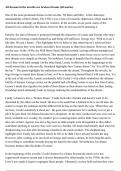
The free will and determinism debate argues whether we have conscious control over our own
actions, acting as active agents (free will), or whether our behaviour is caused by internal and
external factors outside of our conscious control. An example of free will, where you are self-
governing, is the humanistic approach, which believes that we have the ability to change our
behaviour and alter our views of ourself to reduce incongruence and improve wellbeing. Soft
determinism refers to the belief that although internal and external factors affect our behaviour, we
still have some conscious control over what we do, ie we still have some free will. This is seen in the
interactionist method for treating patients of schizophrenia, as although it takes into account the
uncontrollable biological factors (genetic predispositions and imbalances in dopamine), and treats
these with antipsychotic drug therapies, it also emphasises that with CBT a patient can regain control
of their behaviours. Hard determinism (also known as. Fatalism) is incompatible with free will as it
believes that behaviour is entirely out of the individuals control, and aligns well with the biological
approach of psychology, which assumes every psychological problem has a biological basis, with
some conditions being determined from birth due to genetic predispositions (biological
determinism). The behaviourist approach also is fatalistic as it believes we learn through classical
and operant conditioning, through association and reward, without having control of what and when
we learn (environmental determinism).
Mental illnesses such as SZ, OCD and depression often support the determinism side of the debate
as, simply put, no one would consciously choose to have them, The positive symptoms of
schizophrenia, such as paranoia and delusions, are incredibly scary for the patient, often coupled
with the negative symptoms such as speech poverty and avolition, can make it almost impossible to
lead a normal life. No one would choose to live like this, so we can say there must be a causing
factor, a determiner to this illness, that is outside of our control. Furthermore, empirical evidence
from Paul et al’s brain studies on OCD patients demonstrate biological factors, such as heightened
activity in the OFC (abnormal brain circuits) that are said to cause OCD, therefore showing that the
patient isn’t consciously choosing to feel like this. Some psychologists would argue that when taking
mental illnesses into account, we would classify psychopathology as hard determinism, as no one
would choose to suffer like this. Yet others would argue that as the treatments for these disorders,
such as CBT, rely on the patient believing they can regain control of their lives and get better, by
making specific choices, this could also be called soft determinism-as the explanation is purely
deterministic but the treatment relies on some free will.
However, when it comes to maintaining good mental health, free will appears to be useful in
boosting wellbeing. Even if there is no free will in mental health, several studies have found that
believing you have control over what happens to you, (having an internal locus of control) can
improve your mental health. Roberts et al found that teenagers with an internal locus of control ,
considering themselves to be active agents, were less vulnerable to depression than those with an
external locus of control (believing that what happens to them is caused by external factors such as
fate). This suggests that even if free will is an illusion, as some determinists suggest, it is still useful to
believe in our own autonomy, and therefore free will plays a vital role in our society.
Furthermore, hard determinism is rejected in practices of law as it contradicts with the concept of
legal responsibility (being responsible for your own actions). If all of your behaviour occurs from
uncontrollable internal and external factors, you may say that you’re not to blame for your actions.
This occurred in the case of Stephen moberly, accused of murder, who argued that because his
family had a family history of aggression, he had a genetic predisposition for murder, and thus was
not himself responsible for the murder. He used the slogan ‘born to kill’, highlighting a biologically
marks
The free will and determinism debate argues whether we have conscious control over our own
actions, acting as active agents (free will), or whether our behaviour is caused by internal and
external factors outside of our conscious control. An example of free will, where you are self-
governing, is the humanistic approach, which believes that we have the ability to change our
behaviour and alter our views of ourself to reduce incongruence and improve wellbeing. Soft
determinism refers to the belief that although internal and external factors affect our behaviour, we
still have some conscious control over what we do, ie we still have some free will. This is seen in the
interactionist method for treating patients of schizophrenia, as although it takes into account the
uncontrollable biological factors (genetic predispositions and imbalances in dopamine), and treats
these with antipsychotic drug therapies, it also emphasises that with CBT a patient can regain control
of their behaviours. Hard determinism (also known as. Fatalism) is incompatible with free will as it
believes that behaviour is entirely out of the individuals control, and aligns well with the biological
approach of psychology, which assumes every psychological problem has a biological basis, with
some conditions being determined from birth due to genetic predispositions (biological
determinism). The behaviourist approach also is fatalistic as it believes we learn through classical
and operant conditioning, through association and reward, without having control of what and when
we learn (environmental determinism).
Mental illnesses such as SZ, OCD and depression often support the determinism side of the debate
as, simply put, no one would consciously choose to have them, The positive symptoms of
schizophrenia, such as paranoia and delusions, are incredibly scary for the patient, often coupled
with the negative symptoms such as speech poverty and avolition, can make it almost impossible to
lead a normal life. No one would choose to live like this, so we can say there must be a causing
factor, a determiner to this illness, that is outside of our control. Furthermore, empirical evidence
from Paul et al’s brain studies on OCD patients demonstrate biological factors, such as heightened
activity in the OFC (abnormal brain circuits) that are said to cause OCD, therefore showing that the
patient isn’t consciously choosing to feel like this. Some psychologists would argue that when taking
mental illnesses into account, we would classify psychopathology as hard determinism, as no one
would choose to suffer like this. Yet others would argue that as the treatments for these disorders,
such as CBT, rely on the patient believing they can regain control of their lives and get better, by
making specific choices, this could also be called soft determinism-as the explanation is purely
deterministic but the treatment relies on some free will.
However, when it comes to maintaining good mental health, free will appears to be useful in
boosting wellbeing. Even if there is no free will in mental health, several studies have found that
believing you have control over what happens to you, (having an internal locus of control) can
improve your mental health. Roberts et al found that teenagers with an internal locus of control ,
considering themselves to be active agents, were less vulnerable to depression than those with an
external locus of control (believing that what happens to them is caused by external factors such as
fate). This suggests that even if free will is an illusion, as some determinists suggest, it is still useful to
believe in our own autonomy, and therefore free will plays a vital role in our society.
Furthermore, hard determinism is rejected in practices of law as it contradicts with the concept of
legal responsibility (being responsible for your own actions). If all of your behaviour occurs from
uncontrollable internal and external factors, you may say that you’re not to blame for your actions.
This occurred in the case of Stephen moberly, accused of murder, who argued that because his
family had a family history of aggression, he had a genetic predisposition for murder, and thus was
not himself responsible for the murder. He used the slogan ‘born to kill’, highlighting a biologically