
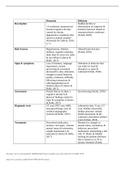
Dementia Delirium
Description Sudden decline or
“A syndrome characterized deterioration of cognitive &
byneurocognitive decline attention function related to
caused by chronic neuropsychiatric syndrome
degenerative conditions that (Schub, 2018)
result in cerebral atrophy”
(Kornusky & Cabrera, 2018,
p. 1)
Risk Factors Hypertension, diabetes Altered brain function
mellitus, cigarette smoking, (Schub, 2018)
older than 65 years old, male,
& non-White (Cabrera &
Holle, 2017)
Signs & symptoms Loss of memory, language Alteration in behavior that
impairment, mental can either be loud &
processing & movement disruptive or quiet &
decreased to slow, delusions, confused (Schub, 2018)
changes in mood behavior,
apathy, confusion, difficulty
following instructions &
w&ering/getting lost in
familiar places (Cabrera &
Holle, 2017)
Assessment Patient history (is there a Sun downing (Schub, 2018)
cognitive decline?) &
physical findings related to
signs & symptoms (Cabrera
& Holle, 2017)
Diagnostic tests CT scan, PET scan, MRI, Laboratory tests, X-ray, CT
neuropsychologic tests & scan, bladder ultrasound,
cerebral angiography lumbar puncture, mental
(Cabrera & Holle, 2017) health assessment, & the
confusion assessment method
exam (Schub, 2018)
Treatments Prescribed medication, Monitor for changes in
monitor vital signs, monitor mental status, orientation, &
mental status & orientation, behavior, prescribed
weight maintenance, & medication, maintaining a fall
education (Cabrera & Holle, risk, IV fluids, & bladder
2017) training for patients delirium
that is based on a UTI or
urinary retention (Schub,
This study source was downloaded by 100000830246019 from CourseHero.com on 06-14-2022 08:37:10 GMT -05:00
https://www.coursehero.com/file/36342717/NR-526-Week-5docx/


