
Introduction (Appeals- Magistrates’ Decisions):
This element explores the power to rectify mistakes in magistrates’ court decisions along
with appeals against decisions of the magistrates’ court
Process of the Criminal Justice Process:
Magistrates Court’s Power to Rectify Mistakes:
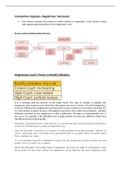
Rectify mistakes: slip rule
Crown Court: re-hearing
High Court: case stated
High Court: judicial review
If D is unhappy with the decision of the Mags Courts, first step to consider is whether the
magistrates have made an error which they themselves can correct. Section 142 of the Magistrates'
Court Act 1980 gives the magistrates court the power to vary a sentence or set aside a conviction if it
is in the interests of justice to do so. This applies to sentence, other orders and conviction - whether
following conviction by the magistrates or after a guilty plea. The latter is understandably rare. It
may occur, for example, if the defendant was wrongly advised as to the law, albeit he would have
the difficult burden of proving this.
The power, commonly known as the ‘slip rule’, is a narrow one and is not intended as an alternative
avenue for the defendant to simply re-argue their case.
Case law has made it clear that it is a power to rectify mistakes in law and procedure, whether at
trial or sentencing, and is most likely to be appropriate (and to succeed) where all parties agree
that a mistake was made.
It is not intended to permit a defendant to argue that the magistrates’ decision on their case was
wrong - that is a matter for an appeal.
While the defendant will usually make an application, the court can make an amendment under
this provision of their own volition. An application can be heard by the same magistrates who
, convicted the defendant but if the conviction is set aside the case will be re-tried by a different
bench.
A finding of guilt might be set aside, for example where the:
legal adviser provided the magistrates with incorrect legal advice; or
defendant did not attend for trial and no explanation for the defendant’s absence was
available at the time. The defendant was therefore tried in their absence and found
guilty. A few days later the defendant attends court with a medical certificate stating that
an emergency hospital admission on the day of trial was the reason that the defendant
was not fit to attend court. In these circumstances it would clearly be in the interests of
justice that the conviction is set aside.
On applications to vary sentence the power is more properly used where the sentence needs to be
reduced, for example where a financial penalty was imposed which was higher than the statutory
maximum for the offence.
However, exceptionally, a sentence can be increased under s.142, for example, if the court was
misled by the defendant.
Challenging Decisions of the Mags Courts:
Rectify mistakes: slip rule
Crown Court: re-hearing
High Court: case stated
High Court: judicial review
If a defendant feels that the magistrates have reached the wrong decision on the substantive merits
then the appropriate course is to appeal. The three means of challenge open to the defendant are as
follows:
a) Appeal to the Crown Court, by way of re-hearing;
b) Appeal to the High Court, by way of case stated; or
c) Application to the High Court for judicial review of the decision.
The choice of either (a), (b) or (c) depends upon the decision that is to be challenged.
Structure of the Criminal Courts:
This element explores the power to rectify mistakes in magistrates’ court decisions along
with appeals against decisions of the magistrates’ court
Process of the Criminal Justice Process:
Magistrates Court’s Power to Rectify Mistakes:
Rectify mistakes: slip rule
Crown Court: re-hearing
High Court: case stated
High Court: judicial review
If D is unhappy with the decision of the Mags Courts, first step to consider is whether the
magistrates have made an error which they themselves can correct. Section 142 of the Magistrates'
Court Act 1980 gives the magistrates court the power to vary a sentence or set aside a conviction if it
is in the interests of justice to do so. This applies to sentence, other orders and conviction - whether
following conviction by the magistrates or after a guilty plea. The latter is understandably rare. It
may occur, for example, if the defendant was wrongly advised as to the law, albeit he would have
the difficult burden of proving this.
The power, commonly known as the ‘slip rule’, is a narrow one and is not intended as an alternative
avenue for the defendant to simply re-argue their case.
Case law has made it clear that it is a power to rectify mistakes in law and procedure, whether at
trial or sentencing, and is most likely to be appropriate (and to succeed) where all parties agree
that a mistake was made.
It is not intended to permit a defendant to argue that the magistrates’ decision on their case was
wrong - that is a matter for an appeal.
While the defendant will usually make an application, the court can make an amendment under
this provision of their own volition. An application can be heard by the same magistrates who
, convicted the defendant but if the conviction is set aside the case will be re-tried by a different
bench.
A finding of guilt might be set aside, for example where the:
legal adviser provided the magistrates with incorrect legal advice; or
defendant did not attend for trial and no explanation for the defendant’s absence was
available at the time. The defendant was therefore tried in their absence and found
guilty. A few days later the defendant attends court with a medical certificate stating that
an emergency hospital admission on the day of trial was the reason that the defendant
was not fit to attend court. In these circumstances it would clearly be in the interests of
justice that the conviction is set aside.
On applications to vary sentence the power is more properly used where the sentence needs to be
reduced, for example where a financial penalty was imposed which was higher than the statutory
maximum for the offence.
However, exceptionally, a sentence can be increased under s.142, for example, if the court was
misled by the defendant.
Challenging Decisions of the Mags Courts:
Rectify mistakes: slip rule
Crown Court: re-hearing
High Court: case stated
High Court: judicial review
If a defendant feels that the magistrates have reached the wrong decision on the substantive merits
then the appropriate course is to appeal. The three means of challenge open to the defendant are as
follows:
a) Appeal to the Crown Court, by way of re-hearing;
b) Appeal to the High Court, by way of case stated; or
c) Application to the High Court for judicial review of the decision.
The choice of either (a), (b) or (c) depends upon the decision that is to be challenged.
Structure of the Criminal Courts:


